When a new product launch is approaching, packaging lead time can become just as important as price. A delayed paper tube may hold up filling, product photography, warehouse receiving and even the final launch date. Therefore, understanding custom paper tube production time early can help buyers build a more realistic schedule and avoid last-minute changes.
In practice, there is no single production time that fits every project. A standard kraft tube with simple printing can move through production faster than a telescopic perfume tube with a custom insert, specialty paper, hot stamping and embossing.
Moreover, sample approval, artwork revisions, MOQ, material availability and shipping all influence the final calendar.
As a practical planning reference, simple projects usually move faster after artwork and structure approval, while highly customized projects need additional time for tooling, sampling and special finishing.
Exact lead time should always be confirmed against the final specification before an order is placed.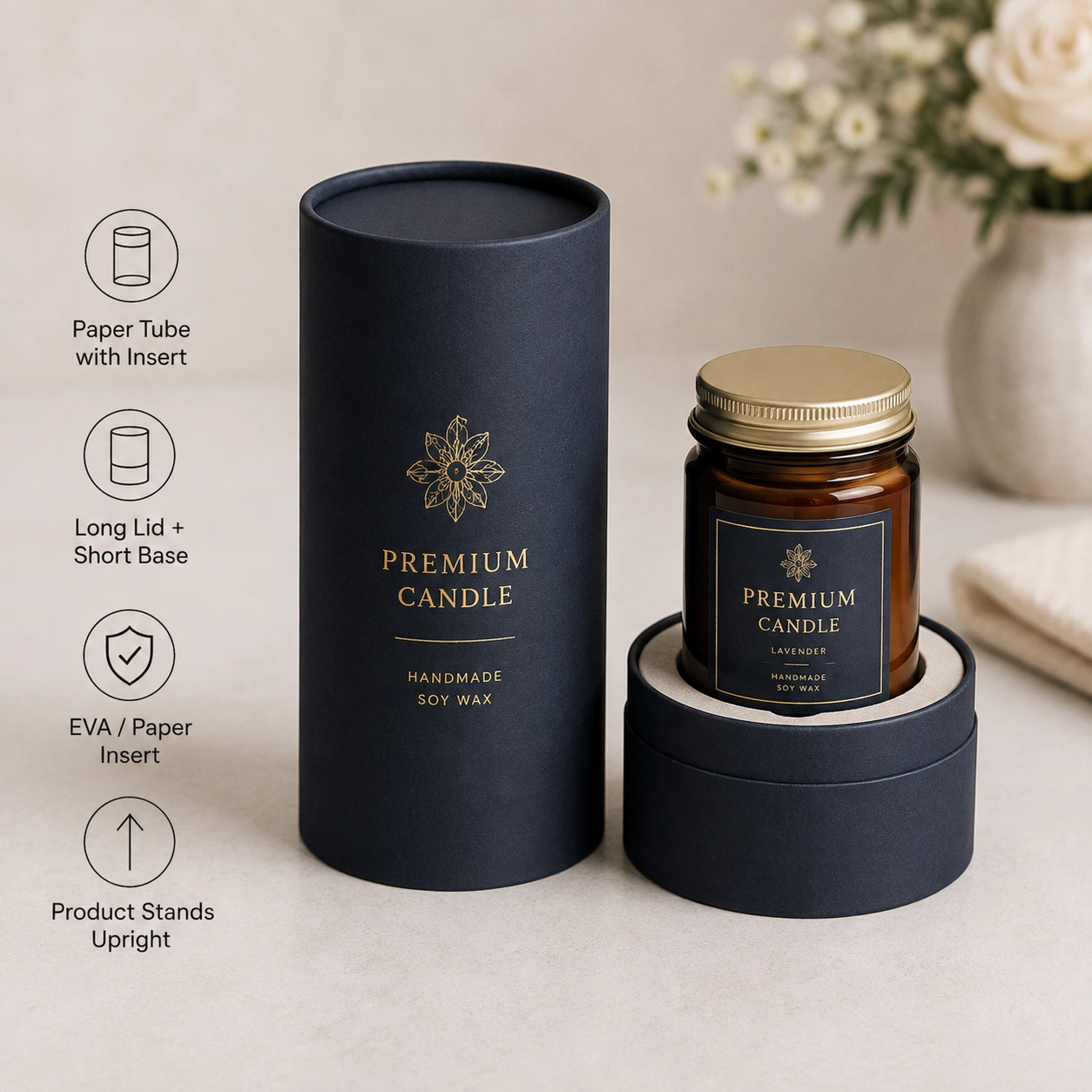
What Does Custom Paper Tube Production Time Include?
The term custom paper tube production time should not be understood as only the number of days a machine spends winding paperboard.
Instead, the complete schedule can include:
- Product and size confirmation
- Structural development
- Material selection
- Artwork preparation
- Structural sampling
- Printed sampling
- Sample approval
- Material preparation
- Printing
- Lamination
- Tube winding
- Tube cutting
- Lid and bottom production
- Food-grade liner application
- Insert production
- Hot stamping
- Embossing or debossing
- Spot UV
- Final assembly
- Quality inspection
- Export packing
As a result, two suppliers may quote different lead times simply because they are counting different stages.
One supplier may begin counting after artwork approval and deposit. Another may include sampling in the quoted schedule.
Therefore, buyers should always ask:
“From which date does your production lead time start?”
That simple question can prevent a surprising amount of confusion.
How Long Should Buyers Plan for?
Instead of relying on one final number, it is more practical to divide the project into stages.
Practical Planning Reference
Production StagePlanning ReferenceMain VariablesRequirement confirmation1–3 working daysProduct size, structure, materialsStructural sampleAbout 3–7 working daysDimensions, insert, toolingPrinted sampleAbout 5–10 working daysPrinting, paper, finishingSample revisions2–7+ working daysNumber of requested changesStandard mass productionAbout 10–25 working daysQuantity, structure, materialComplex mass productionAbout 15–30+ working daysInserts, special paper, multiple finishesInspection and packing1–5 working daysQuantity and packing requirements
These figures should be treated as planning references rather than fixed production promises.
A factory should confirm the actual schedule after reviewing:
- Final size
- Structure
- Quantity
- Material availability
- Number of SKUs
- Printing
- Finishing
- Insert
- Current production schedule
In addition, transportation time is separate from manufacturing time.
Courier, air freight and sea freight can create completely different delivery calendars.
Why Can Similar Paper Tubes Have Different Lead Times?
The biggest reason custom paper tube production time varies is that “paper tube” describes a packaging category rather than one standard manufacturing specification.
Consider these two examples.
Project A: Simple Tea Tube
- Standard diameter
- Kraft paper
- One-color printing
- Paper lid
- No insert
- No window
- No special finish
- One artwork
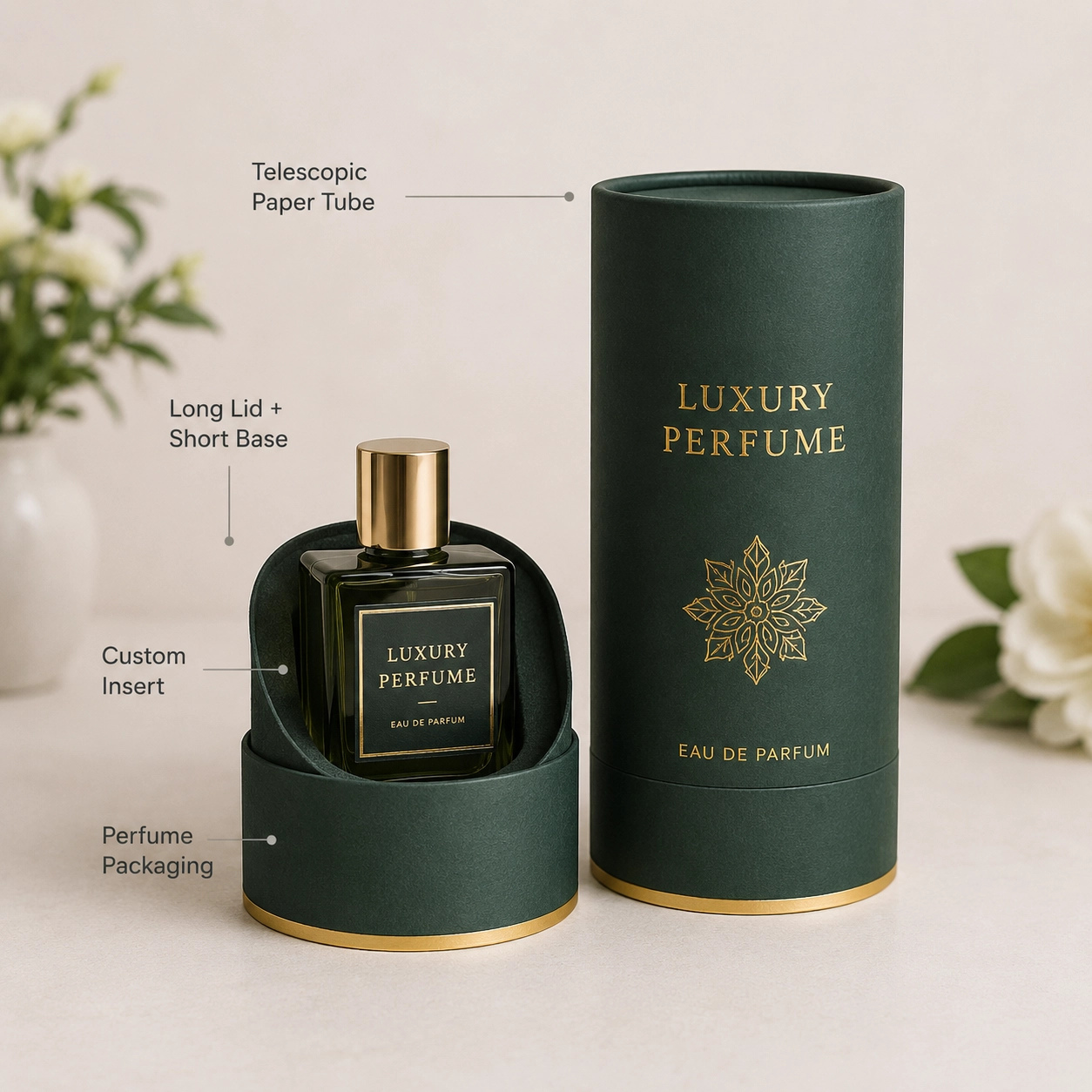
Project B: Luxury Perfume Tube
- Custom diameter
- Specialty paper
- Pantone printing
- Long telescopic lid
- EVA insert
- Gold hot stamping
- Embossing
- Soft-touch lamination
- Two artworks
Both are paper tubes.
However, Project B requires more:
- Material preparation
- Structural testing
- Tooling
- Printing setup
- Insert development
- Finishing
- Quality checks
Consequently, its production schedule will naturally be longer.
Common Applications
Different applications also create different lead-time requirements because the package must match the product.
Perfume Packaging
Perfume tubes often require more development because the bottle may be made from heavy glass and needs accurate internal positioning.
Typical components include:
- Rigid paperboard
- Telescopic structure
- Shoulder-neck structure
- EVA insert
- Flocked insert
- Specialty paper
- Hot stamping
- Embossing
- Soft-touch lamination
For example, the insert should hold the perfume bottle upright without pressing too tightly against the label or glass.
Therefore, the actual bottle or an accurate technical drawing should be provided during development.
Moreover, an insert may require several small adjustments before the fit feels correct.
As a result, perfume packaging usually requires more preparation than a standard gift tube.
Skincare and Cosmetic Packaging
Cosmetic tubes can range from simple serum packaging to multi-product skincare sets.
A single serum bottle may only need a standard tube and cardboard insert.
By contrast, a skincare set containing:
- Serum
- Cream jar
- Facial oil
- Applicator
requires multiple product positions.
Consequently, insert development and sampling become more important.
In addition, premium cosmetic brands often select foil stamping, embossing or specialty paper.
Each process adds another production stage.
Tea Packaging
Tea tubes can be relatively straightforward when the tea already sits inside a sealed inner pouch.
A simple structure might use:
- Kraft paper
- Standard paperboard tube
- Paper lid
- Basic printing
Therefore, the project may move through development relatively efficiently.
However, direct-food-contact structures may require:
- Food-grade liner
- Foil liner
- Peel-off membrane
- Additional material confirmation
As a result, food-contact requirements can extend development time.
Coffee Packaging
Coffee packaging follows a similar principle.
When the coffee is already sealed inside a high-barrier pouch, the paper tube mainly provides:
- Branding
- Physical protection
- Shelf presentation
- Gift value
Nevertheless, integrated food-contact structures or specialized closures require additional preparation.
Chocolate and Candy
Chocolate packaging may use:
- Paper trays
- Dividers
- Food-grade liners
- Windows
- Inner pouches
- Foil membranes
A simple tube containing individually wrapped candy can be relatively efficient.
However, a luxury truffle tube with custom compartments and decorative finishing requires additional assembly and testing.
Therefore, product protection should not be skipped simply to shorten the schedule.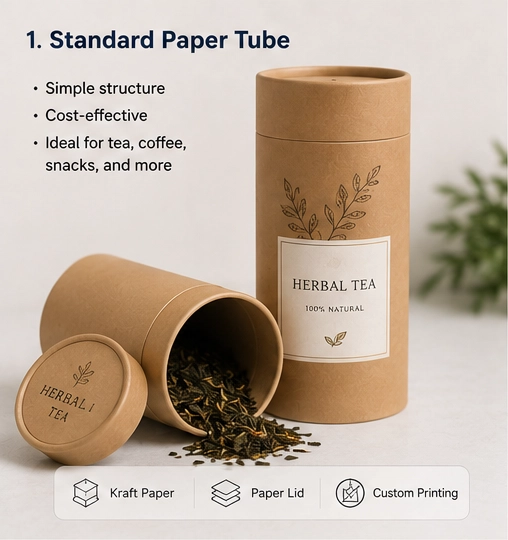
Candle Packaging
Candle jars can be heavy.
Consequently, the tube may require:
- Stronger walls
- Reinforced bottom
- EVA insert
- EPE insert
- Molded-pulp support
- Paperboard insert
A physical sample should be tested with the real candle jar before production approval.
Gift Packaging
Gift tubes can range from extremely simple to highly customized.
Small lightweight accessories may use a basic rigid tube.
Meanwhile, luxury gifts can involve:
- Telescopic structure
- Ribbon
- Specialty paper
- Custom insert
- Hot stamping
- Embossing
Therefore, the product and structure—not simply the word “gift”—determine the real timeline.
Material Options
Material choice can have a direct impact on custom paper tube production time.
Kraft Paper
Kraft paper is widely used for:
- Tea
- Coffee
- Food
- Candles
- Natural cosmetics
- Gift products
Standard kraft materials are generally straightforward to source and process.
Moreover, the paper already provides a natural visual character.
Therefore, buyers can sometimes avoid additional lamination or excessive finishing.
Art Paper
Coated art paper supports:
- CMYK printing
- Pantone printing
- Photography
- Fine text
- Gradients
- Detailed graphics
After printing, it can also receive:
- Matte lamination
- Gloss lamination
- Soft-touch lamination
- Anti-scratch film
However, every added finishing process extends the production sequence.
Specialty Paper
Specialty paper can significantly improve perceived value.
Options include:
- Textured paper
- Linen paper
- Metallic paper
- Pearlized paper
- Dyed-through paper
- Leather-look paper
Nevertheless, specialty paper may require additional sourcing time.
Furthermore, certain surfaces need testing before hot stamping or embossing.
Therefore, buyers working toward a fixed launch date should confirm material availability early.
Food-Grade Materials
Food-grade paper tubes may use:
- Food-grade paper
- PE-coated paper
- Grease-resistant paper
- Aluminum foil laminate
- Metallized film
When the liner or closure is customized, material preparation can take longer.
Consequently, food-contact requirements should be discussed during quotation rather than after sampling.
Structure Options
The structure is another major driver of custom paper tube production time.
Standard Paper Tube
A basic paper tube normally includes:
- Main tube body
- Paper lid
- Paperboard bottom
- Printed outer wrap
Because the components are relatively simple, fewer development steps may be required.
Shoulder-Neck Tube
A shoulder-neck structure includes an inner neck that extends above the body.
The lid needs to fit smoothly over this section.
If the lid is too loose, the package can feel cheap.
Conversely, if it is too tight, customers may struggle to open it.
Therefore, dimensional testing is essential.
Telescopic Tube
A telescopic tube normally uses a longer upper section and a shorter lower base.
This structure is popular for:
- Perfume
- Skincare
- Candles
- Premium gifts
The lower section may contain a custom insert that holds the product upright.
As a result, both the lid fit and insert position must be tested carefully.
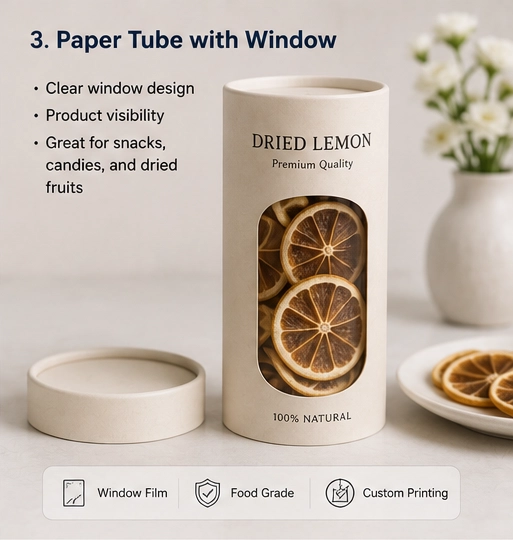
Window Tube
A window structure adds:
- Die cutting
- Transparent film
- Film attachment
- Alignment checks
- Additional inspection
Moreover, when the product must remain visible through the window, the insert also needs to keep the item in the correct position.
Therefore, window tubes usually require more coordination than closed tubes.
Push-Up Tube
Push-up packaging includes an internal platform that moves vertically.
Paper thickness, friction and inner diameter must work together.
Consequently, functional testing is especially important.
Twist-Up Tube
Twist-up tubes include a more complex dispensing mechanism.
Therefore, component tolerances and assembly steps can increase development and production time.
Sleeve Structure
An outer sleeve creates another printed component.
However, it can also simplify multi-SKU projects.
For instance, several products can share one standard tube while only the sleeve artwork changes.
How Printing Affects the Schedule
Printing can influence custom paper tube production time long before mass assembly begins.
CMYK Printing
CMYK works well for:
- Photography
- Illustrations
- Gradients
- Multicolor graphics
However, artwork should be completely approved before printing starts.
Otherwise, late artwork changes can restart part of the production process.
Pantone Printing
Pantone colors are useful for maintaining brand consistency.
Nevertheless, paper texture and lamination can change the perceived color.
Therefore, strict brand-color projects may need physical color approval.
Multiple SKUs
Several designs may use the same tube size but different printing.
For example:
- Green tea
- Black tea
- Jasmine tea
- Herbal tea
- Fruit tea
may all share one structure.
However, each design can require its own printing setup.
Consequently, SKU count can influence the schedule even when the tube dimensions remain identical.
Printing & Finishing Options
Special finishing adds value, but it also adds production stages.
Hot Stamping
Hot stamping normally requires a custom die.
Popular foil options include:
- Gold
- Silver
- Copper
- Rose gold
- Black
- Holographic foil
A small logo is usually easier to produce than a large full-body foil pattern.
Embossing
Embossing creates a raised surface.
When the embossed area must align exactly with foil, registration becomes more demanding.
Therefore, additional setup and inspection may be required.
Debossing
Debossing creates a recessed effect.
Although visually subtle, it still requires tooling.
Spot UV
Spot UV creates glossy contrast over selected areas.
Fine alignment with printed graphics can require extra production control.
Matte Lamination
Matte film produces a low-glare premium surface.
It is widely used for perfume, tea, skincare and gift packaging.
Gloss Lamination
Gloss lamination creates stronger shine and color saturation.
However, it remains another separate processing stage.
Soft-Touch and Anti-Scratch Lamination
Soft-touch film creates a velvety surface.
Meanwhile, anti-scratch film can protect dark packaging.
Nevertheless, specialty films may require additional material preparation.
How Inserts Affect Production Time
Custom inserts can significantly change custom paper tube production time because they must fit the real product accurately.
Paperboard Insert
Paperboard inserts can be:
- Die-cut
- Folded
- Layered
- Printed
They work well for lightweight products.
Molded Pulp
Molded pulp can provide shaped product support.
However, a new custom design may require mold development and sampling.
EVA
EVA is often used for:
- Perfume
- Skincare
- Jewelry
- Premium gifts
The cutout needs to match the product accurately.
Therefore, exact dimensions are essential.
EPE and Foam
EPE provides cushioning for fragile products.
Although visually simpler, the fit still needs testing.
Two-Level Support
Tall bottles may require support around both the bottom and upper section.
That structure takes longer to develop.
Nevertheless, the additional support can significantly reduce movement during transportation.
How MOQ Affects Production Time
Order quantity has a direct relationship with custom paper tube production time, but the relationship is not as simple as “higher quantity always means longer production.”
A larger order naturally requires more machine time, assembly and inspection.
However, small customized runs still need:
- Material preparation
- Printing setup
- Machine adjustment
- Tooling
- Quality-control setup
In addition, multi-SKU orders can extend the schedule.
Consider these examples:
5,000 identical tubes
- One structure
- One artwork
- One insert
- One finish
versus:
5,000 tubes across five designs
- Five artworks
- Several printing setups
- Possibly different colors
The total quantity is the same.
Nevertheless, the production complexity is different.
Want to Understand Why MOQ Changes?
If you are still deciding how many packages to order, read our What Affects MOQ for Custom Paper Packaging? guide.
It explains how materials, structures, inserts, tooling, printing and SKU quantity influence minimum production quantities.
Together, these two articles answer two important sourcing questions:
How much packaging should I order?
and
How long will that packaging take to produce?
Does a Higher MOQ Always Mean a Longer Lead Time?
Not necessarily.
Production can remain efficient when:
- One structure is used
- One diameter is used
- Materials are standardized
- Artwork is consistent
- Inserts are identical
- Finishing remains the same
For example, 10,000 identical tubes can sometimes be easier to schedule than 3,000 tubes divided across several structures and artworks.
Therefore, complexity matters almost as much as quantity.
Sample Approval Can Be the Biggest Delay
Many buyers focus on factory manufacturing days.
However, sample approval can become the most unpredictable part of the entire project.
Imagine the following process:
- A first structural sample is produced.
- The diameter changes.
- Another sample is required.
- The logo position changes.
- The insert is adjusted.
- A new product sample arrives.
- Another fit test begins.
Suddenly, several rounds of revisions have been added before mass production starts.
Therefore, one of the easiest ways to shorten the total project timeline is to provide accurate product information from the beginning.
How to Reduce Lead Time Without Increasing Risk
Reducing custom paper tube production time should not mean skipping necessary testing.
Instead, remove avoidable delays.
Send the Real Product Early
Whenever possible, provide the real:
- Bottle
- Jar
- Candle
- Cosmetic container
- Gift product
This reduces uncertainty during structural development.
Confirm Size Before Artwork
Do not finalize artwork before the tube dimensions are approved.
Otherwise, artwork may need to be rebuilt after structural changes.
Use Available Materials
If your launch date is close, choose standard or readily available paper.
A rare specialty paper may create unnecessary sourcing delays.
Standardize Multiple SKUs
Use one structure across several products whenever possible.
Then change:
- Artwork
- Sleeve
- Label
- Product card
This can make production easier.
Limit Special Finishing
More processes mean more scheduling steps.
A well-designed tube using good paper and one foil logo can still look premium.
Approve Samples Quickly
Internal approval can sometimes take longer than factory production.
Therefore, define who can approve:
- Structure
- Color
- Artwork
- Insert
- Finish
before sampling begins.
Finalize Regulatory Text
For food and cosmetic packaging, regulatory text should be finalized before mass printing.
Late text changes can delay the entire production schedule.
Compliance & Sustainability
Compliance requirements can influence planning, especially for food-contact and export packaging.
Depending on the project, buyers may request:
- FSC-related material information
- Food-contact reports
- Material declarations
- Migration reports
- BRC-related documentation
- IFS-related documentation
- REACH/SVHC information
- EPR support information
Exact requirements depend on the selected materials, product and target market.
Therefore, documentation should be discussed at the quotation stage.
From a sustainability perspective, efficient planning can also reduce waste.
For example, standardizing one structure across several SKUs may reduce:
- Extra tooling
- Obsolete packaging
- Repeated setup
- Excess inventory
Moreover, early planning can reduce the need for expensive emergency air freight.
How to Customize and Build a Realistic Timeline
To receive an accurate custom paper tube production time, provide a complete project brief.
Step 1: Product Information
Send:
- Product type
- Dimensions
- Weight
- Photos
- Physical sample if possible
Step 2: Tube Dimensions
Confirm:
- Inner diameter
- Outer diameter
- Height
- Lid depth
- Required headspace
Step 3: Structure
Choose:
- Standard paper tube
- Shoulder-neck tube
- Telescopic tube
- Window tube
- Sleeve tube
- Push-up tube
- Twist-up tube
Step 4: Materials
Confirm:
- Kraft paper
- Art paper
- Specialty paper
- Food-grade liner
- Foil liner
- Bottom material
- Lid material
Step 5: Insert
Choose:
- No insert
- Paperboard
- Molded pulp
- EVA
- EPE
- Foam
- Plastic tray
Step 6: Printing
Choose:
- CMYK
- Pantone
- One-color printing
- Combination printing
Step 7: Finishing
Confirm:
- Hot stamping
- Embossing
- Debossing
- Spot UV
- Matte lamination
- Gloss lamination
- Soft-touch film
- Anti-scratch film
Step 8: Quantity
Provide realistic quantities such as:
- 500 pcs
- 1,000 pcs
- 3,000 pcs
- 5,000 pcs
- 10,000 pcs
Step 9: Artwork
Provide editable:
- AI
- EPS
Special-finishing areas should be clearly marked.
Step 10: Target Market
Tell the supplier where the finished packaging will be sold.
This allows relevant documentation requirements to be reviewed earlier.
Step 11: Final Delivery Date
Do not provide only the desired factory completion date.
Instead, tell the supplier when the packaging needs to arrive at:
- Your filling factory
- Your warehouse
- Your contract packer
- Your fulfillment center
Then production and transport can be planned together.
Related Products: Custom Paper Tubes / Food Packaging / Cosmetic Packaging
Why Choose Pack Packaging?
Pack Packaging supports custom paper tube development from structure design through mass production.
Our manufacturing facility covers 20,000㎡, including a 2,000㎡ food-grade workshop.
In addition, monthly paper tube production capacity exceeds 10,000,000 pieces.
Our 20+ member design team can assist with:
- Structural development
- Size optimization
- Material selection
- Insert development
- Artwork layout
- Sampling
- Printing
- Finishing
- Production planning
- Cost optimization
- Export packing
When buyers ask about custom paper tube production time, our team reviews the complete project instead of applying one fixed lead time to every paper tube.
Our OEM and ODM capabilities include:
- Custom diameters
- Custom heights
- Kraft paper
- Art paper
- Specialty paper
- Food-grade liners
- Foil liners
- Paper lids
- Shoulder-neck structures
- Telescopic structures
- Window structures
- Push-up tubes
- Twist-up tubes
- Paperboard inserts
- Molded-pulp inserts
- EVA inserts
- EPE inserts
- CMYK printing
- Pantone printing
- Hot stamping
- Embossing
- Debossing
- Spot UV
- Matte lamination
- Gloss lamination
- Soft-touch lamination
- Anti-scratch lamination
- Structural samples
- Printed samples
- Quality inspection
- Export packing
Depending on the selected materials and application, supporting documentation may include FSC, food-contact reports, BRC-related documentation, IFS-related documentation, RoHS 2.0, REACH-SVHC and EPR support information.
The exact documentation should always be confirmed against the approved materials and destination market.
Frequently Asked Questions
1. How long does custom paper tube packaging production take?
There is no single fixed lead time. A simple project can move more quickly, while packaging with custom inserts, specialty paper, liners or several finishing processes requires more steps. For planning purposes, standard mass production may often be considered in roughly a 10–25 working-day range after final approval, while highly customized projects may require longer.
2. How long does sampling take?
A basic structural sample can usually be developed faster than a fully printed sample. Printing, hot stamping, embossing and custom inserts can add additional time.
3. When does production lead time begin?
This should be confirmed in the quotation. Depending on the project, the schedule may begin after deposit, final artwork approval, sample approval or material confirmation.
4. Does a larger quantity always take longer?
Not necessarily. A large standardized order may be easier to schedule than a smaller project containing several structures, SKUs and finishing processes.
5. Which processes usually add more production steps?
Specialty paper, custom inserts, multiple foil colors, embossing, spot UV, windows and complex structures generally add more preparation than simple printing and lamination.
6. Can I skip sampling to save time?
For a new custom structure, sampling is strongly recommended. Skipping fit, color or insert checks may save time initially but create much larger problems during mass production.
7. How can I shorten the overall packaging timeline?
Provide accurate product dimensions, finalize the structure before artwork, choose available materials, standardize SKUs where possible and approve samples quickly.
8. Is transportation included in production lead time?
Normally, manufacturing and transportation should be planned separately. Ask for the expected production completion date, dispatch date and transportation schedule.
Explore More Custom Packaging Solutions
Looking for more packaging options? Discover our complete range of custom packaging products designed for different industries and applications.
Folding Boxes – Lightweight and fully customizable cartons for retail packaging.
Rigid Boxes – Premium rigid gift boxes for luxury brands.
Corrugated Boxes – Durable shipping and e-commerce packaging solutions.
Child Resistant Boxes – Secure packaging for regulated products.
Accessories – Custom inserts, tissue paper, ribbons, labels, and more.
Paper Tubes – Explore our dedicated collection of custom paper tube packaging for tea, coffee, cosmetics, candles, spirits, and other premium products on our specialized website.
Need custom packaging? Contact our team today for a free quote and expert consultation.