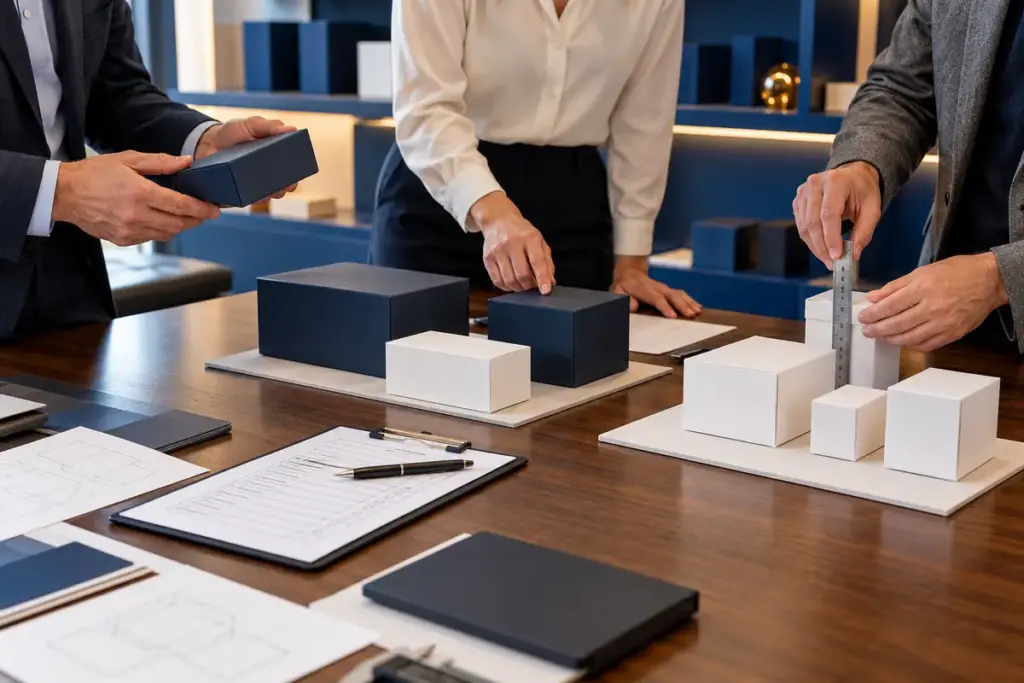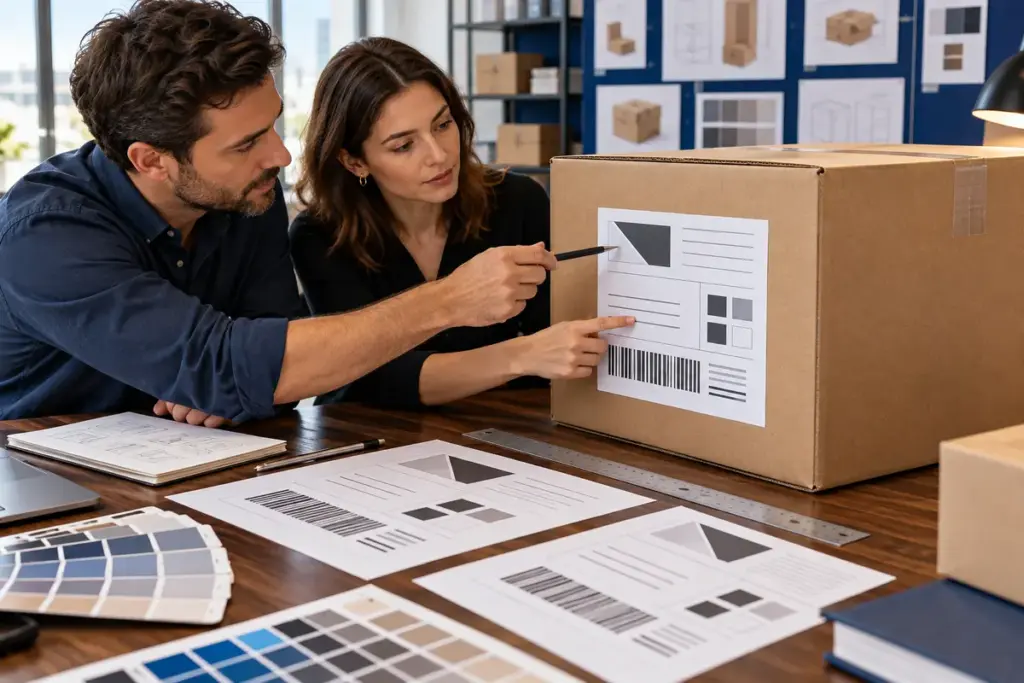
You ask a supplier for a sample of your custom packaging, and what comes back might be a plain unprinted box, a printed proof, or a fully finished unit. Each one is a packaging prototype that answers a different question — and first-time buyers routinely approve the wrong one. They sign off graphics on a structure nobody tested with the real product, or pay for a finished sample just to check whether a lid sits straight. The three sample types exist because the decisions they support are genuinely different.
This guide separates them cleanly. It covers what a white sample, a digital proof, and a sales sample each verify, and what drives their cost and lead time. It also sets out the order in which you should iterate through them before committing to production. The step-by-step project sequence itself lives in our workflow guide. Here we focus only on the prototype decisions. Those are the ones that decide whether your first run is right the first time.
What Are the Three Packaging Prototype Types?
A white sample is an unprinted structural prototype — real board, real die-line, no graphics. Its job is to prove the physical package: dimensions, tolerances, assembly, and how your product actually sits inside it. A digital sample (a soft proof on screen or a printed draw-down on stock) represents the visuals. It covers colour behaviour, artwork placement, and finish decisions, checked before plates and tooling are committed. A sales sample is the finished reference unit: production materials, real printing, real foil or embossing, real insert — built to the specification mass production will follow.
The fastest way to keep them straight is to map each one to the question it answers:
| White sample | Digital proof | Sales sample | |
|---|---|---|---|
| What it is | Unprinted structural prototype in real or equivalent board | On-screen proof or printed draw-down showing graphics and finish | Fully finished unit in production materials and construction |
| What it verifies | Size, tolerance, assembly, closure feel, product fit | Colour, artwork position, print and finishing decisions on the chosen stock | The complete result — structure, graphics, and insert together |
| What it cannot tell you | How the printed design will read | How the structure behaves with your product inside | Nothing — but it is the slowest and most expensive to redo |
| Where it sits | First, before graphics are committed | Once structure is locked and artwork exists | Last, as the approval and acceptance reference |
What Does a White Sample Prove?
Because there is no print on a white sample, every observation you make is about the construction. Three things get settled here, and none of them can be reliably judged from a drawing.
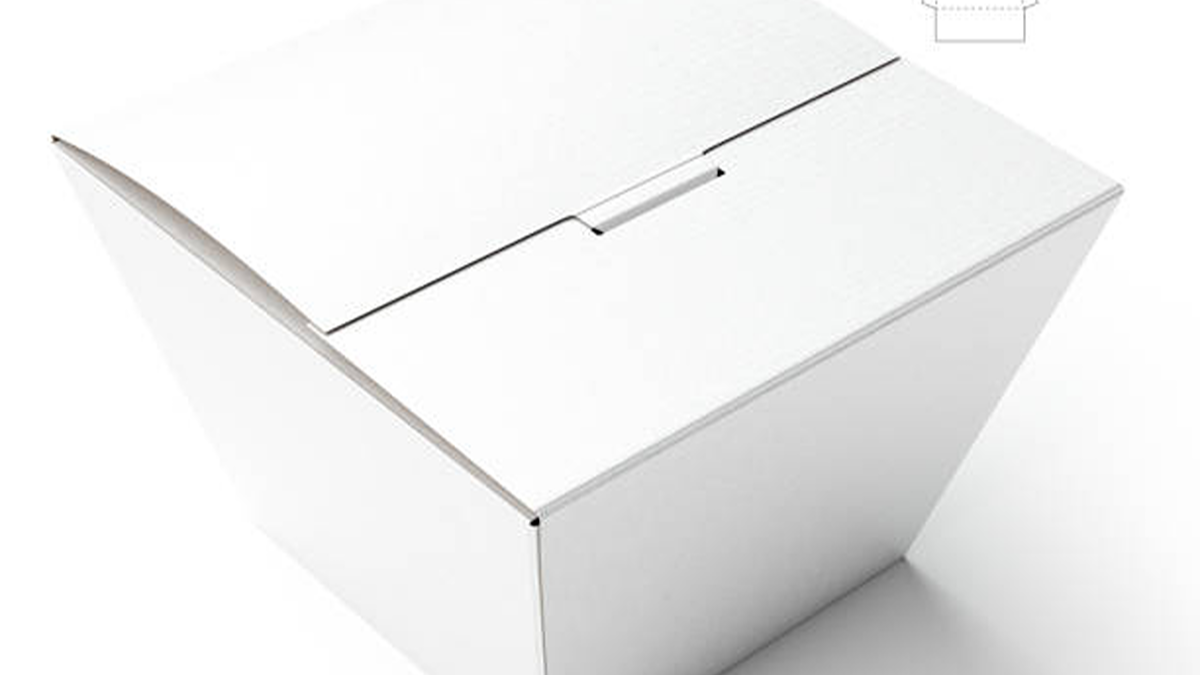
- Dimension tolerance. Internal dimensions, wall thickness, and how the lid overlaps the base all behave differently on a physical unit than on a spec sheet. A one- or two-millimetre error in a lid tolerance is invisible on paper and obvious in your hands.
- Assembly and closure function. Glue tabs, folding seams, telescoping action, and the resistance of a lid can only be evaluated by opening and closing the real thing repeatedly — and by checking whether the box stands upright on a shelf.
- Contents fit. Put your actual product inside, not a mock-up. Weight distribution, insert depth, and how the product behaves under a bit of pressure only show up with the real item fitted.
White samples can be hand-built from board or die-cut on the production tooling, and the two are not equally faithful. A hand-built mock-up shows fit and proportion; a die-cut sample shows the exact construction. We will tell you which one your structure needs when you request it, and the point is to make this decision before anyone spends money on graphics.
What Do Digital and Printed Proofs Check?
Once structure is locked, the conversation moves to visuals. A digital proof is a rendered representation of your artwork on the dieline. It is useful for checking placement, copy, and overall design logic quickly, because it costs almost nothing to iterate. Its limit is colour accuracy: screen profiles differ, and uncoated stocks absorb ink and shift colour noticeably, so a brand-critical hue cannot be responsibly signed off from a screen alone.
That is where a printed draw-down comes in: real ink on your actual stock, run under press conditions. Reputations in print are checked against this kind of physical evidence. The wider printing industry aligns press conditions and proofs through print proofing standards in the ISO 12647 series. Its Part 7 covers proofing processes working directly from digital data, as a process-control framework rather than a pass/fail certificate. Finishes behave the same way: foil, embossing, debossing, and spot UV need a physical surface to be judged properly. Our guide to custom packaging color matching walks through how brand colour travels from a Pantone reference to a consistent result across runs.
What Is a Sales Sample For?
A sales sample — sometimes called a pre-production sample — is built to the full specification: production-grade board, real printing, real finishing, and the actual insert or internal fitting. Nothing about it is representative in the abstract; it is the package as the finished goods will be.
It earns its place for two jobs. First, downstream presentation. This is the unit a product manager puts in front of a retail buyer, a distributor, or an internal decision meeting. It shows the purchase experience rather than a construction sketch. Whether you are evaluating a rigid box, a paper tube, or a mailer, the constructions this applies to are visible in our product catalog. Second, and just as important, it becomes the acceptance baseline: the signed unit stays on file, and the mass-production run is inspected against it. When a shade looks off at delivery, the question is answered by comparison to the approved sample, not by memory.
How Do Cost and Lead Time Vary by Sample Type?
Sample costs are not flat, and any supplier who quotes you one number for “a sample” without asking about construction is guessing. What each prototype costs and how long it takes depends on structure complexity, size, material grade, finishing, and how many rounds you need. Shipping the physical units to you sits on top of that.
In relative terms, a digital proof is the cheapest and fastest, since it is mostly a file exchange. A white sample costs more and takes longer, especially when it is die-cut from real tooling rather than hand-built. A sales sample sits closest to a single production unit, so it takes the longest and costs the most. The working-day range for each type is quoted per project. The custom packaging quote itemises the sample line together with the structure, so you see exactly what you are approving. For how prototypes interact with full production schedules, our breakdown of custom paper tube production time is the closest worked example on the site.
Which Sample Answers Which Question
When buyers ask us “which sample do I need,” we treat it as a decision rule rather than a preference:
| The question you are facing | The sample that answers it |
|---|---|
| Does the size, fit, and closure work with my actual product? | White sample. Nothing else tests the physical construction before graphics are committed. |
| Does the brand colour, artwork placement, and finish read as intended on this stock? | Digital proof, then a printed draw-down for anything colour-critical. |
| What do I show a retail buyer, and what do I inspect the production run against? | Sales sample. One finished unit becomes your presentation tool and your acceptance reference. |
| I changed the structure after approving artwork — what re-approves what? | White sample first, then re-proof only the affected graphics. Structural changes ripple forward, never backward. |
The default iteration order follows the dependencies: structure, then visuals, then the finished unit. Each stage’s approval conditions the next — a print proof made on an unvalidated box gets scrapped the moment the structure changes. Not every project needs all three; skip any stage whose question is already settled, and only that one.
What Should You Send Before Sampling Starts?
Prototype rounds get wasted when the inputs are vague. Before requesting your first sample, send:
| Send this | Detail |
|---|---|
| Product dimensions and weight | or the product itself, which beats any measurement for fit checks. |
| Target structure or references | including insert intentions and how the package opens. |
| Quantity and target market | since both influence grade choices and tolerance expectations. |
| Artwork files | for the proof stage: vector format built on the agreed dieline, Pantone references rather than screen values, and separate layers for foil, emboss, and spot UV. |
| Your launch window | so sample rounds are sequenced rather than compressed into panic. |
These inputs slot into a defined sequence — where sampling sits within the full project, and what precedes and follows it, is laid out in our custom packaging project workflow.
Frequently Asked Questions
Do I need all three samples before production?
Not necessarily. The minimum is usually a structure check (white sample) plus a visual check (proof). A sales sample earns its cost when you need an acceptance baseline for the run or must present the finished package to buyers. If your structure is standard and the graphics are simple, fewer rounds are reasonable.
What is the difference between a white sample and a pre-production sample?
A white sample is unprinted and proves construction; a pre-production (sales) sample is fully finished and represents the production specification as a whole. They answer different questions at different cost points, which is exactly why the order between them matters.
How many revision rounds are normal?
It depends on the structure. Simple formats often settle in one or two rounds; custom inserts and complex closures typically take a second or third pass. Each structural change resets the approvals downstream of it, which is why we push every change upstream into the white sample stage.
How much does a packaging prototype cost?
There is no honest flat price: it depends on structure, size, material, finishing, and the number of rounds, plus shipping. The sample charge appears as an itemised line in your quotation rather than a published rate, and we do not run blanket free-sampling offers. What applies to your project is confirmed with the quote.
Can I approve brand colors from a digital proof alone?
For layout, copy, and placement decisions, yes. For brand-critical colour on uncoated or textured stock, a screen profile is not a reliable basis — request a printed draw-down on the actual material before signing the shade.
Can the sales sample double as a retail presentation unit?
That is one of its two standard jobs — the other is staying on file as the acceptance reference for the production run. Plan for at least two finished samples if your buyer needs one on their desk, and factor that into the sample request.
Can I skip the white sample and go straight to a finished one?
You can, though we advise against it. A dimensional or fit problem discovered on a finished sample means re-cutting tooling, redoing graphics, and re-running the unit — days become weeks. The white sample exists precisely to make those failures cheap.
Final Thoughts
Match the prototype to the question. Structure doubt goes to a white sample; visual doubt goes to a digital proof and, for anything colour-critical, a printed draw-down; presentation and acceptance go to the sales sample. Pay in that order and every expensive stage is only ever built on decisions already settled at a cheaper one.
Tell us which decision your sample needs to support — structure, graphics, or a sales reference. Send it to PK Paper Box and we will recommend the sample type, timeline, and files required.