انتقل إلى المحتوى

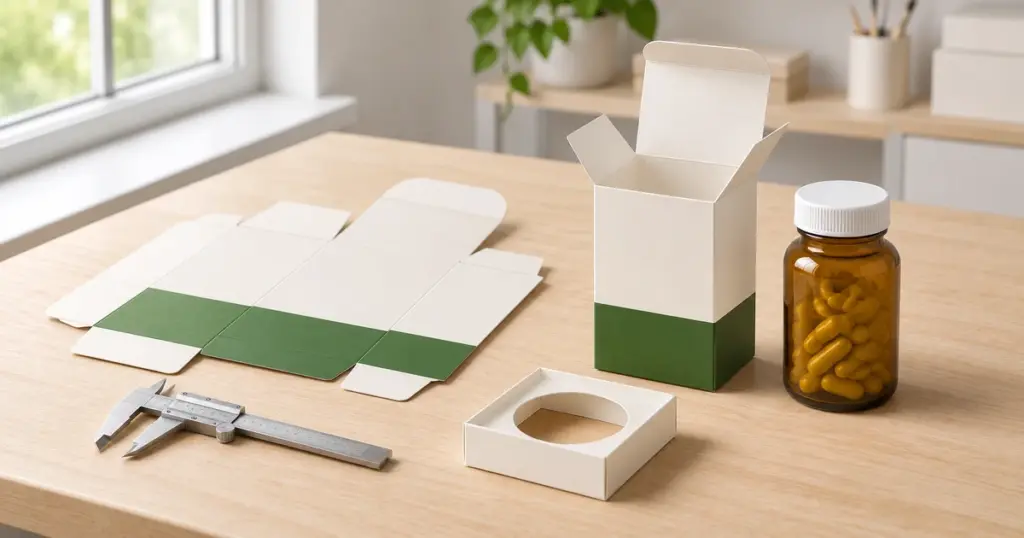
Start a vitamin bottle carton with the مملوء, capped and labeled bottle. Check its widest point and full height, then choose a bottom closure that supports the filled bottle and works on the packing line. Add an insert when a sample shows movement or when the carton needs to hold a leaflet or more than one bottle in a fixed position.
These checks apply to a folding carton around a closed vitamin or supplement bottle. Use the bottle and its closure in the sample, including any band or other feature that changes the outside dimensions.
إجابة سريعة
- Size the carton around the finished bottle. Measure the widest point, overall height and filled weight with the cap, band and label in place.
- Choose a bottom to sample. A tuck end is a starting point for a light bottle. For a heavier bottle packed by hand, compare a snap-lock bottom and a pre-glued auto-bottom.
- Check the whole pack. Load the bottle and any insert or leaflet, close the carton, and test removal and shipping-case fit. For machine packing, run the sample on the intended line.
Measure the bottle the way it will arrive at the cartoner
| What to measure or record | What it helps you specify |
|---|---|
| Maximum width and depth | Inside width and depth. Check the body, كتف, cap and band. For a non-round bottle, measure both axes in the intended loading orientation. |
| Overall height with cap fitted | Usable height and cap clearance. Measure from the surface that supports the bottle to the nearest part of the closed top flaps. Account for any raised insert. |
| Filled weight and bottle material | Bottom and board to sample. Record whether the bottle is glass or plastic and include the weight of any leaflet or accessory packed alongside it. |
| Loading direction and bottle orientation | Opening and line trial. Record top or side loading, which way the bottle label faces, and the cartoner’s setup and blank limits if it will be machine packed. |
Compare bottom closures with the actual bottle inside
| بناء | When to sample it | What to verify |
|---|---|---|
| Straight or reverse tuck end | A relatively light bottle and a simple rectangular carton | Make sure the cap clears the top flaps, the bottom stays seated with the bottle inside, and the closure feeds or folds in the required direction. |
| Snap-lock bottom | A project that needs an interlocking base and can accommodate manual setup | Time the folding sequence and check that operators can seat the tabs consistently before loading. |
| Auto-bottom or crash-lock bottom | A heavier filled unit or a hand-packing project where faster carton erection matters | Check that the pre-glued base opens fully and sits flat, then evaluate the filled carton in its shipping case. Confirm compatibility before using it on an automated line. |
To isolate the effect of the bottom closure, keep the filled bottle, board specification and shipping-case configuration consistent where practical. If the converter proposes a different board for each design, test each closure with its proposed production board under the same shipping conditions and compare the quoted cost of each combination. Use the dieline and filled sample to see how the base supports the bottle. Read the folding carton structure guide or see the Paperboard Packaging Council’s folding carton examples.
Two worked examples for vitamin bottle cartons
These examples use hypothetical bottle and carton dimensions to show how to plan a first sample. Confirm the fit and tolerances with the actual filled bottle, board and packing method before approving production.
Example 1: A light plastic bottle on an existing cartoner
Inputs. A filled plastic vitamin bottle weighs 95 ز, measures 48 mm across its widest point and is 102 mm tall with the cap and band fitted. The co-packer already runs tuck-end cartons and loads from the side.
First sample. Ask the co-packer which tuck direction the cartoner can close. Start with a tuck-end blank that fits the line and aim for 51 × 51 mm of clear inside width and depth and 106 mm of usable height with the carton closed. The sample leaves 3 mm across each lateral dimension (51 − 48) و 4 mm vertically (106 − 102) before allowing for production variation. Start without an insert and check whether the bottle stays in place.
Approval check. Run the blank and actual filled bottle through the cartoner. Check that the cap and band clear the loading opening, the flaps close without catching, and the bottom stays seated in the filled pack. If loading binds, note whether it happens at the opening or inside the carton before changing the size or flap geometry.
Example 2: A heavier glass bottle packed by hand
Inputs. A filled glass bottle weighs 320 ز, measures 62 mm across its widest point and is 118 mm tall. The packing team loads from the top by hand, and the brand wants a paperboard cradle to limit movement at the base.
First samples. Compare a snap-lock bottom and an auto-bottom with the same bottle and cradle. Suppose the clear internal height from the closed carton floor is 125 mm and the cradle raises the bottle 3 مم. The trial leaves 4 mm of headroom (125 − 3 − 118). ل 66 × 66 mm inside footprint, measure sideways fit at the cradle as well as at the shoulder. ال 4 mm difference between carton width and bottle diameter applies to the bare carton. The fitted cradle determines how much the bottle actually moves.
Approval check. Have the same operator erect and fill 10 cartons of each style using the same method. Record total time, mislocked tabs or bases that do not open fully, and whether the filled carton rocks or bulges. Pack the filled samples in the intended shipping case and compare both bases under the agreed handling checks. Use the results and quoted carton costs to decide whether the auto-bottom’s setup time is worth any price difference.
Decide whether the bottle needs an insert
A closely fitted carton may be enough for a light, regular bottle that stays upright during normal handling. Sample a paperboard collar or base cradle if a glass bottle moves inside the carton or if a narrow bottle has to fit in a larger presentation pack. A collar can help limit sideways movement at the shoulder. A base cradle can support and position the bottom. Choose the contact points with the actual bottle in hand.
Check that the insert leaves the cap clear and gives the customer room to lift the bottle out. If there is a leaflet, load a folded production-size copy during sampling. It should stay where the customer can find it without pushing the bottle against a score line or making the lid spring open.

Approve the filled carton and its pack-out
- Build several samples. Have the person or team that will pack the order erect the cartons and load filled bottles. Record any jams, repeat folds or insert adjustments.
- Check presentation and removal. Inspect front-panel bulge, the lid position, bottle movement and cap clearance. Open the carton as a customer would and remove the bottle without snagging the label or leaflet.
- Pack the samples in their shipping case. Confirm orientation and units per case. Agree with the supplier or testing team on transit checks appropriate to the delivery route.
If you are considering a fitted paper tube for a premium vitamin set, compare it with the carton using the same filled bottle and leaflet. The carton may simplify line loading and shelf layout. The tube may suit a presentation pack where opening and product reveal matter more. Compare packaging formats for supplement bottles.
Get a quote for a vitamin bottle carton
Send four details to start: bottle dimensions with the cap fitted, الوزن المملوء, order quantity per SKU and delivery destination. Then tell us the bottle count per carton, how you load it and whether it needs an insert or leaflet. Ask for a blank sample if you need to trial the packing line or a finished sample if you also need to approve print and fit.
Explore custom folding cartons أو request a quote for vitamin bottle cartons.