Zum Inhalt springen
When buyers start sourcing food packaging, they usually ask about price, Größe, Drucken, MOQ and lead time first. That is understandable. These details affect the project immediately.
But once the paper tube will be used for tea, Kaffee, Gebäck, Schokolade, supplements or pet treats, appearance is only part of the decision. Buyers also need to consider hygiene, food contact safety, contamination control, traceability and shelf-life protection.
This is why more purchasing teams are searching for BRC IFS food packaging suppliers.
Trotzdem, there is one important point to understand: a factory certificate does not automatically mean that every paper tube is suitable for every food product. The final safety and performance depend on the paper, Liner, Klebstoff, Tinte, Beschichtung, Schließung, filling method and destination market.
Also, rather than only asking, “Do you have BRC or IFS?”, buyers should also ask:
Can this supplier recommend and document the right packaging structure for my specific product?
Holen Sie sich ein individuelles Verpackungsangebot
Send us your product type, Abmessungen, quantity and target market. Our team will recommend a suitable paper tube structure and material.
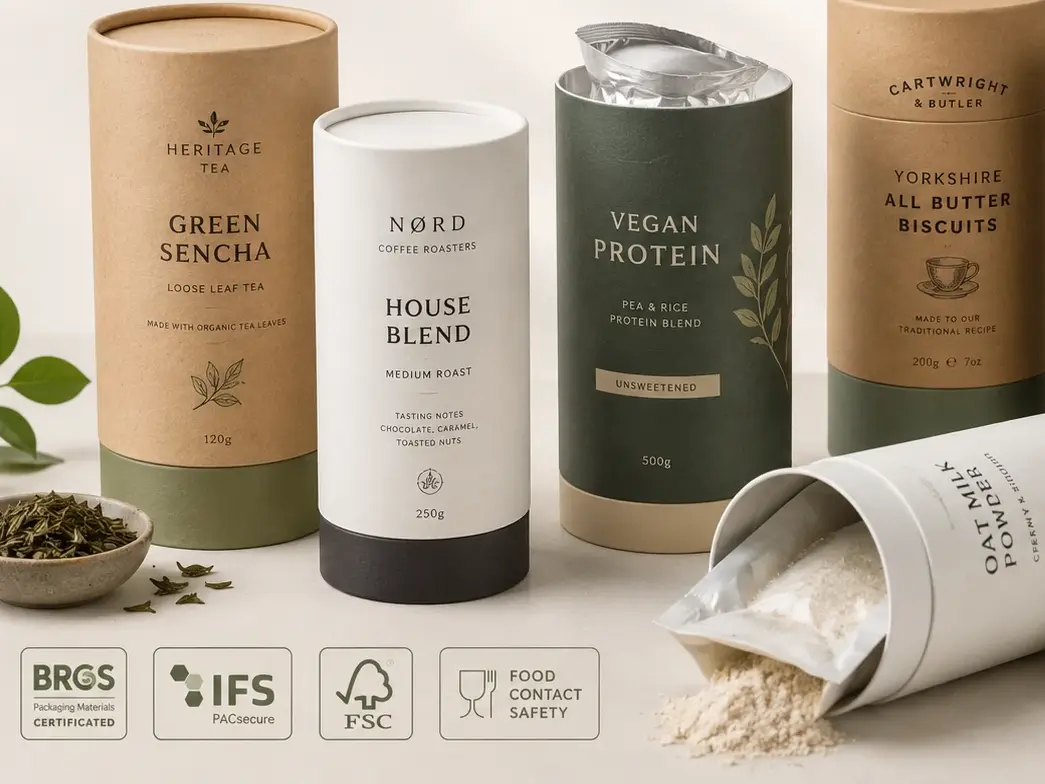
What Is Food Contact Paper Tube Packaging?
Food contact paper tube packaging is a cylindrical package developed for food or food-related products.
Auf den ersten Blick, it may look similar to an ordinary gift tube. The main difference is often inside the structure.
A decorative tube mainly needs to look attractive and protect the product during handling. A food packaging tube may also need to resist moisture, Fett, Sauerstoff, aroma transfer or direct contact with the product.
Depending on the application, the structure may include:
- A rigid paperboard tube body
- Kraftpapier, art paper or specialty paper wrapping
- A food-contact liner
- PE, foil or another barrier layer
- Ein Papier, metal or composite lid
- A membrane or tamper-evident seal
- Food-compatible adhesives, inks and coatings
- A separate food-grade inner pouch
The phrase “food-grade paper tube” should describe the complete packaging system, not only the base paper.
Zum Beispiel, the paper may be suitable for food packaging, but buyers should also consider the liner, Kleber, printing ink and coating. If the food is oily, aromatic or moisture-sensitive, these details become even more important.
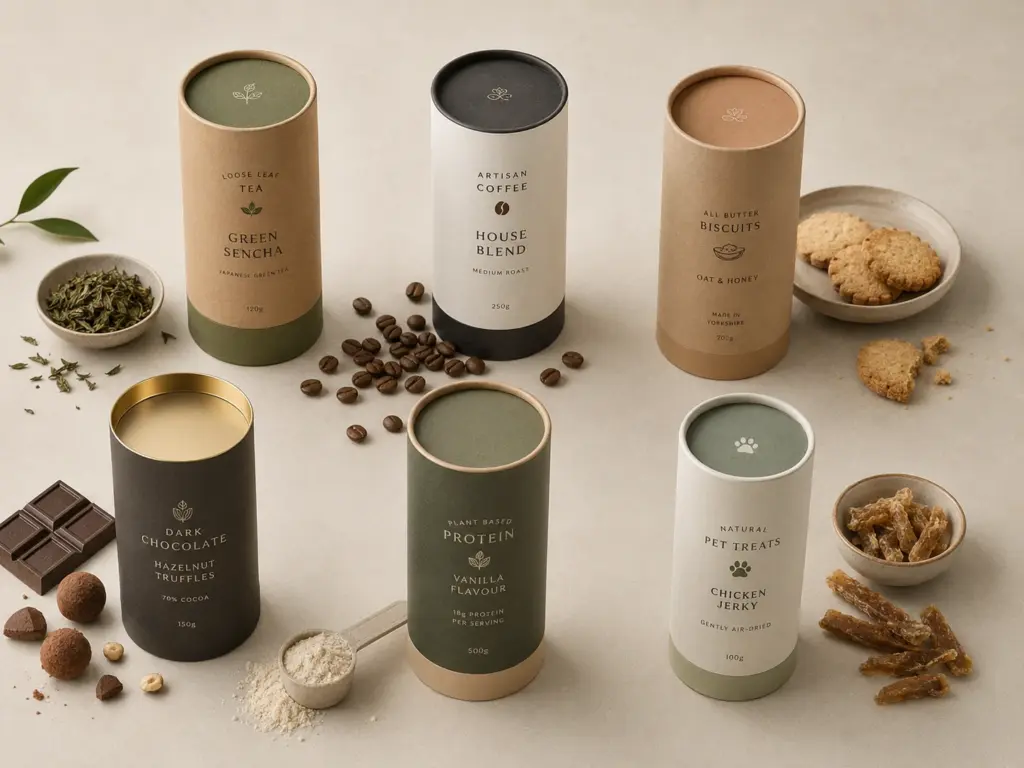
What Do BRC and IFS Mean for Food Packaging?
“BRC and IFS certified packaging” is a common search term, but professional buyers should check the exact standard shown on the certificate.
For a paper packaging manufacturer, the most relevant standards are normally:
- BRCGS Global Standard for Packaging Materials
- IFS PACsecure
These standards focus on packaging safety, quality management, Hygiene, risk assessment, process control, traceability and legal compliance.
IFS Food or IFS PACsecure?
This is where some buyers—and suppliers—get confused.
IFS Food mainly applies to companies that process food or pack loose food products.
IFS PACsecure is designed for packaging manufacturers and converters. For a factory producing empty paper tubes, IFS PACsecure is normally the more relevant standard.
When a supplier says, “We are IFS certified,” it is worth asking:
- Which IFS standard is listed?
- Which factory address is covered?
- Does the scope include paper packaging?
- Is the certificate still valid?
- Is your order produced within the certified site?
These are normal supplier-approval questions, especially for food brands and importers.
Why BRCGS and IFS PACsecure Matter
Better Hygiene Control
Food packaging production may involve risks such as dust, insects, foreign objects, poor storage or chemical contamination.
A controlled factory should have clear procedures for:
- Workshop cleaning
- Employee hygiene
- Pest control
- Raw-material storage
- Foreign-body prevention
- Equipment maintenance
- Waste management
- Finished-product protection
A sample can show the printing and structure, but it cannot show how the factory controls hygiene during daily production. That is where an audited management system becomes useful.
Product-Based Risk Assessment
Different foods need different packaging.
Loose tea does not have the same requirements as coffee beans. Biscuits are different from protein powder, while dried salmon pet treats may contain more oil and stronger aromas.
Before recommending a structure, the supplier should understand:
- Is the product dry, oily or moisture-sensitive?
- Will it directly touch the paper tube?
- Will an inner pouch be used?
- Welche Haltbarkeitsdauer ist erforderlich?
- How will the product be filled?
- What are the storage conditions?
Ehrlich, using the same liner for every food product is not a professional approach.
Better Traceability
If a customer reports an odor, liner or printing problem, the factory should be able to trace the production batch and related materials.
This may include:
- Paperboard
- Inner liner
- Adhesive
- Printing ink
- Surface coating
- Production and inspection records
Good traceability helps the factory investigate complaints and take corrective action more quickly.
More Consistent Mass Production
A handmade sample may look perfect, but producing 50,000 oder 500,000 pieces consistently is a different challenge.
During mass production, the factory needs to control:
- Diameter and height
- Deckel passt
- Liner position
- Printing color
- Foil stamping position
- Oberflächenveredelung
- Cleanliness
- Packing protection
BRCGS and IFS systems provide a stronger framework for managing these processes, although buyers should still approve samples and specifications before production.
Verwandte Produkte
Kundenspezifische Papierröhren – Packaging for tea, Kaffee, Snacks, cosmetics and candles.
Lebensmittelverpackung – Custom boxes and tubes for dry foods and confectionery.
Kosmetikverpackungen – Premium packaging for skincare, perfume and beauty brands.
Allgemeine Anwendungen
Teeverpackung
Loseblatttee, matcha and herbal tea may need protection from moisture, light and external odors.
Depending on the shelf-life target, the tube can be combined with a food-contact liner or sealed inner bag.
Kaffeeverpackung
Coffee is sensitive to oxygen, moisture and aroma loss.
In vielen Projekten, the paper tube works best as premium secondary packaging around a sealed high-barrier coffee pouch. For other projects, a foil-lined tube and inner seal may be considered.
The correct structure depends on the filling method and required shelf life.
Biscuits, Cookies and Snacks
Paper tubes are popular for cookies, Nüsse, Cracker, sweets and dry snacks because they provide strong shelf presentation and physical protection.
Jedoch, greasy products may stain ordinary paperboard over time. A grease-resistant liner or inner pouch may therefore be necessary.
Chocolate and Confectionery
Chocolate and candy brands often choose paper tubes for gift sets and seasonal products.
An insert or tray can separate the products, prevent movement and improve presentation.
Powders and Supplements
Protein powder, seasoning, herbal powder and supplements may require moisture resistance, tamper evidence and a reliable closure.
The structure may include a foil liner, membrane seal, pouch or customized insert.
Pet Treats
Paper tubes can also be used for dried meat treats, cod and salmon toppers, biscuits and powdered pet supplements.
Because these products may contain oil or strong aromas, the barrier material should be selected based on the actual formulation.
BRC IFS food packaging
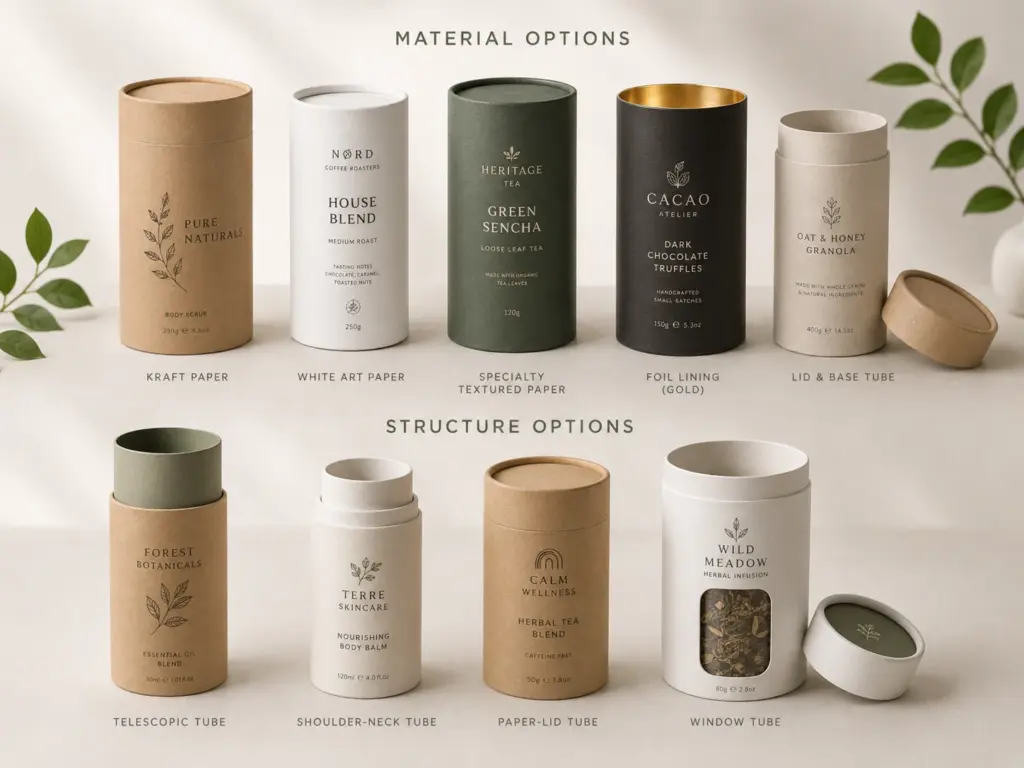
Kraftpapier
Kraft paper creates a natural and environmentally focused appearance. It is often used for organic tea, Kaffee, healthy snacks and artisanal products.
Kunstdruckpapier
Art paper provides a smooth printing surface for detailed graphics, photographs and accurate brand colors.
Spezialpapier
Strukturiert, pearlescent and metallic papers can create a more premium appearance.
Jedoch, buyers should also consider printing performance, lamination and recyclability before making a final choice.
Food Contact Paper Liner
A paper-based liner may be suitable for certain dry or individually wrapped products.
Its suitability depends on grease, Feuchtigkeit, contact time and storage conditions.
PE or Polymer Liner
A coated or laminated liner can improve grease and moisture resistance.
The material should be evaluated according to the food type and target market.
Aluminiumfolien-Liner
Foil laminates can offer stronger protection against oxygen, Feuchtigkeit, light and aroma transfer.
Trotzdem, the presence of foil alone does not make a tube airtight. The lid, seam and inner seal are equally important.
Inner Pouch
For many food products, using a sealed food-grade pouch inside the paper tube is the most practical solution.
The pouch provides the main barrier, while the paper tube supports branding, display and physical protection.
Strukturoptionen
Deckel- und Bodenrohr
This is a common structure for tea, Snacks, chocolate and gift foods. Lid depth and tightness can be customized.
Teleskoprohr
A telescopic structure uses two sliding sections and creates a premium opening experience.
Schulter-Nacken-Rohr
An inner shoulder holds the lid in position and provides better alignment.
Paper Lid or Plug
Paper closures may help reduce plastic use, although their suitability depends on sealing and barrier requirements.
Membrane-Sealed Tube
A membrane can provide tamper evidence and additional protection. The sealing process should be tested before mass production.
Papierröhre mit Einsatz
Paperboard or molded pulp inserts can hold chocolate, Gläser, bottles or gift products securely.
Fensterrohr
A window can improve product visibility, but buyers should consider protection, adhesive safety and recyclability.
Push-Up and Twist-Up Tube
Push-up and twist-up structures are mainly used for solid cosmetics, balms and deodorants. Some designs may also be adapted for solid food products, but each project must be evaluated separately.
Drucken & Finishing-Optionen
Food paper tubes can be customized with:
- CMYK-Druck
- Pantone-Farbdruck
- Heißfolienprägung
- Prägen und Tiefprägen
- Spot-UV
- Matte or gloss lamination
- Soft-touch finishing
- Beschichtungen auf Wasserbasis
Pantone printing is useful for maintaining brand colors, while foil stamping and embossing can create a more premium appearance.
For BRC IFS food packaging, printing is normally placed on the outside of the tube. The factory should also control ink curing, Geruch, set-off and possible migration risks.
Einhaltung & Nachhaltigkeit
BRC IFS food packaging Materials
BRCGS evaluates the factory’s product-safety and quality-management system.
It does not mean that every paper tube is automatically suitable for direct contact with every type of food.
IFS PACsecure
IFS PACsecure is designed for packaging manufacturers and converters. It is normally more relevant to a paper tube factory than IFS Food.
Food Contact Safety
Food contact safety depends on the actual material and conditions of use.
Wichtige Faktoren sind unter anderem:
- Food type
- Direct or indirect contact
- Contact time
- Temperature
- Fat and moisture content
- Shelf life
- Destination market
Product-specific reports or declarations may be required.
FSC
FSC certification relates to responsible forest sourcing and material traceability.
It is not a food-safety certificate and does not replace food-contact testing.
EUDR
EUDR relates to deforestation-free supply chains for certain commodities and derived products entering the EU market.
It is a regulatory requirement, not a packaging certification logo.
EPR
EPR usually places packaging-waste responsibilities on the business introducing packaged goods into a market.
Depending on the country, this may involve registration, reporting or fees. EPR is not a factory certification.
Recyclingfähigkeit
A paper tube’s recyclability depends on the complete structure.
Plastic windows, Schaumstoffeinlagen, metal parts and heavy lamination may make recycling more difficult. For sustainability-focused projects, buyers can consider paper lids, Papiereinlagen, separable components and reduced lamination.
How to Customize Food Contact Paper Tubes
To receive an accurate recommendation, buyers should provide:
- Product dimensions or filling volume
- Product type and characteristics
- Direct or indirect food contact
- Required shelf life
- Zielmarkt
- Bestellmenge
- Logo and artwork file
- Preferred printing and finishing
A physical sample should be approved before production to check size, Kapazität, Deckel passt, Farbe, liner and overall appearance.
Mindestbestellmenge und Vorlaufzeit hängen von der Struktur ab, Größe, Material, Druck- und Veredelungsanforderungen.
Warum Packverpackungen wählen??
Pack Packaging provides custom paper tubes, boxes and complete paper packaging solutions for global brands.
Our capabilities include:
- Approximately 20,000㎡ manufacturing facility
- Approximately 2,000㎡ food-grade workshop
- Monatliche Kapazität von mehr als 10,000,000 Einheiten
- 20+ design and engineering team
- Customized diameter, height and structure
- OEM and ODM packaging development
- BRC IFS food packaging Material, liner and finishing recommendations
- Sample production and artwork checking
- Quality-control and compliance-document support
We do not see a paper tube as only a printed cylinder. For food brands, it is part of the protection system, customer experience and supplier-approval process.
Häufig gestellte Fragen
1. Does BRCGS certification make every paper tube food safe?
NEIN. It confirms that the factory follows an audited packaging-safety system. The finished tube still needs suitable materials for the intended food and use conditions.
2. What is the difference between IFS Food and IFS PACsecure?
IFS Food mainly applies to food processors. IFS PACsecure applies to packaging manufacturers and is normally more relevant for paper tube factories.
3. Can food directly touch the paper tube?
It depends on the inner liner, Klebstoff, coating and intended use. In vielen Fällen, a sealed food-grade pouch is recommended.
4. Which liner should I choose?
The liner depends on moisture, Öl, Aroma, oxygen sensitivity and shelf-life requirements.
5. Can the tube size be fully customized?
Ja. Durchmesser, Höhe, Wandstärke, Deckeltiefe, liner and insert can be customized.
6. What documents should I request?
Buyers may request certificates, Materialspezifikationen, Berichte über Lebensmittelkontakt, declarations of compliance, FSC documents and quality records.
7. What is the MOQ?
MOQ hängt von der Größe ab, Struktur, Material, Druck und Veredelung. A quotation can be provided after reviewing the project details.
8. Are FSC, EUDR and EPR food-safety certifications?
NEIN. FSC relates to forest sourcing, EUDR to deforestation-free supply chains and EPR to packaging-waste responsibilities.
Entdecken Sie weitere maßgeschneiderte Verpackungslösungen
Entdecken Sie weitere maßgeschneiderte Verpackungslösungen
Auf der Suche nach weiteren Verpackungsmöglichkeiten? Entdecken Sie unser komplettes Sortiment an maßgeschneiderten Verpackungsprodukten für verschiedene Branchen und Anwendungen.
Faltschachteln – Leichte und vollständig anpassbare Kartons für Einzelhandelsverpackungen.
Starre Boxen – Hochwertige starre Geschenkboxen für Luxusmarken.
Wellpappkartons – Langlebige Versand- und E-Commerce-Verpackungslösungen.
Kindersichere Boxen – Sichere Verpackung für regulierte Produkte.
Zubehör – Benutzerdefinierte Einsätze, Seidenpapier, Bänder, Etiketten, und mehr.
Papierröhren – Entdecken Sie unsere spezielle Sammlung von kundenspezifische Papierröhrenverpackung zum Tee, Kaffee, Kosmetika, Kerzen, Spirituosen, und andere Premiumprodukte auf unserer spezialisierten Website.
Letzte Gedanken
BRCGS and IFS PACsecure certification can be a strong starting point when evaluating a food packaging supplier.
But good food packaging is not created by simply adding certification logos to an ordinary paper tube.
It comes from understanding the product, selecting the right liner, controlling production, checking documentation and testing the final structure before mass production.
Teilen Sie uns Ihre Produktgröße mit, Menge, Logodatei und Zielmarkt. Unser Team empfiehlt Ihnen die richtige Struktur, Material und Verarbeitung.
Send us your product dimensions, intended use and order quantity to receive a custom quotation.