
A fragrance collection can look coordinated on the shelf while hiding very different bottles inside. One SKU may have a wide glass base, another a tall pump, and a third a square shoulder. For buyers considering multi SKU paper tube packaging, the useful question is which components can genuinely be shared without making packing, product removal or presentation awkward.
This guide provides a project planning method for secondary presentation tubes holding sealed bottles. It compares a common outer cylinder, separate insert designs and a small family of tube sizes. The worksheets and approval steps below are recommendations for discussion with your supplier, rather than industry acceptance standards or evidence of tested protection.

Define the shared format before asking for a price
In multi SKU paper tube packaging, “same packaging” can mean several different things. Two products might share the outside diameter but use different heights. They might share a tube body and lid while requiring different inserts. Alternativ, the structural parts may match while every printed wrap remains specific to one fragrance or market.
Separate those decisions in the brief. Specify the proposed common outer tube dimensions, closure construction, visible paper and decoration. Then list what changes by SKU: Flasche, insert opening, platform height, printed identity, information panel and quantity. Review custom paper tubes and round boxes around this component map, rather than treating the collection as one undifferentiated order.
Custom internal fitments are an established option in luxury tube construction: Smurfit Westrock’s luxury tube overview describes them alongside alternative tube shapes and closures. That supports considering the outer tube and internal holder separately. It does not demonstrate that a particular shared format will fit your bottles or meet your distribution requirements.
Build a bottle family worksheet
Start with actual production bottles, including the final closure, label and any overcap. Nominal fill volume alone cannot describe their physical envelope. Record the widest points, Gesamthöhe, filled weight and areas the insert must avoid. A decorative cap may be wider than the bottle body; a square bottle needs room for its corners, not merely its side width.
For each candidate, add the intended opening sequence and how the consumer grips the bottle. A compact jar and a tall dropper can occupy a similar diameter yet require different support and finger access. Unser paper tube insert guide covers general material and holder options; the additional task here is comparing those requirements across an entire collection.
| Worksheet field | Record for each SKU | Shared-format decision |
|---|---|---|
| Product envelope | Maximum width, corners, height and closure projection | Can the same usable inner space accommodate each item? |
| Support and contact | Permitted contact zones, filled weight and fragile features | Which insert geometry must remain SKU-specific? |
| Presentation | Visible bottle height, front orientation and removal grip | Can different platforms deliver an acceptable reveal? |
| Commercial identity | Produktname, Größe, market version and approved artwork | Which printed parts must stay separately controlled? |
| Demand and distribution | Quantity split, replenishment pattern and sales route | Does common stock offset added packing complexity? |
Attach drawing revisions and sample references to the worksheet. Where dimensions vary, agree how representative samples will be selected and measured; use the packaging tolerances guide to frame that conversation. Avoid choosing an arbitrary universal clearance for all bottle surfaces and insert materials.
Compare three practical architectures
The best multi SKU paper tube packaging solution may contain more than one outer size. Evaluate these options before fixing the artwork or requesting production tooling.
One outer tube with individual inserts
This approach is worth prototyping when bottle envelopes are reasonably close and the desired shelf presentation is consistent. Use interchangeable paper tube inserts only where their outer interface is deliberately designed to match the shared tube. Their bottle openings and supporting features can still differ. Confirm how each insert sits, whether it can rotate, and how operators identify the correct version.
A small family of outer sizes
Grouping narrow bottles separately from wide jars can avoid forcing every product into the largest cylinder. Keep visual elements coordinated while allowing the structure to change. Luxury fragrance collection packaging does not require every pack to have identical dimensions; proportions, material and graphic hierarchy can provide continuity.
A dedicated format for an outlier
A heavy square bottle, unusual decorative closure or accessory kit may justify a separate structure. Ask the supplier to explain the additional components and packing steps. An exception can be preferable to compromising the whole range, but its commercial value should be assessed against the expected demand rather than assumed.
Approve presentation across every combination
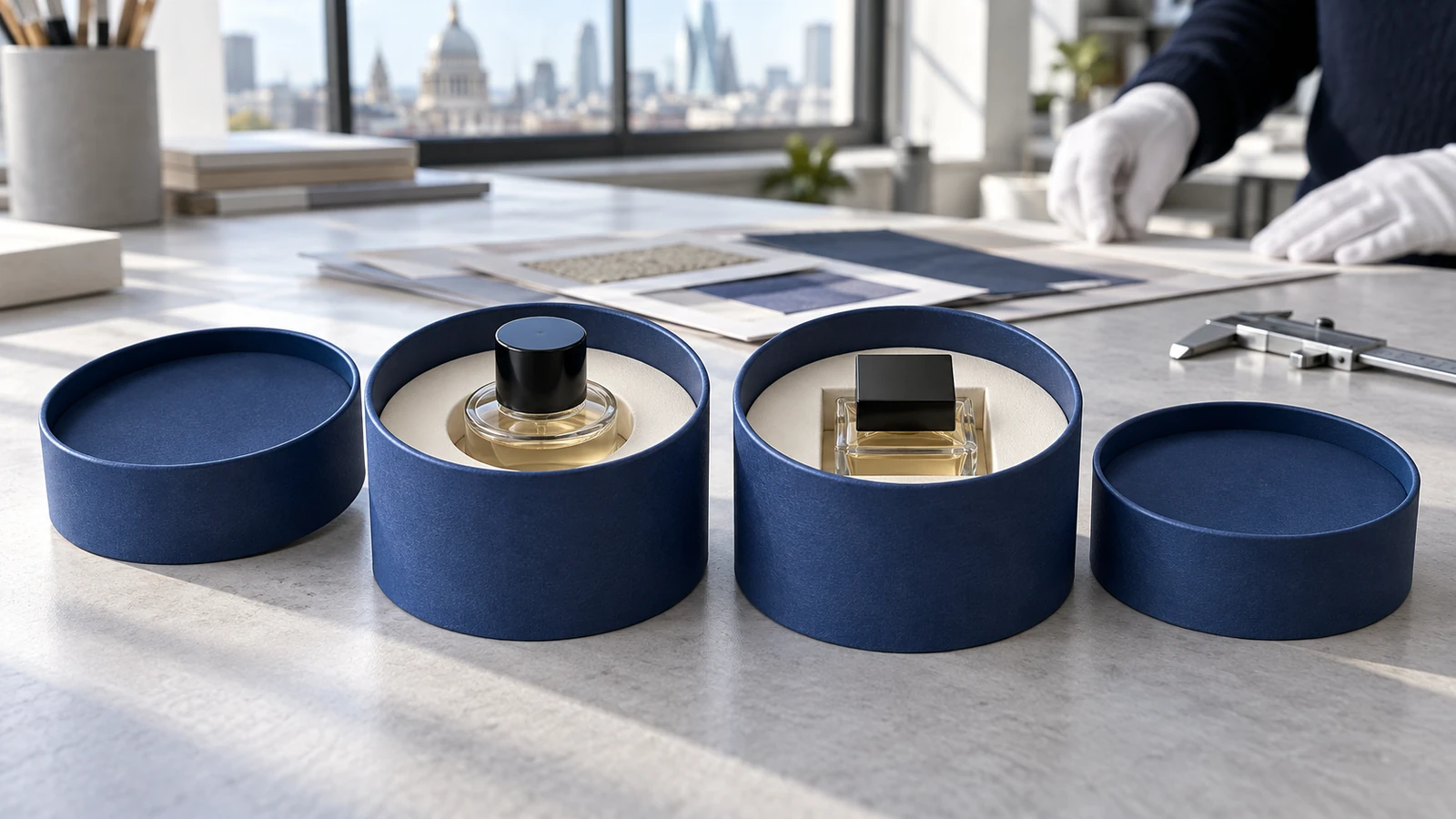
A sample that looks good with the largest bottle says little about the smallest. Review bottle platform height adjustment, exposed shoulder, label visibility and grip access for every intended combination. A raised platform should be a specified component with an assembly method; an unspecified stack of packing pieces leaves the result open to interpretation.
With custom cylinder packaging for multiple bottles, define whether you mean different bottles across separate SKUs or several products inside one gift pack. Those are different layouts. This guide addresses one bottle per tube, with structural components shared across the range.
Ask for assembled comparison samples using the intended paper and finish. Place them together under the same viewing conditions. Check lid closure, bottle orientation, access and the appearance after repeated agreed handling. Use the lid fit and unboxing approval guide for the opening review, and retain a labeled reference for each approved configuration.
A presentation check is not a shipping qualification. If bottle mass, insert geometry or the shipping arrangement differs, ask the responsible packaging specialist which configurations need assessment and whether any grouping is justified. Do not assume that approval of one SKU establishes protection for all the others.
Keep product identity separate from structural sharing
Identical outer dimensions do not make different products commercially interchangeable. A shared paper tube specification should distinguish a structural component code from the finished product identity. Control the artwork, insert and bottle association together so a visually similar component does not silently become an approved substitute.
Der GS1 GTIN Management Standard, release 1.1, separates declared net content changes from dimensional or gross-weight changes. Section 2.3 requires a new GTIN when legally required declared net content printed on the pack changes; section 2.4 sets a separate threshold for changes exceeding 20% in a physical dimension or gross weight. Keeping the tube size constant therefore does not remove product identification requirements. Have the brand’s responsible team apply the full rules and relevant market requirements.
For a paper tube SKU identification checklist, record the bottle reference, insert code, wrap revision, finished product code and destination. Use readable identifiers in addition to color cues. Before a changeover, remove the previous variant’s components from the work area and check the first assembled pack against its approved reference. These are suggested packing controls, not a claim that any particular factory already follows them.
Compare the complete component cost
Multi SKU paper tube packaging should be quoted as a component system. Ask separately about outer structures, decoration versions, Einsätze, setup, Probenahme, assembly and packing. Confirm minimum quantities and replenishment conditions for each component; a combined collection quantity does not establish a shared manufacturing minimum.
Zum Beispiel, consider an illustrative launch split of 700, 200 Und 100 units across three fragrances. A proposal for 1,000 common outer structures still needs the correct insert and artwork allocation. If every outer wrap is already fragrance-specific, the usable shared stock may be smaller than the headline total suggests. These figures explain planning logic only and are not an order recommendation or supplier offer.
Ask for the packed master-carton dimensions and actual packing quantities for each proposed architecture. Compare freight using a current shipment quotation. Include additional handling, component storage and likely obsolete stock in the commercial review. Standardizing the outer tube should be a considered choice, rather than an unsupported promise of lower cost or environmental benefit.

Release a configuration list with the purchase order
A practical release document assigns one approved configuration to every finished SKU. State which components are genuinely common, which are unique, and who can approve substitutions. Specify whether lids and bases are interchangeable within the shared format or supplied as matched sets. Carry the same references into repeat orders using the packaging reorder and version-control workflow.
Request sample review through structure and sampling development with a written list of unresolved points. Close those points before approving the collection. A drawing revision, bottle change or new insert material should trigger a review of the affected configurations instead of relying on the collection’s earlier approval.
Frequently asked questions
Can different bottle sizes use the same paper tube?
Möglicherweise, when each bottle fits the usable space and its dedicated holder delivers acceptable support, presentation and removal. Compare actual samples. A smaller bottle may need a revised platform; a wide closure or square corner may require another outer size.
Does a common tube mean one insert fits every SKU?
NEIN. The external insert interface may be shared while the bottle opening and support points differ. Approve each intended combination and define how the versions are identified during packing.
Will sharing tubes reduce the order minimum?
That depends on the supplier’s production and decoration requirements. Request minimums by structural component, insert and artwork version. Do not infer a combined minimum from matching outside dimensions.
Can one approved sample cover the whole collection?
Use a separate configuration record for every SKU. Any proposal to group performance assessments needs a technical rationale from the responsible specialist. Similar appearance alone is insufficient.
Prepare your collection brief
Send PACK Packaging a bottle-family worksheet, production samples or controlled drawings, quantity split, presentation references and distribution details. Include the intended shared components and any non-negotiable differences. Browse perfume bottle paper tube formats as structural references, then request a comparison of the three architectures above. A clear multi SKU paper tube packaging brief gives both teams a concrete basis for quoting, sampling and approving the collection.