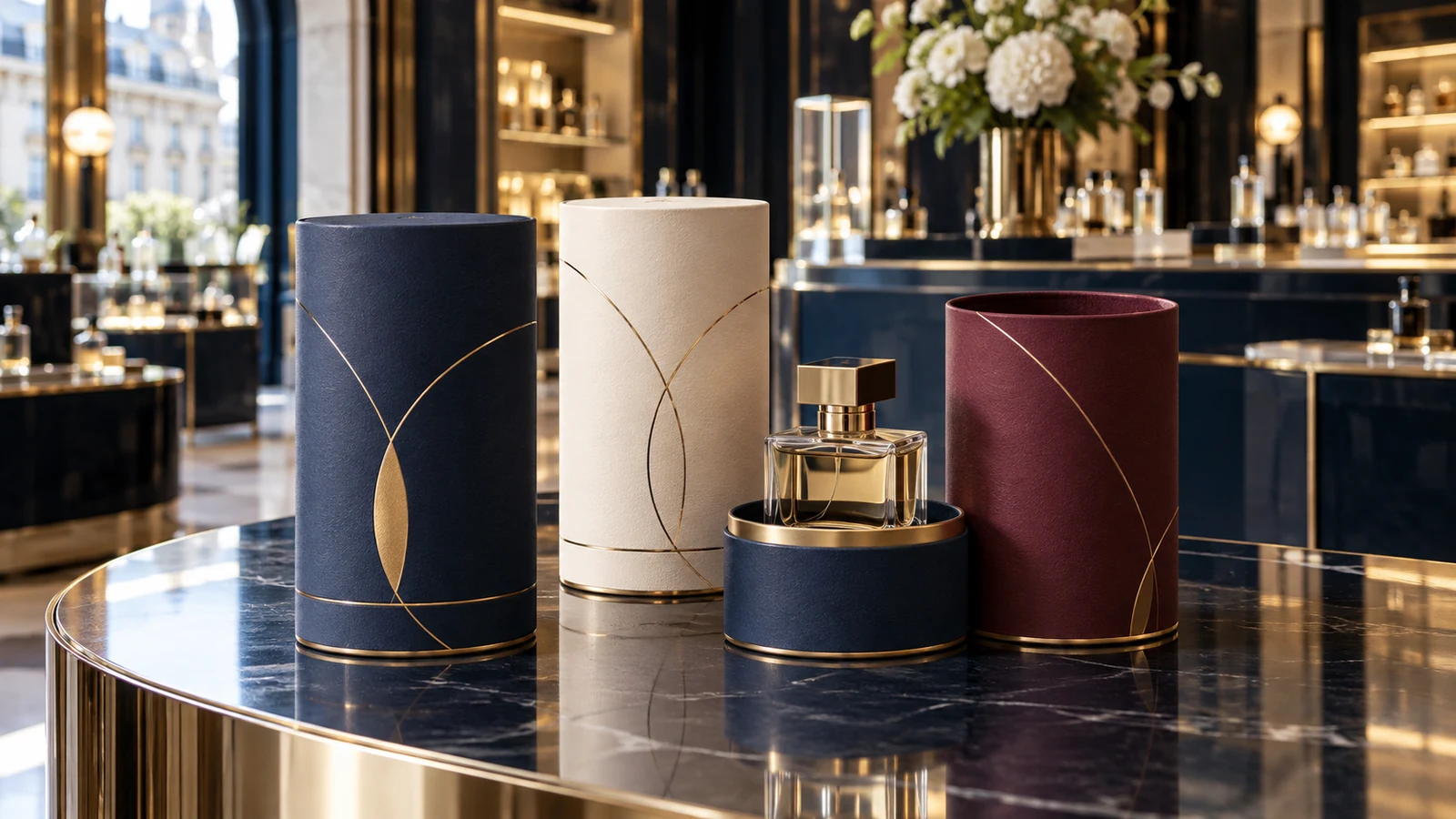
Luxury paper tube packaging can look convincing in a render and still disappoint when a buyer lifts the lid. The cap may catch halfway, drag against a decorated shoulder, or release so suddenly that the bottle becomes awkward to handle. For fragrance, skincare and premium gifting, the opening action deserves its own approval specification.
This guide focuses on removable-lid presentation tubes used as secondary packaging around a finished bottle, jar or gift. It offers a practical way to brief your supplier, compare samples and record an acceptable opening experience. The proposed checks are project recommendations, not universal industry tolerances or a claim that any particular pack has passed testing.
Specify luxury paper tube packaging around the opening sequence
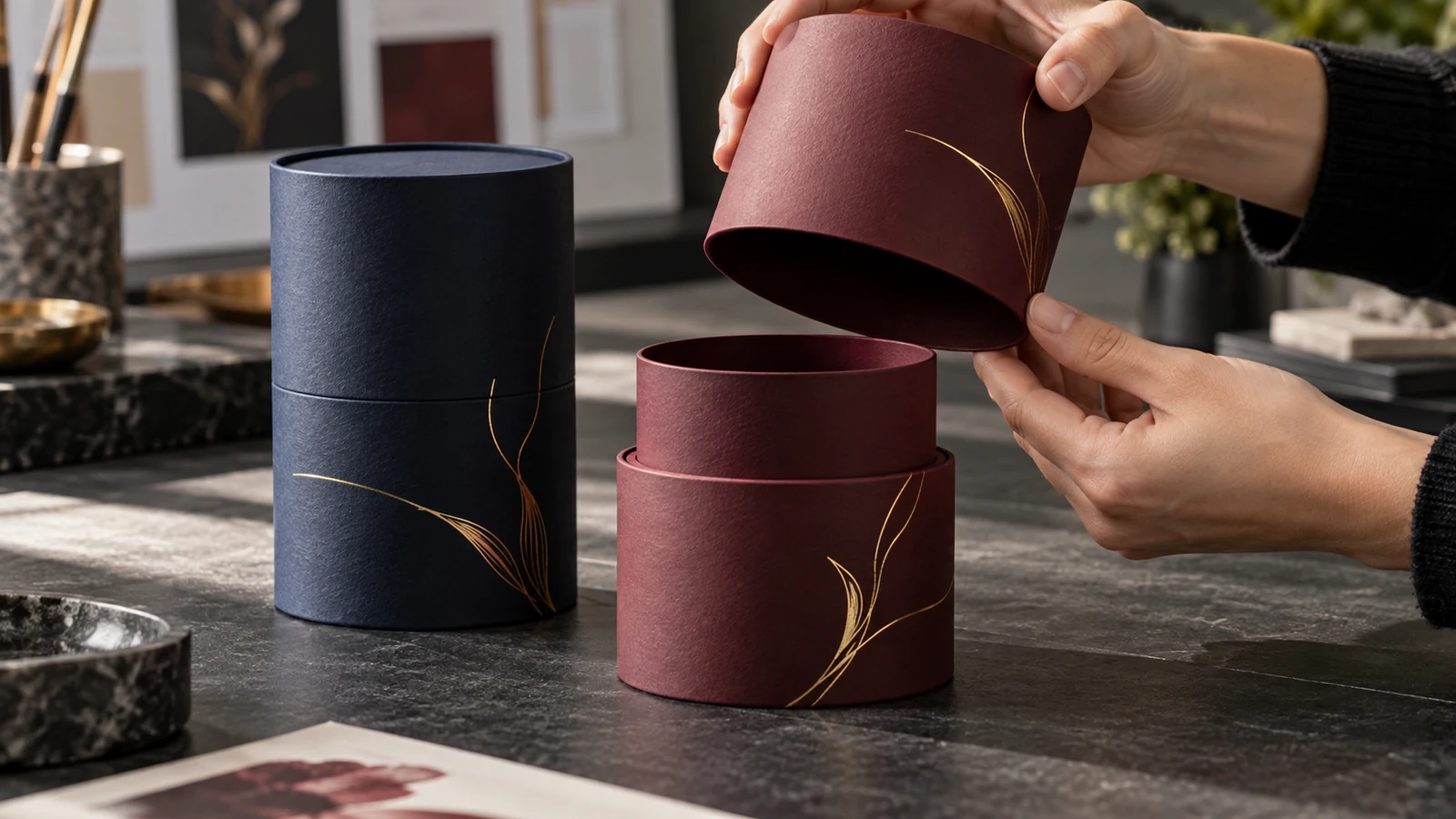
Before selecting finishes, describe what the customer should do: hold the lower body, lift the lid, see the product, then remove it without touching a vulnerable pump or label. A long lid and short base produce a different reveal from a shallow cap. Neither structure is automatically more luxurious; each needs enough accessible surface for a comfortable grip.
For custom telescopic paper tubes, ask the supplier to identify the inner shoulder, the lid overlap and the finished contact surfaces on a section drawing. A nominal outside diameter alone cannot describe how those parts interact. Review the structure alongside the product and the intended packing method through our packaging structure and sampling service.
Keep three decisions separate: how the lid opens, how the insert holds the product, and how the complete pack survives distribution. A pleasing lid action does not establish bottle protection, and a secure insert does not prove an acceptable opening experience.
Turn “premium feel” into a lid approval brief
For luxury paper tube packaging, separate the initial release from movement along the shoulder. A sample that starts smoothly may still scrape near the end of its travel. Ask reviewers to describe where an issue occurs rather than simply marking the tube “tight.”
A useful paper tube lid fit specification records the assembled construction, the direction of movement and the product condition. Include whether the assessment uses an empty tube or a filled, finished retail pack. Agree acceptable behavior before approving the decorated sample.
| Characteristic | What to observe | What to record |
|---|---|---|
| Initial release | Can the reviewer start opening with the intended grip? | Grip position, orientation and any sudden release |
| Travel along the shoulder | Does the lid move consistently, or bind at a repeatable point? | Location of catching, rubbing or visible damage |
| Seating | Does the lid return to its intended closed position? | Closed height, alignment and visible gap against the drawing |
| Product reveal | Is enough of the bottle accessible for removal? | Exposed gripping area and contact with cap, pump or label |
| Repeat use | Does opening change after the agreed handling sequence? | Number of cycles, sample identity and before/after observations |
There is no responsible universal opening-force value for every diameter, paper combination and use case. If force measurement is important, agree the fixture, pull direction, speed, conditioning and acceptance range with the supplier or laboratory. Distinguish the force needed to begin movement from resistance during travel; a number without a repeatable method is difficult to compare.
Approve finished samples through a controlled comparison
An unprinted structural sample helps establish the geometry. A decorated sample answers additional questions about the actual wrap, surface finish and contact areas. Do not approve a bare structure and assume the final specialty paper tube box will behave identically.
- Freeze the sample configuration. Identify the drawing revision, paper and wrap references, insertar, bottle, closure and artwork. Record any substituted component.
- Compare under the same conditions. Store samples together before the review and record the environment and storage period. Have the supplier or laboratory define conditioning when the project needs controlled comparison.
- Use the intended grip and orientation. Review the empty tube for structural behavior, then the filled pack for customer handling. Keep those observations separate.
- Repeat the agreed opening sequence. Choose the number of cycles for the project and note where wear first appears. A repeated handling check is not a shelf-life or transit validation.
- Retain a labeled reference set. Keep approved and unacceptable examples with photographs and written reasons. Specify whether production lids and bases must be interchangeable or supplied as matched sets.
This paper tube sample approval checklist should travel with the purchase specification. Ask how the supplier will check production against the approved behavior and what changes require resampling. The objective is a repeatable purchasing decision, rather than a promise that every sample will feel identical.
Check the finish where the lid actually travels
With foil stamped paper tubes, inspect both the visible branding and any decorated surface near the sliding interface. Ask the supplier to review whether foil, realce, a raised label or a wrap join lies in a contact area. Do not assume a visually attractive proof confirms mechanical compatibility.
For matte or textured designs, review surface appearance before and after handling. Photograph rub marks using the same lighting and viewing angle. Agree which marks are unacceptable on the selling face and which hidden contact marks, if any, are acceptable. Nuestro packaging scuff resistance approval guide explains how to document appearance criteria separately from structural fit.
Perfume bottle tube packaging also needs a removal check with the actual finished bottle. Include its cap, label and coating, plus the intended insert. For heavy glass or delicate decoration, identify the permitted support areas and provide finger access. A snug cavity that makes removal difficult can undermine an otherwise well-controlled reveal.
Separate presentation approval from shipping and barrier claims
A friction-fit presentation lid is not evidence of an airtight seal. Sonoco’s paper tube packaging overview describes different lining and closure options for different applications. The purchasing lesson is to specify the required function; the word “tube” does not establish barrier performance.
If a project contains loose tea, coffee or powder instead of a sealed perfume bottle, write a separate brief for product contact, sealing and preservation. A luxury appearance cannot substitute for the relevant material documentation and package validation. Do not transfer another manufacturer’s performance claims to your own construction.
For shipping, evaluate the filled product, insertar, tube and outer shipper together. ISTA’s design and testing guidance emphasizes understanding the actual distribution environment, using representative samples and defining damage criteria before testing. Ask the testing provider to select the appropriate current procedure. An informal opening review does not demonstrate ISTA compliance.
Use published design cases with the right attribution
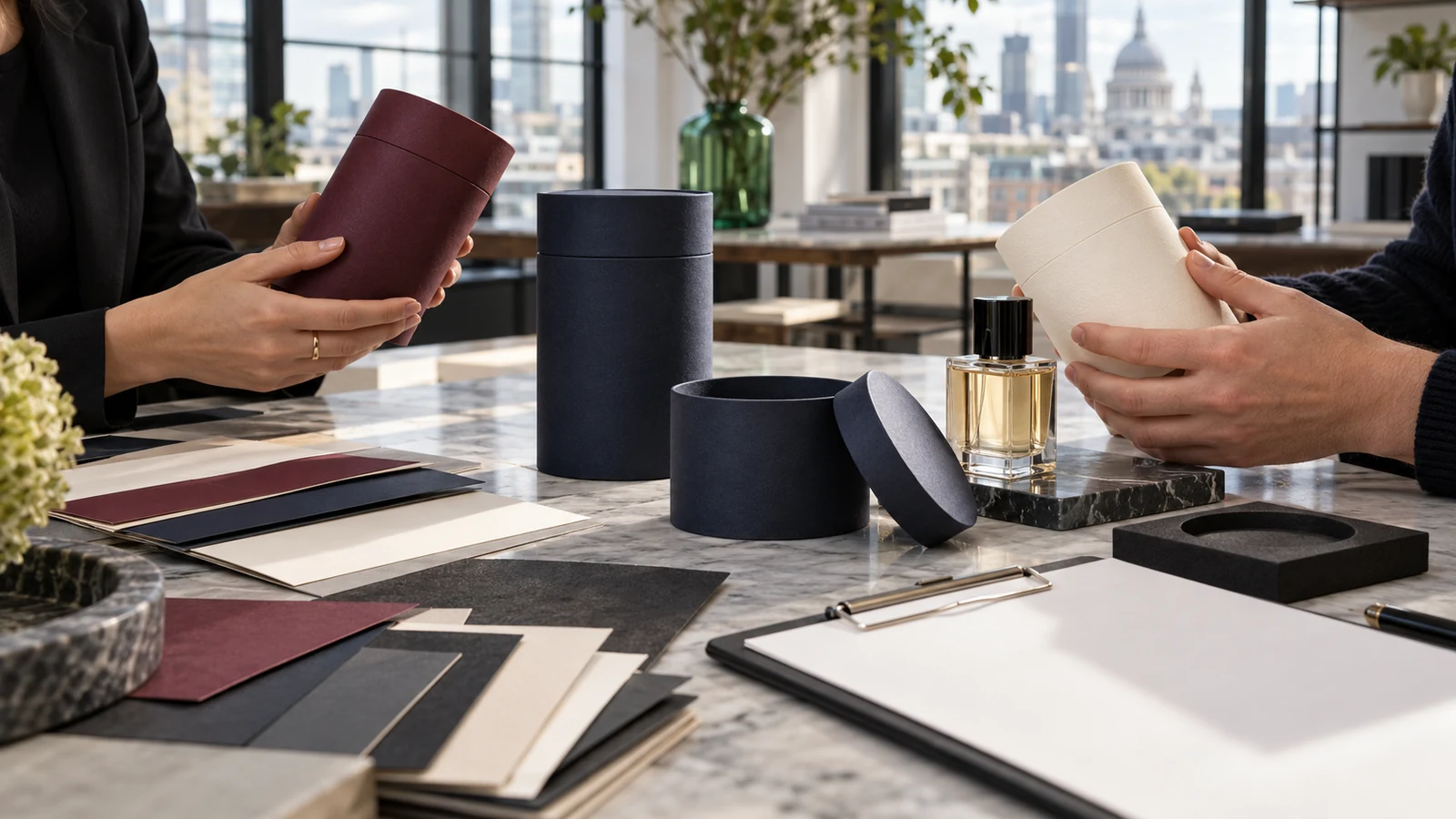
Design references can improve a luxury paper tube packaging brief when they explain a decision. In DIELINE’s A.Ok packaging feature, writer Chloe Cordover discusses Alessandra Olanow’s design for an essential oil brand, pairing a minimal graphic system with a paper tube and frosted glass bottle.
Our interpretation is that a coherent visual language gives the buyer a clearer approval target than a list of unrelated decorative effects. Translate that lesson into your own colors, hierarchy and tactile priorities. This is an external design reference, not a PACK Packaging customer project, and it supplies no evidence about your tube’s opening force or transit performance.
If responsible fiber sourcing is part of the brief, ask for the applicable claim and supporting records for the order. FSC explains chain of custody certification as a system for tracking forest-based materials through the supply chain. Do not treat an FSC claim as proof of recyclability, compostability or functional package performance.
Coordinate the tube with the rest of the packaging range
A tube may be one component of a wider launch. Compare custom round boxes and paper tubes with custom rigid gift boxes when a gift set needs several components displayed together. A custom folding carton may suit a separate refill SKU, mientras corrugated mailer boxes address the outer shipping layer.
These are different structural decisions, so specify what each layer must accomplish. For child-resistant requirements, a tightly fitted tube lid is insufficient evidence: request a separately evaluated closure system appropriate to the product and market. Keep cosmetic feel and safety requirements in different acceptance records.
What to send in a quotation request
For custom printed cylinder boxes, send the actual product dimensions and filled weight, physical samples if available, desired opening sequence, insertar requisitos, artwork and finish references. Add the order quantity, SKU split, delivery destination and intended distribution route so quotations describe comparable constructions.
Nuestro perfume bottle paper tube range provides format references. Dimensions are developed for the project rather than selected from a mandatory fixed size. Before comparing unit prices, ask what the quoted sample and production approval include, and how proposed substitutions will be controlled.
Frequently asked questions
Does a tighter lid make a paper tube more luxurious?
No necesariamente. The buyer should be able to grip, open and reseat the lid as intended without awkward force or damage. Approve a defined behavior with the finished product instead of assuming maximum tightness is desirable.
Should we specify opening force in newtons?
Use a force requirement when it supports a real purchasing decision and the parties can reproduce the method. Agree the equipment, fixture, speed and sample condition before setting a project-specific range.
Can a white sample replace a decorated approval sample?
It can support structural development, but it does not show the final wrap, impresión, foil or finish. Review the finished construction before releasing production, especially where decorated surfaces contact moving parts.
Can one tube size fit every bottle in a fragrance collection?
Only after evaluating each bottle and insert combination. Check caps, etiquetas, peso lleno, removal access and the intended reveal. Sharing an outside format does not establish that the internal fit is suitable.
Does an opening check replace shipping testing?
No. Opening checks assess handling and presentation. Distribution testing assesses the product-package system against selected hazards. Define separate acceptance criteria and retain separate records.
What should change when we reorder?
Carry forward the controlled specification and approved references. Review changes to the bottle, insertar, papel, finish or construction before accepting them; decide whether new sampling or testing is needed.
Build a sample brief buyers can approve
For luxury paper tube packaging, start with the opening sequence and the finished product, then connect structure, decoration and distribution requirements. Send PACK Packaging your product details and design priorities to discuss a sample brief with written approval points. A clear brief makes the quotation more useful and gives both teams a shared basis for reviewing production.