Saltar al contenido

When a square fragrance bottle goes into a round presentation tube, its corners can catch at the mouth even though the side width looks small enough. The bottle may also fit through the opening yet turn in its holder or sit too low to grasp. Specifying paper tube packaging for square bottles starts with three separate checks: the opening the bottle passes through, the pocket that locates it, and the space the customer needs to lift it out.
This guide covers secondary presentation packaging for capped fragrance bottles. It offers a buying and sample review method, with illustrative dimensions and no universal fit allowance or shipping performance claim.

Measure the bottle that will actually be packed
Request the current bottle drawing and a representative assembled sample with the intended cap, label and any decorative sleeve. Record which face should be visible when the tube is opened. Note the base profile, hombro, corner treatment and protrusions at each height. Two bottles with the same fill capacity can need very different openings and support pockets.
Por ejemplo, Verescence describes its Cubic bottle as square with beveled edges and its Priam bottle as square with sharper edges. The catalogue illustrates why the word “square” alone is insufficient. These are independent catalogue examples, not PACK Packaging projects, and the drawings and dimensions for your actual components should guide approval.
Write a square perfume bottle packaging brief with a fixed reference face and measurement heights. Ask the bottle supplier which dimensions are controlled and whether decoration changes the envelope. Measure the finished cap separately, especially when it overhangs the shoulder. Photograph the sample in the same orientation used on the drawing so that everyone can identify the side, front and top.
Use the diagonal to screen a proposed tube opening
For a sharp rectangular profile entering a circular opening straight along its axis, the diagonal of the enclosing rectangle is a useful first check. Calculate the square root of the sum of width squared and depth squared. A hypothetical 48 by 40 mm profile has a diagonal of about 62.5 milímetros. A 58 mm round opening would therefore fail this idealized sharp corner check, even though both individual side dimensions are less than 58 milímetros.
A 63 mm opening would not automatically be ready to order. That figure leaves only about half a millimeter of nominal diameter difference in the idealized example, before allowing for bottle variation, an inner sleeve or the insertion path. Beveled corners may reduce the actual enclosing circle, but the two side dimensions alone do not quantify that reduction. Use the verified outline or physical sample and agree a realistic allowance with the supplier.
When reviewing paper tube packaging for square bottles, ask for the round tube opening diameter at the narrowest point along the insertion path. The decorative outside diameter cannot answer that question. Check the finished mouth, any rolled rim or sleeve, and the opening of each insert. A wider tube body below a narrow entrance will not solve a restriction at the entrance.
Browse the cajas redondas personalizadas y tubos de papel for construction options, then ask for a project drawing with the usable opening shown separately from the external dimensions.

Separate the entrance from the insert pocket
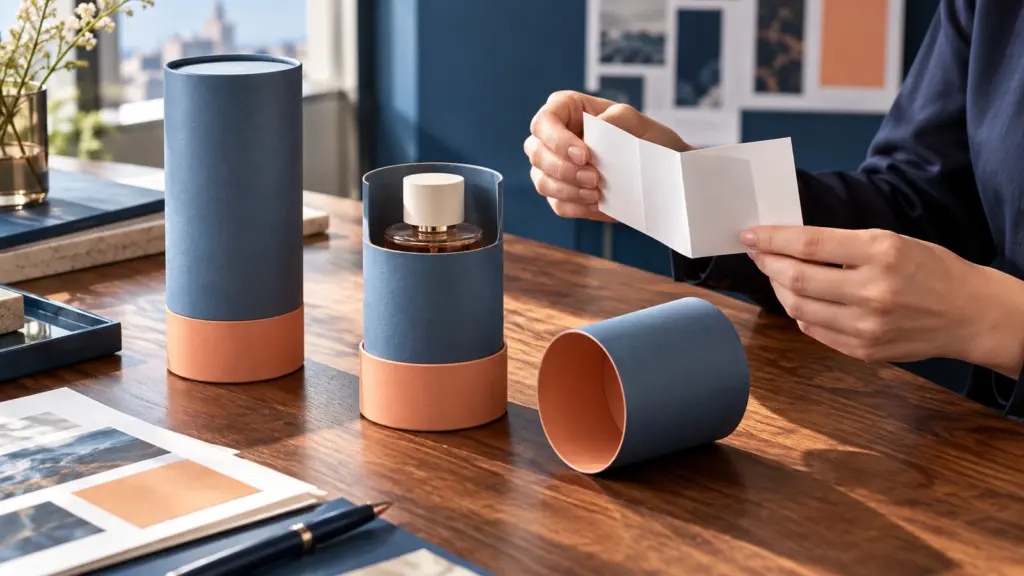
A square bottle insert can locate the lower body inside a circular shell. Ask the supplier to show which portions of the bottle the pocket supports and which areas remain clear. A shaped pocket may limit unwanted turning, while a circular holder may allow the front label to drift from the intended viewing direction. The actual outcome depends on the complete sample and its fit.
Review the corner clearance in a paper tube at the same heights where the insert contacts the bottle. Inspect whether a corner wedges into an insert transition before the base reaches its intended seat. If the bottle stops early, first identify the contact point. Enlarging the whole pocket could introduce movement without removing an obstruction at the entry.
Check the insert against the glass and the decorative surface. If the front face is intended to remain untouched, mark that area on the drawing and identify alternative support zones. A buyer can use the paper tube insert overview to compare concepts, then record the selected contact zones on the approved drawing rather than assuming a catalogue option meets the brief.
Review the bottle removal path with a finished sample
Put the assembled bottle into the holder from the orientation planned for production. Open the tube as a buyer would and check where fingers can grip. Try lifting the bottle by the intended body area and note whether it needs an awkward tilt or a second hand to free a corner. Do not assume the cap is a suitable lifting point; confirm the intended handling with the component supplier and the brand team.
If a finger recess is needed, show it on the insert drawing and check that it does not expose a sharp contact edge. Decide how much of the bottle should sit above the insert for access and how much room remains under the closed lid. El pump protection and clearance guide covers the separate issue of keeping the closure free of unwanted contact.
The purpose of this paper tube packaging for square bottles review is to see whether the same sample passes through the opening, seats fully, faces the right way and lifts out as intended. Record each observation independently. A sample can pass one check and still need changes elsewhere.

Put four decisions on the approval sheet
| Decision | Reference to record | What to observe |
|---|---|---|
| Entry fit | Assembled bottle revision and narrowest opening | Passes in the planned orientation without corner interference |
| Seat and orientation | Insert drawing and intended front face | Base reaches its seat and label faces the intended direction |
| Removal | Grip area and removal sequence | Customer can grasp and lift without an unintended contact point |
| Closed condition | Finished tube, lid and bottle assembly | Lid closes as intended, with the agreed clearance at the cap |
For paper tube packaging for square bottles, keep the signed drawing and the corresponding physical sample together. Record the bottle, tapa, insert and sleeve revisions, which samples were checked, and who can approve a change. If a glass mold, cap or insert pocket changes, revisit the affected checks before relying on the earlier sample. A bench approval establishes the observed fit and handling of the sample; distribution protection requires separate evaluation for the packed product and intended route.
Discuss the physical review with the structure and sampling team. El perfume paper tube collection shows presentation formats. A photo cannot verify fit for a specific bottle, so bring the drawing and sample to the discussion.
Preguntas frecuentes
Can I size a round tube from the bottle width alone?
No. Check the actual corner envelope, the widest part of the assembled bottle and the narrowest opening. Use the diagonal as a screen for a sharp rectangular profile and confirm the result on a physical sample.
Does a beveled bottle always need a smaller tube?
No necesariamente. The bevel changes one cross section, but the cap, shoulder or decoration could control the opening. Check every relevant section of the assembled bottle.
Can we reuse the same insert for another square bottle?
Only after reviewing the second bottle and its intended support, orientation and removal. Similar external dimensions do not establish that the base contour or decoration is compatible.
Send your bottle envelope and sample brief
To develop paper tube packaging for square bottles with PACK Packaging, send your assembled bottle drawing or sample, target presentation, cantidad y destino. Mark the front face, prohibited contact areas and intended removal sequence. Those details help define the custom tube and insert sample before you approve the production configuration.