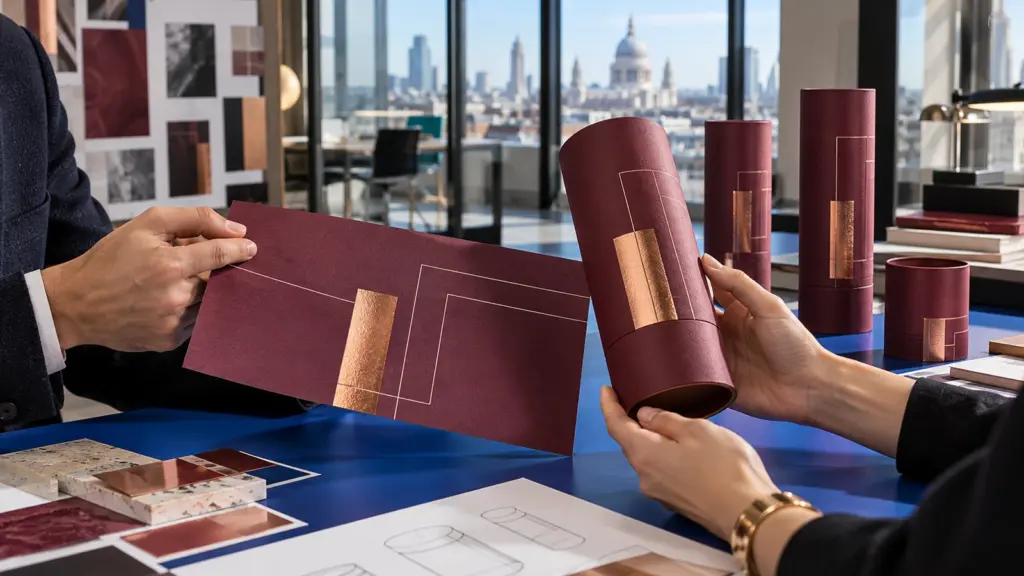
A foil border can look perfectly centered in a design file yet appear uneven beside printed lettering on the finished cylinder. For a premium fragrance launch, paper tube foil registration should therefore become an approval question before the purchase order is released. The buyer needs an agreed reference for the relationship between decorative layers, not simply a request for “luxury gold printing.”
This guide addresses removable-lid paper tubes used as secondary presentation packaging for sealed perfume and skincare containers. It proposes a practical purchasing workflow for artwork review, samples and production handoff. The suggested checklist is a project planning tool, not an industry test method or a universal tolerance standard.
Separate three relationships in the decoration brief
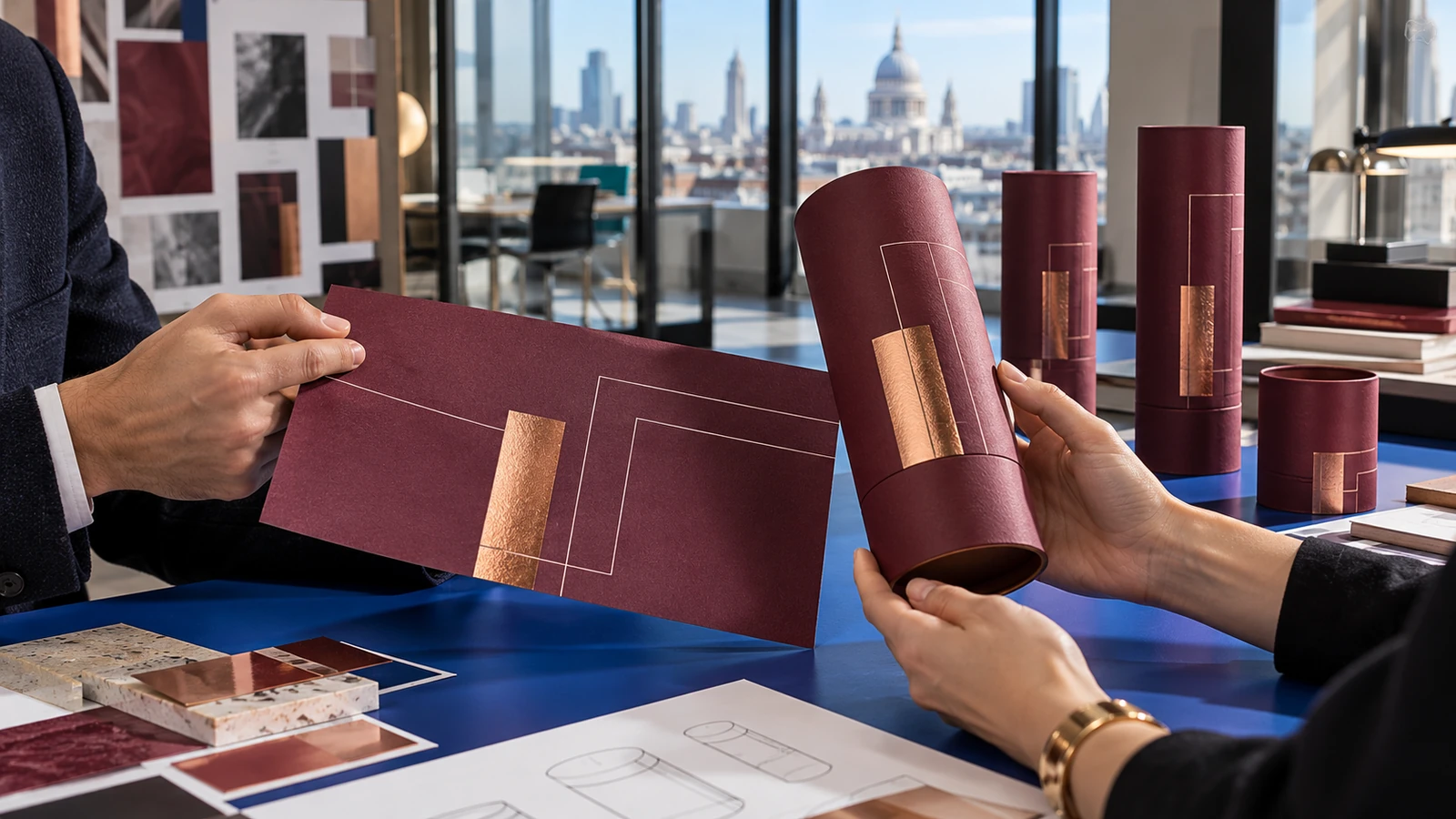
첫 번째, define foil-to-print registration: the position of a stamped detail relative to an inked image on the same wrap. 두번째, identify foil-to-emboss alignment if a raised feature is part of the design. 제삼, review the decoration on the assembled cylinder. These relationships need separate references because approving one does not automatically approve the others.
예를 들어, a copper rectangle might be correctly aligned to a printed panel on a flat sheet while the completed tube presents that panel away from its intended front. 거꾸로, the front panel can be correctly positioned while the rectangle sits unevenly beside the printed name. Record the actual disagreement rather than grouping both issues under “bad alignment.”
Start with the custom paper tube and round box collection to identify the structure. Specify which component carries the critical artwork: long lid, short base or a visible inner sleeve. Do not use a logo on a freely rotating lid as an unqualified measurement reference for another component.
Ask the stamping supplier to review the actual artwork
A paper tube foil registration brief should include the production artwork, intended wrap stock, printed layers, proposed finish and actual size. Highlight the details that must align closely. A decorative line beside a printed border deserves explicit discussion even when both look straightforward on a screen.
Kluge’s primary design guidance advises consulting the stamping supplier for production specifications where close alignment involves print, foil or coatings. It also distinguishes this work from conventional offset trapping. The purchasing implication is to request a process-specific file review rather than applying a familiar print setting without confirmation.
Keep a separate foil artwork layer that the supplier can identify, and ask it to confirm the required delivery format, scale and reference marks. Have the artwork owner resolve discrepancies between the visible proof and production files. A supplier should not have to infer which of several similar versions carries the approved border.
그만큼 overview of luxury packaging finishing can help buyers compare decorative options. This approval stage goes further: select the exact relationship to be inspected, the intended production route and the sample needed to demonstrate it. Choosing a process name alone does not complete those decisions.
Approve a material combination, not a foil color name
For hot foil paper tube artwork, identify the wrap paper, its surface, any printing or coating beneath the foil, and the proposed foil reference. Ask the supplier which of those inputs the sample represents. If a smooth proof stock is substituted for the intended textured wrap, record the sample as provisional.
Foilco’s design education explains that foil grades use adhesives suited to different applications and emphasizes matching foil and substrate. It also describes dies as physical tools that transfer the selected decoration. These points support evaluating the specified combination; they do not establish that every foil grade will perform on every paper.
A foil grade and substrate sample is useful when several papers are under consideration. Put each combination under a distinct reference and ask for the supplier’s assessment. Keep the accepted choice in the specification. A color swatch alone should not silently authorize a change of paper surface, foil grade or decoration sequence.
Ask separately about fine reversed details, small spaces and large solid areas. Request a representative sample of the demanding features instead of only the easiest logo. Any numerical line or spacing limits should come from the selected supplier’s assessment for this job; do not copy a value from unrelated packaging and call it a universal rule.
Use flat and assembled references for different decisions
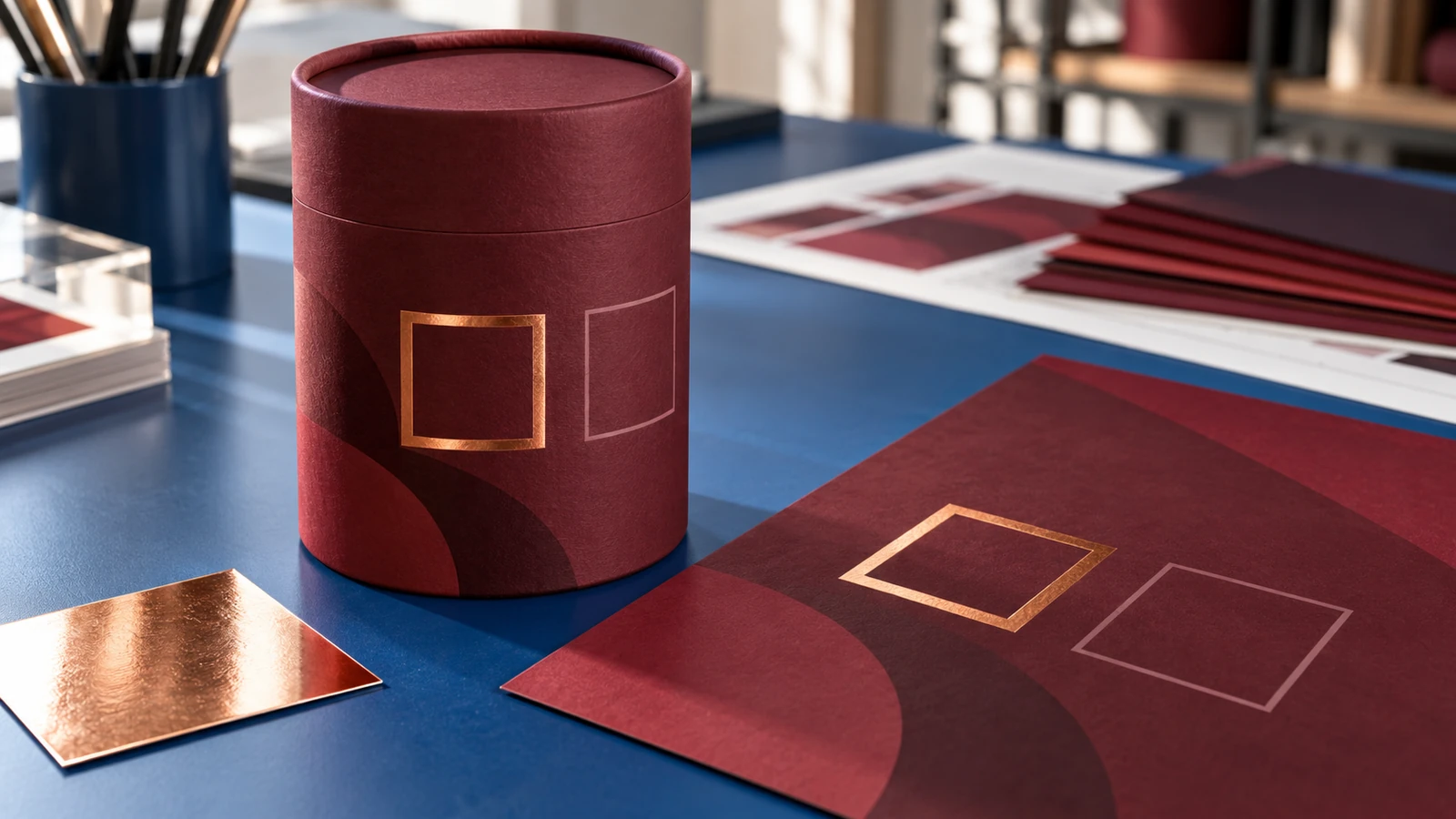
Review paper tube foil registration first on an identifiable decorated wrap and then on an assembled sample representing the proposed construction. The flat reference makes the relationships between layers easier to discuss. The assembled reference shows the result in the form the buyer will actually handle.
For a finished cylinder foil inspection, agree how the sample will be viewed. Record the intended front, the orientation of the component being assessed and the lighting arrangement used for approval. Turn the cylinder to inspect the complete decorative area. These are recommended comparison conditions, not a prescribed standardized inspection environment.
Ask reviewers to distinguish an actual displacement from a change in highlight as the reflective surface turns. If a disputed feature is difficult to document, take a clear contextual photograph and a close view tied to the same sample identifier. Photographs help explain the concern but should not replace the physical reference when appearance remains disputed.
우리의 paper tube seam placement guide addresses the location of the wrap join. Use it for that separate question. In the present record, focus on the relationship between the decorative layers and the finished appearance; the two approvals can share a sample without becoming the same decision.
Build a short acceptance record before production
A foil-to-print alignment approval needs a clear subject, reference and decision owner. The following fields are a proposed purchase-project record. Agree any measured limits, sample quantities and escalation rules with the supplier and brand team before production release.
| Record field | What to identify | Question it resolves |
|---|---|---|
| Critical relationship | Named foil feature and printed or embossed reference | Which two elements are being compared? |
| Material and file revision | Wrap, 마치다, foil reference, artwork and component | What combination does approval cover? |
| Physical reference | Identified flat sample and assembled cylinder | What should production and receiving compare? |
| Acceptance boundary | Agreed limits and examples, with reviewer responsibility | When does variation require a decision? |
| Change control | Inputs that require renewed review | What cannot be substituted silently? |
Keep registration, foil coverage and surface condition as separate observations. A sample can align correctly but have missing decoration, or show complete coverage with the wrong position. Avoid allowing one attractive feature to obscure another unresolved requirement. The final disposition should name the issue it accepts or rejects.
A paper tube foil registration record should also state whether the approval is provisional or production release. An attractive development sample can settle the design direction while leaving the final stock or process unconfirmed. Mark those open points visibly so a project coordinator cannot mistake an early presentation approval for completed manufacturing approval.

Handle an approval disagreement without losing traceability
Consider an illustrative copper foil paper tube design with an oxblood wrap, a pale printed panel and a copper border. The assembled sample looks acceptable to the designer, but procurement sees an unequal gap on one side. Identify the sample and the exact pair of features, then compare it with the agreed reference. Do not resolve the concern by circulating differently cropped photographs.
If a design revision is proposed, show what changed and request a revised sample appropriate to that change. A wider gap might alter the design intent; it should not be accepted automatically merely because it appears easier to produce. The brand owner should approve the visual decision and the supplier should confirm the production specification.
Use the structural sampling discussion to coordinate the physical sample needed for the review. Retain accepted samples and revision identifiers for later receiving checks. Reorders should reference the approved construction and artwork rather than an old email that says only “same copper finish.”
For presentation ideas, the perfume bottle paper tube range provides relevant examples. Treat those images as design references. They do not establish measured registration, a particular foil supplier, or test results for your proposed project.
Frequently asked questions
Can a digital proof approve the finished foil appearance?
It can establish content and intended placement. Ask for an appropriate physical reference to evaluate the actual paper, reflective finish and assembled presentation before treating visual approval as complete.
Should every detail have the same registration requirement?
Identify the critical relationships separately. A free-standing decorative mark and a border closely following printed artwork create different approval questions. Agree requirements for the actual features rather than assigning an unexplained blanket limit.
Does changing foil color leave the approval valid?
Ask the supplier to identify whether the proposed change also affects grade or process, and let the brand review the appearance. Record the decision and evidence needed; do not assume equivalence from a similar color name.
Is a photograph sufficient for a disputed production sample?
It can document where to look. Keep the identified physical sample available when reflections, viewing angle or small positional differences prevent a reliable decision from the photograph alone.
Send a decoration brief that can be approved
For paper tube foil registration planning, send PACK Packaging the component drawing, actual-size artwork, desired paper and finish references, critical decorative relationships and intended presentation. Include the physical approval route and decision owner. We can discuss custom structure and sampling requirements so the purchasing file records what must be confirmed before production release.