Skip to content
Custom advent calendar boxes turn a collection of products into a coordinated gifting experience. For procurement teams, however, the main challenge is keeping the entire set accurate: every product must fit its assigned compartment, every drawer needs the correct artwork, and the packed calendar must reach the launch location ready for sale.
Start with a complete product map before requesting a decorative mockup. This guide explains how to specify a multi-compartment calendar, compare supplier quotations and approve an assembly process that your packing team can actually follow.
What Are Custom Advent Calendar Boxes?
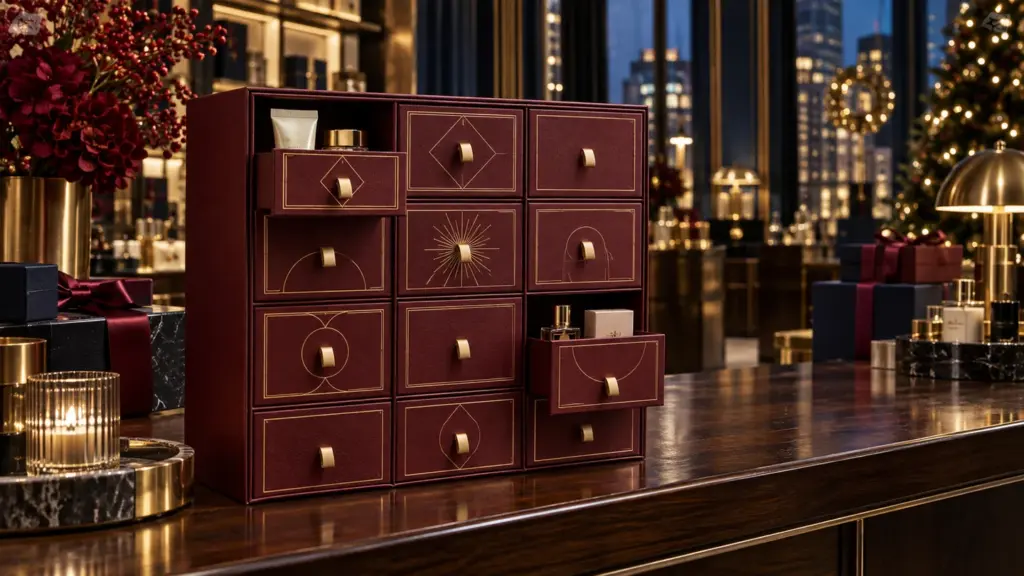
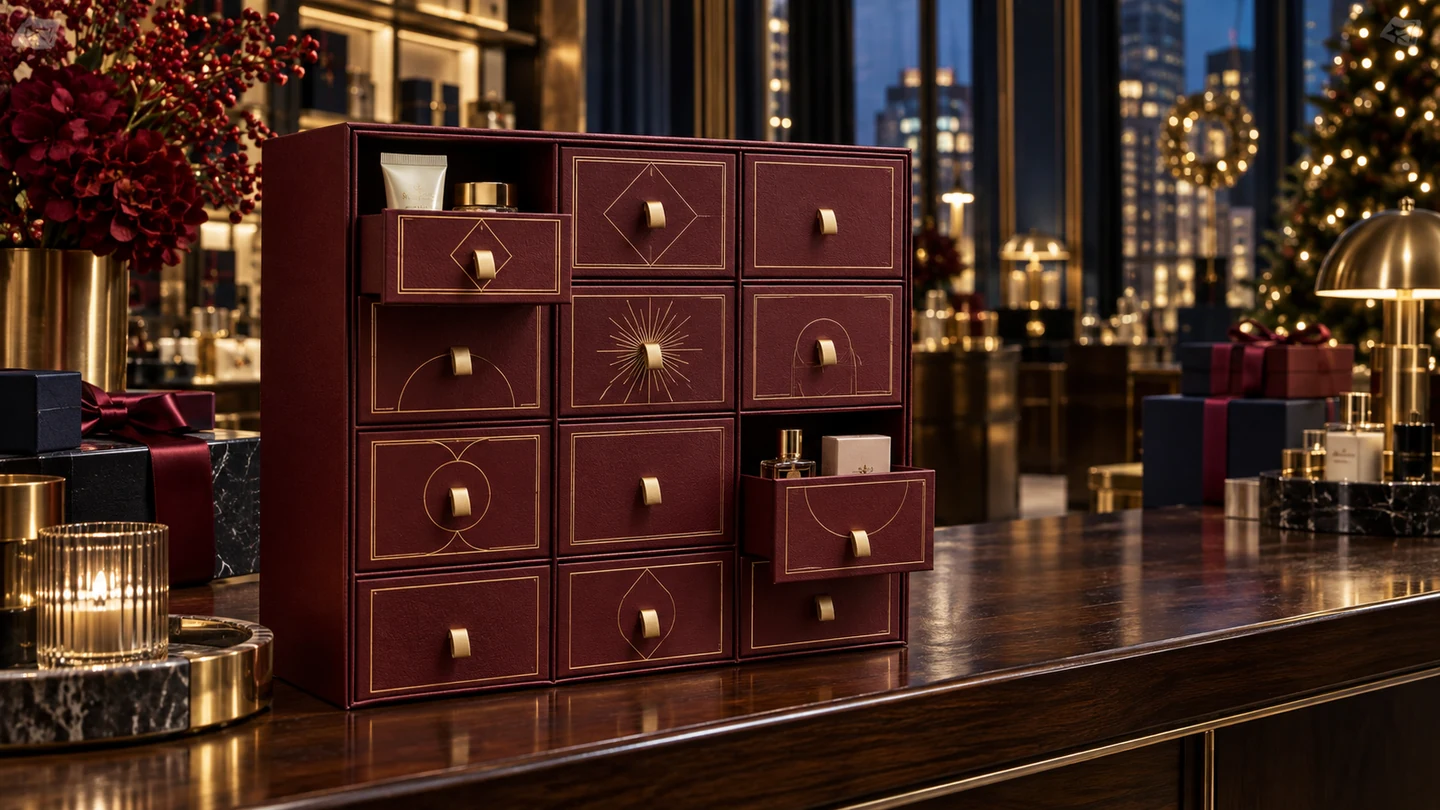
An advent calendar package divides an assortment into separately accessed compartments. A brand can use drawers, small folding cartons or opening panels to create a sequence of product discoveries. The compartment count should follow the campaign and assortment, rather than force products into a layout chosen only for appearance.
For example, a beauty brand might combine miniature jars, boxed accessories and sealed sample products. Each item brings a different footprint, orientation and packing requirement. The outer case gives these components a shared presentation, but it does not remove the need to specify each component individually.
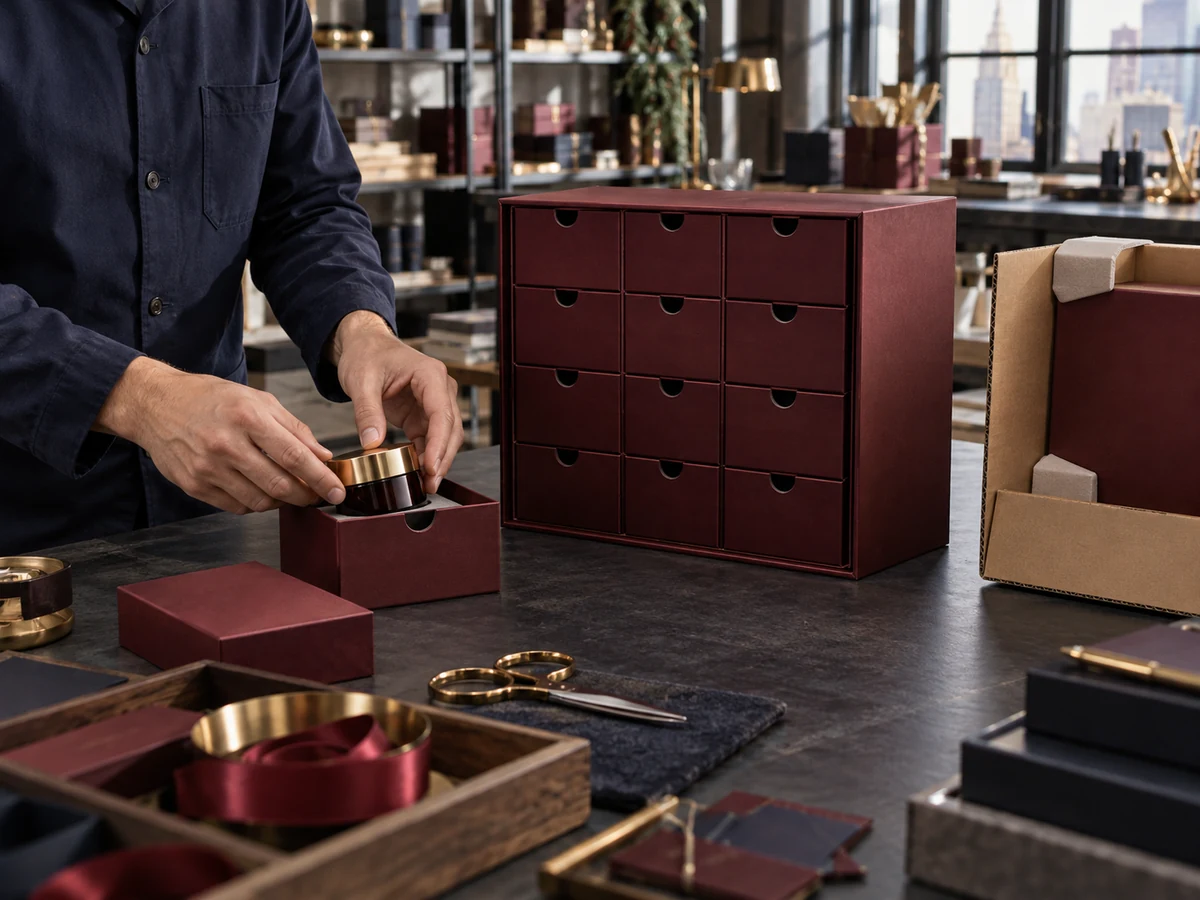
Our multi-drawer advent calendar gift boxes provide a relevant starting point for discussing a cabinet-style construction.
Why the Complete Set Matters for Brands
A missing item can undermine a calendar even when the outer packaging looks excellent. Likewise, a correct assortment placed in the wrong sequence can conflict with campaign messages or product instructions. Treat assortment accuracy as a purchasing requirement alongside print quality.
Define who owns the product list, who approves artwork and who performs final packing. If several suppliers deliver products to a separate assembly location, nominate one person to control revisions. A clear responsibility list helps prevent an outdated product dimension from reaching the packaging factory.
Build a Product-to-Compartment Map
Create one controlled spreadsheet with a row for every position. Include the product SKU, actual packed dimensions, filled weight, preferred orientation, compartment reference, insert reference and artwork revision. Record whether the product arrives in its own retail carton or needs additional support.
Then identify any positions that share the same drawer and insert. Common components may simplify ordering and replenishment, but check every assigned product before approving that common design. Similar-looking jars can have different lids or shoulder shapes.
Keep customer-facing day numbers separate from factory component codes. This allows the packing team to identify a drawer even when its decorative number is hidden. If an item changes, review the affected compartment, insert, artwork and packing instruction together.

Materials and Packaging Structures
A rigid case with wrapped drawers can suit a keepsake presentation. Alternatively, smaller folding cartons arranged inside a supporting case can create individually accessible compartments. Opening-panel designs offer another experience, but their opening action needs careful evaluation with the intended products.
Compare these options against product weight, display orientation and assembly requirements. Review rigid box construction options when the campaign calls for a substantial outer case. Ask the supplier to explain the proposed board, wrap, partitions and joining method rather than quoting only an overall material thickness.
Paperboard inserts, folded dividers and other cushioning options should support specific items. Discuss suitable packaging inserts and accessories with physical product samples. A material name alone does not demonstrate that an insert will hold a bottle securely or release it comfortably.
Printing, Finishing and Artwork Control
A calendar has many visible surfaces, so supply an artwork index that matches the compartment map. Identify drawer fronts, side panels, outer doors, inside messages and any separate product cards. Mark orientation clearly; a correct file can still become an upside-down drawer front.
Use a proof showing the complete assembled arrangement as well as individual component files. This is especially useful when a pattern continues across several drawers. Ask which visual alignments the manufacturer can control and agree on acceptable results using a physical sample.
Foil, embossing and printed detail can create different effects. Evaluate the chosen finish on the proposed wrap material, including corners and frequently handled areas. Keep essential identification readable instead of relying entirely on subtle decorative effects.
Applications and Customization Choices
Beauty assortments, jewelry collections and promotional gift sets can all use calendar formats, but their handling requirements differ. Jewelry may need controlled presentation within a small compartment; miniature cosmetic containers may need support that keeps their closures accessible.
For consumable products, distinguish the decorative calendar from the product’s primary packaging. Tell the supplier whether any component will contact the contents. Do not treat a decorative paper wrap as evidence of suitability for direct contact.
Review the broader gift packaging range alongside your campaign brief. Customize the opening sequence, drawer arrangement, printed messages and outer presentation only after confirming the assortment and intended packing workflow.
Cost Factors: Compare a Complete Calendar
Request a quotation for one complete, sale-ready packaging set. Specify whether it includes the case, all drawers, inserts, printed cards, assembly and protective packing. A low case price is difficult to compare with another supplier’s fully assembled offer.
Ask suppliers to separate one-time development or tooling charges from recurring production costs. Also identify special materials, multiple artwork versions, hand assembly and inspection work. Request the proposed delivery configuration and packed dimensions so your logistics team can compare storage and freight implications.
Evaluate simplification options individually. Standardizing drawer sizes may help production, while replacing several inserts with one universal design may create unnecessary empty space. Ask for samples and revised quotations before accepting a change as a saving.
MOQ: Clarify the Unit Behind the Number
There is no universal minimum order quantity for this category. A supplier’s minimum may refer to complete calendars, a particular printed component, a wrap material or an insert design. Ask which minimum applies to every unique part of your set.
For multiple language editions or regional assortments, identify shared components and version-specific pieces. Confirm how these versions affect the order quantity and whether spare drawers or inserts can be supplied separately. Document any agreed overage and how it will be allocated between components.
Sampling, Packing and Launch Planning
Approve a structural sample with representative products before finalizing decoration. Next, review a complete decorated calendar and a packing trial using the current compartment map. Our structure and sampling process can support this discussion.
During the trial, check product identity, position, opening access and the finished set’s stability. Include the protective outer shipping pack in the review; the retail calendar and its transport packaging have different jobs. Agree on verification appropriate to the actual distribution route.
Work backward from the required arrival date through packing, transport, production, sample approval and product availability. Ask the supplier to confirm this sequence against current capacity. Do not assume a standard lead-time statement includes artwork changes, delayed product samples or third-party assembly.
Sustainability and Supplier Selection
Assess the full material list, including finishes, adhesives, inserts and accessories. Ask which components can be separated and what disposal information is supportable in your destination market. Avoid broad recycling claims based only on the visible paper exterior.
If reuse is part of the campaign, specify the expected use and evaluate the opening mechanism accordingly. A keepsake appearance alone does not establish durability or a lower environmental impact.
Choose a manufacturer that can discuss component control, version management and packing responsibilities with the same clarity as appearance. Request an itemized proposal, a sample approval record and an agreed method for reporting shortages or assembly errors.
FAQ
What should I send when requesting custom advent calendar boxes?
Send the assortment list, compartment count, product samples or confirmed dimensions, artwork scope, order quantity, destination and required arrival date. Identify who will pack the products and whether you need an assembled or unassembled delivery.
Can different products use identical drawers?
Sometimes, but validate every product inside the proposed drawer and insert. Shared external dimensions do not guarantee suitable support, opening access or presentation for every item.
Should the packaging supplier also assemble the calendars?
Compare responsibilities, product availability and logistics before deciding. Wherever assembly happens, provide the same approved product map, component references and finished-set checklist.
How can buyers reduce avoidable revisions?
Freeze the assortment and confirm product dimensions before detailed artwork approval. Maintain one revision register and require a review whenever a product, insert or compartment assignment changes.
Request a Complete Advent Calendar Proposal
Prepare your product-to-compartment map and share it with PK alongside your branding, quantity and launch requirements. Ask for a coordinated proposal covering structure, individual components, decoration, packing scope and sample approvals. That gives your purchasing team a practical basis for comparing offers and moving the complete calendar toward production.