Skip to content

Selecting the right folding carton structure is an engineering decision that directly impacts product safety, operational costs, and profit margins. A choice based on aesthetics over structural integrity leads to damaged goods from transit stress, slow packing lines due to machine incompatibility, and increased freight expenses, creating financial liabilities across the supply chain.
This analysis provides a framework for choosing a carton based on key performance metrics. We evaluate how product weight, such as items over 500g, dictates the need for lock-bottom styles over standard tuck ends, and how board caliper and grain direction provide the necessary compression strength to prevent failures from the warehouse to the retail shelf.
How Do You Choose a Folding Carton Structure?
Selecting the right folding carton structure requires balancing product weight, retail display needs, filling process efficiency, and supply chain stress to prevent damage and control costs.
Picking a folding carton structure is a critical engineering decision that directly impacts product safety, brand perception, and operational costs. A poor choice can lead to damaged goods from transit stress, slow packing lines, or a product that looks cheap on the shelf. The right structure is a calculated balance of four key areas: the product itself, its retail environment, your packing process, and its journey through the supply chain.
| Factor | Key Considerations |
|---|---|
| Product Characteristics | Dimensions, weight, fragility, and shape. Weight is a primary guide for bottom style selection. |
| Retail & Use Case | How it’s displayed (shelf, peg hook), how consumers interact with it, and where branding must be placed. |
| Packaging Process | Manual vs. automated filling lines. The structure must match equipment capabilities and speed requirements. |
| Supply Chain & Logistics | Stacking strength for warehousing, and resistance to shock, vibration, and temperature changes during shipping. |
Evaluate Product Characteristics and Weight
Everything starts with the product. Before you can choose a style, you need hard data. A structure designed for a lightweight cosmetic powder will fail if used for a heavy glass jar. This initial analysis defines the non-negotiable physical constraints for your carton.
- Get exact measurements. Document the product’s precise length, width, height, weight, and shape. This data forms the baseline for the internal dimensions of the carton.
- Assess fragility. Delicate or breakable items often need more than just a box. This may mean incorporating inserts, partitions, or designing a tighter-fitting carton to limit movement and provide support.
- Use weight as a primary filter. Product weight is a simple way to narrow down your options. Lightweight items under 150g are fine with simple tuck styles. Heavier products over 500g demand stronger structures like lock-bottom or auto-bottom cartons to prevent failure.
Analyze Retail Display and Use Case
A carton’s job isn’t just to protect; it’s also a silent salesperson. How and where the product is sold dictates much of its structural design. A box destined for an e-commerce shipment has different needs than one hanging on a retail peg hook.
- Map the retail environment. Will the carton stand upright on a shelf, hang from a peg hook, or sit in a counter display? A hanging carton needs a reinforced top panel, while a shelf carton needs a stable base and strong Primary Display Panel (PDP). E-commerce cartons must prioritize durability over shelf appeal.
- Define consumer interaction. Consider how the customer will use the product. Multi-use items, like a box of tea bags, need a reclosable feature. High-value or regulated goods, like pharmaceuticals, require tamper-evident seals built into the structure.
- Identify the Primary Display Panel (PDP). Know which face of the carton will be seen by customers at the point of sale. The structure must be designed to keep this panel clean, flat, and prominently visible, ensuring brand messaging is never compromised.
Align with Packaging and Filling Processes
A perfectly designed carton is useless if it jams your production line. The carton structure must be fully compatible with your filling and packing operations. Choosing a style that requires slow, manual assembly for a high-volume product is a recipe for inefficiency and high labor costs.
- Match structure to filling method. For manual or semi-automatic filling, choose styles that are fast and easy for operators to erect. Auto-bottom (or crash-lock) cartons are ideal here because they pop open with a secure base, saving time.
- Select for high-speed automation. Fully automatic, high-speed cartoning lines run best with efficient, consistent structures. Straight Tuck End (STE), Reverse Tuck End (RTE), and Seal-End cartons are standards for these environments because they feed and close predictably.
- Confirm equipment compatibility. Before committing, verify that your chosen structure works with your existing machinery. Check constraints like maximum blank size, glue system requirements, and the physical capabilities of your cartoner.
Consider Supply Chain and Logistics Demands
The journey from your warehouse to the retail shelf is often rough. The carton structure must be robust enough to survive stacking, shipping, and handling without compromising the product inside. This means looking beyond the individual box and considering its role in a larger logistics system.
- Evaluate stacking requirements. If your products will be palletized and stacked high in a warehouse, the cartons need significant compression strength. This often requires a higher board caliper (thickness) to prevent the bottom layers from being crushed.
- Factor in transit hazards. Your supply chain may involve vibration from trucks, shocks from drops, and significant temperature or humidity swings. A longer or more complex route demands a tougher structure to protect the contents.
- Optimize the material specifications. Choose the right board grade and grain direction to provide the necessary stiffness. For example, Solid Bleached Sulfate (SBS) offers a premium print surface, while Coated Recycled Board (CRB) can be a cost-effective choice for general goods. The goal is to provide adequate protection without over-packaging and driving up costs.
By systematically working through these four areas, you move from guessing to making an informed engineering decision. The optimal folding carton structure is the one that reliably meets all these functional demands, protecting the product from the factory floor to the customer’s hands.
How Do Product Size and Weight Affect Carton Structure?
Product size and weight are the primary engineering inputs that dictate carton style, board thickness, and closure type, directly influencing cost and supply chain performance.
The Influence of Product Dimensions on Carton Design
The most basic job of a carton is to fit the product. A proper dimensional fit requires a controlled amount of clearance—just enough to allow for easy packing and unpacking without letting the product shift and scuff during transit. A carton that’s too tight can split at the scores, while one that’s too loose risks product damage from internal impacts. The goal is a snug fit that immobilizes the contents.
As carton dimensions increase, the unsupported span of the paperboard panels grows. This creates a risk of “panel sag,” where the carton walls bow or deflect under the product’s weight or stacking pressure. To counteract this, engineers either increase the board thickness (caliper) for greater stiffness or add structural features like interlocking tabs that shorten the free span of the panels.
Minimizing void space inside the carton is critical. Excess empty space not only increases the risk of product movement but also inflates shipping costs. Carriers use dimensional weight (DIM weight) to charge for the space a package occupies, so an oversized carton can lead to significantly higher freight expenses, even for a lightweight product.
How Product Weight Dictates Board Caliper and Closure Type
Product weight directly determines the required board caliper, or thickness. Lighter items might be fine in a standard 16 pt board, but heavier products demand thicker boards, such as 28 pt, to provide the necessary crush resistance and stacking strength. A thin board holding a heavy item is prone to panel deflection and will likely fail under compression.
The choice of closure is a direct function of load. For lightweight items, simple friction-based closures like tuck ends are perfectly adequate because they aren’t expected to bear significant weight. Their job is simply to keep the box closed.
Once product weight exceeds a certain threshold, typically around 500 grams (or about 1.1 lbs), the carton must shift from a friction closure to a load-bearing structure. For these heavier products, styles like a lock-bottom or an auto-lock bottom are necessary. These designs distribute the load across multiple interlocking panels, preventing the catastrophic bottom failure that can happen with a simple tuck end under heavy weight.
Matching Carton Style to Combined Load and Dimensions
The ideal carton style is a direct response to both size and weight. Simple tuck-end styles are the go-to for small, lightweight products like cosmetics or small electronics where stacking pressures are minimal. They are efficient and provide a clean canvas for branding.
When a product is heavier, denser, or taller—like glass bottles or jars—a tuck end is no longer sufficient. The vertical load requires a stronger base. This is where lock-bottom and auto-lock bottom styles become essential, providing the structural integrity needed to support the weight and prevent the bottom from giving way.
For items that are large, fragile, or have multiple components, the outer carton walls alone aren’t enough. In these cases, internal inserts or partitions become a critical part of the structure. They serve to secure the item, prevent movement, and help distribute the product’s weight across the carton’s base and walls, reducing stress on any single point.
Impact on Supply Chain Performance and Cost
Right-sizing a carton based on product dimensions is a direct cost-saving measure. It reduces paperboard consumption and, more importantly, lowers transportation costs by avoiding dimensional weight penalties. A well-designed carton packs efficiently into master shippers and onto pallets, maximizing cube utilization.
The structure must also be designed for sufficient stacking strength to meet both warehouse and retail requirements. A carton that can’t withstand the compressive force of being stacked on a pallet will deform or crush, leading to product damage, unsaleable goods, and retailer chargebacks.
Finally, the carton’s structure must be engineered to endure the realities of the supply chain. This means reinforcing corners, bottoms, and closures to withstand the forces from drops, conveyor-line vibrations, and repeated manual handling during transit. A failure at any of these points compromises the product inside.
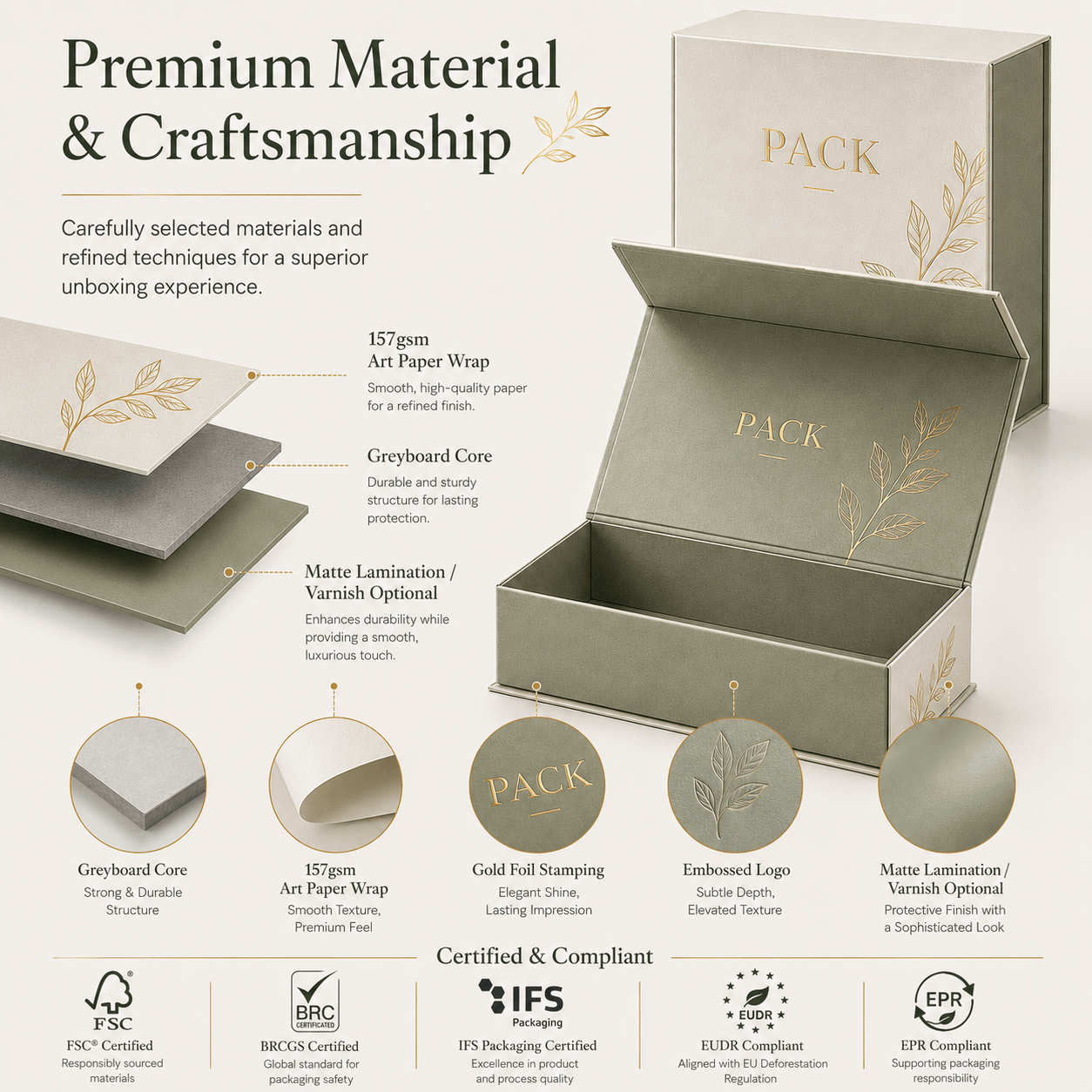
Premium Packaging to Elevate Your Brand
Which Closure Style Is Best for Your Product?
Choosing the right closure is a technical decision balancing product weight, protection needs, packing line speed, and your brand’s unboxing experience.
Assess Product Weight and Load Requirements
Product weight is the first gate in your decision. A closure that works for a lightweight cosmetic will fail for a heavy glass jar. Start with these thresholds:
- For lightweight products (under about 250g), a standard tuck-end closure like an RTE or STE is usually sufficient and cost-effective.
- For medium-weight items (250g–500g), a snap-lock bottom provides better support, which is critical if the cartons will be stacked.
- For heavy products (over 500g) or items with a high center of gravity, you need a lock-bottom, auto-bottom, or glued closure to prevent the base from failing.
Determine Protection and Security Needs
The closure style directly impacts how secure your product is from damage, contamination, and tampering.
- If tamper evidence is mandatory, such as for pharmaceuticals, a seal-end or glued closure is the only real option. These provide a permanent, destructive seal.
- For fragile products like glass or electronics, pair a strong base like an auto-lock bottom with protective internal inserts to immobilize the item.
- When preventing contamination is the priority for food products, seal-end cartons create a secure barrier that protects against external elements.
Consider Packing Line Speed and Automation
A closure that’s great for manual packing can bring a high-speed automated line to a halt. Match the style to your operational reality.
- High-speed automatic lines demand simple tuck-end styles. They are fast, efficient to close, and minimize jams.
- Auto-lock (or crash-lock) bottoms are perfect for semi-automated lines. They offer fast erection and a strong base without complex manual folding.
- Manual packing lines can handle more complex assembly styles like snap-lock bottoms, where speed is less important than achieving a strong base.
Align with Branding and Unboxing Goals
The closure is part of the customer’s first physical interaction with your brand. Make it count.
- Use a Straight Tuck End (STE) style when you need a clean, uninterrupted front panel for high-impact graphics. It hides the tuck flaps on the back.
- For a premium or unique unboxing experience, choose specialty closures like tab-locks or sculpted concave/convex locks that create a more deliberate opening process.
- If the goal is simple and functional retail display, a standard Reverse Tuck End (RTE) offers a practical balance of performance and cost.
How Does the Packing Process Affect Carton Design?
The packing process is a primary design constraint, not an afterthought. A carton must be engineered for the specific machinery it runs on to prevent costly stoppages and failures.
Machine Compatibility as a Core Design Constraint
A folding carton is never designed in isolation; it must function as a reliable component within a larger mechanical system. The geometry of the carton, its board caliper, and the precise placement of scores must align perfectly with the forming, loading, and closing equipment. Any mismatch leads to line stoppages. Designs have to account for machine-specific details like the exact position of vacuum cups, transfer points, and the action of flap kickers to ensure consistent performance.
High-speed packing lines, in particular, magnify any inconsistencies. They demand board grades that offer highly predictable behavior to maintain runnability. Even a seemingly minor tweak to machine settings, such as moving vacuum cups a fraction of an inch away from a crease, can be the difference between a successful run and a production rate that drops by over 30%.
Influence on Structural Features and Carton Geometry
The method of packing directly dictates the physical structure of the carton. Automated loading machinery determines the necessary opening size, internal clearances, and the sequence of the flaps to prevent the product from snagging during insertion. The board’s stiffness and the depth of its scores are not arbitrary; they are engineered to allow the carton to erect into the correct shape without buckling or cracking under mechanical stress.
Similarly, closure features like glue patterns and tuck-in tabs must be designed for reliable machine application and sealing. The carton must not only close correctly but also maintain its squareness after being filled. A box that loses its shape is structurally compromised, unable to provide the compression resistance needed for stacking and transport.
Impact on Downstream Handling and Palletization
Focusing solely on making a carton run well on the packing line can create major problems downstream. A carton’s final dimensions directly affect the efficiency of the corrugated shipper it goes into and, ultimately, the final pallet pattern. An oddly shaped carton can lead to poor cube utilization, wasted space, and significantly higher shipping costs.
Changes made to a carton’s size for better packing performance can also have unintended consequences on its structural integrity. A small adjustment might solve a jamming issue on the line but unexpectedly reduce the carton’s overall compression strength. This highlights the need to design the carton as one part of a complete system, anticipating stresses from the packing line all the way through warehousing and transport to prevent failures.
Common Failures Caused by Process Mismatches
When a carton’s design isn’t perfectly synchronized with the packing process, specific and costly failures occur. These issues are almost always preventable by designing for the machine from the start.
- Buckling during erection: This frequently happens when the vacuum pick positions are not correctly matched to the carton’s creases and structural panels.
- Misfolding or incomplete opening: Inconsistent score quality or poorly designed flaps that interfere with mechanical parts can prevent the carton from opening fully and correctly.
- Line stoppages: The most immediate problem is when cartons fail to feed from the magazine, open, or seal reliably at the target production speed, bringing the entire line to a halt.
- Loss of squareness: A carton that loses its perpendicular shape after packing is significantly weaker, compromising its ability to be stacked and leading to crushed products and pallet instability.
How Do Paperboard and Inserts Affect Structural Performance?
Paperboard properties set the baseline stiffness, while inserts reinforce critical areas and manage load. An effective design treats the carton and inserts as an integrated structural system.
The Role of Paperboard Properties
The paperboard itself is the foundation of a carton’s structural integrity. Its intrinsic properties determine the starting point for stiffness, load-bearing capacity, and how it behaves on automated machinery.
- Paperboard grade (like SBS, FBB, or SUS) and caliper are the primary factors that dictate baseline stiffness and how much weight a carton can support.
- Grain direction is a critical detail. The higher stiffness in the machine direction (MD) versus the cross direction (CD) directly impacts panel buckling, how cleanly a score folds, and tear resistance.
- Bending stiffness, measured in milliNewton-meters (mN·m), directly correlates with top-load compression strength and a panel’s ability to resist flexing under the weight of the product.
- For consistent performance on automated lines, basis weight (gsm) and caliper must be controlled within tight tolerances, such as ±5% for gsm and ±0.03mm for caliper.
How Structural Inserts Function
When the outer carton alone isn’t enough, inserts like partitions, trays, and liners come into play. They aren’t just filler; they are engineered components that actively manage forces within the package.
- Inserts carry product weight, transferring the load away from the carton’s outer panels and directing it to stronger points like the base or corners.
- By reinforcing critical areas, especially corners, inserts can boost a carton’s overall compression strength by 40-60%, preventing crushing during stacking and distribution.
- They lock the product in place, which minimizes movement and reduces the dynamic impact loads that stress walls and closures during drops and vibration in transit.
- Inserts can also compensate for the structural strength lost from features like die-cut windows by providing a supportive backing or creating an internal support frame.
Balancing Board Caliper and Insert Complexity
A fundamental design choice is whether to use a heavier, more expensive outer board or a standard board fortified with structural inserts. Using inserts often allows for a thinner outer board, which can optimize material costs. This strategy introduces more complexity and cost into the packing process.
The carton and its inserts must be evaluated as a single, integrated system. Performance should be validated through physical tests that simulate real-world conditions, including top-load compression, drop tests, and impact analysis. For especially demanding applications, advanced solutions like Z-Flute lamination can provide strength comparable to corrugated board without requiring separate inserts.
Key Specifications for Structural Reliability
To ensure a carton performs reliably from the converting line to the retail shelf, several key specifications must be managed tightly.
- Treat caliper as the primary structural specification, not just basis weight. Caliper has a direct impact on die-cutting accuracy and how well the carton folds and holds its shape.
- Crease geometry and depth must be verified to ensure clean folds without cracking, a risk that increases with thicker boards or heavy coatings.
- Glue bond peel strength is essential. Inserts can add significant peel stress to seams and joints, so the bond must be strong enough to hold the entire system together.
- For automated lines, the opening force must stay within the equipment’s limits (often ≤25 N) to prevent misfeeds, jamming, and incomplete carton erection.
How Do Retail and E-Commerce Requirements Differ?
Retail cartons are built for on-shelf beauty. E-commerce cartons are built for in-transit survival. The structural priorities and engineering trade-offs are completely different.
Primary Function: On-Shelf Presentation vs. In-Transit Protection
A retail carton’s primary job is to act as a silent salesperson. It uses high-quality graphics and visual presentation to grab a customer’s attention on a crowded physical shelf. The structure is built to present the brand and product information in the best possible light.
An e-commerce carton has a different mission. Its main role is to protect the product while it’s inside a larger shipping box or mailer. While branding is still important for the unboxing experience, the structure must first and foremost prevent damage during a rough transit journey.
This creates a core trade-off. Retail packaging optimizes for graphics and shelf appeal, sometimes at the expense of pure strength. E-commerce packaging prioritizes structural integrity to survive the stresses of individual shipping.
Distribution Environment and Handling Stresses
The logistics chain for retail products is relatively simple and controlled. Cartons are typically packed in a master case, moved on a pallet from a distribution center, and unpacked onto a store shelf. The number of handling points is limited.
E-commerce packages face a much more aggressive journey. They go through automated sortation facilities, ride on miles of conveyor systems, and are handled individually by last-mile couriers. This environment introduces far more opportunities for drops, impacts, and continuous vibration.
Because of this, e-commerce cartons must be engineered for a harsher reality. They need to withstand higher compression forces from being stacked with dissimilar items, survive drops from various heights, and resist failure from constant shaking and temperature changes.
Material Selection and Structural Reinforcements
Retail cartons often use standard paperboard like Solid Bleached Sulfate (SBS), which is chosen for its excellent print surface. Structures are usually simple and cost-effective, such as a reverse tuck end (RTE), which is sufficient for shelf display.
For e-commerce, material selection focuses on durability. This often means using stronger grades like Coated Unbleached Kraft (CUK) for better tear and puncture resistance, or specifying a higher caliper (thickness) of SBS to improve crush resistance.
Structural design also gets an upgrade. E-commerce cartons frequently use reinforced structures like auto-lock bottoms or full seal ends. These designs provide better load-bearing capacity and prevent panels from bowing or closures from failing during the chaos of shipping.
Testing and Validation Protocols
Validating a retail carton is straightforward. It usually involves checking print quality, ensuring the product fits correctly, and performing basic transit tests while the carton is safely inside a master shipping case.
E-commerce cartons, on the other hand, must pass a battery of rigorous, standardized tests. These include drop tests from multiple heights and orientations, vibration tests that simulate a truck journey (like ASTM D4728), and compression tests (like TAPPI T804) to ensure the carton can withstand stacking pressure.
The entire point of e-commerce testing is to formally prove that the package can protect the product by itself throughout the entire individual shipping cycle, from the warehouse to the customer’s doorstep.
How Does Carton Structure Affect Packaging Cost?
Carton structure drives cost through material use, manufacturing speed, shipping volume, and damage risk. Small design choices create significant financial effects across the supply chain.
Material Usage and Conversion Efficiency
The cost of a carton starts with its flat blank size. Inefficient shapes that don’t nest well on a paperboard sheet increase material consumption and waste. For instance, choosing a thicker paperboard like 24 pt instead of 18 pt directly raises the raw material cost for every unit. The complexity of the structure also impacts manufacturing speed. Designs with many folds or intricate locks run slower on folder-gluer machines, which increases the labor and machine time per carton. Simple, straight-line designs run faster through die-cutting and gluing, improving yield and lowering conversion costs.
Tooling and One-Time Setup Charges
Creating a custom carton shape requires a new cutting die, which is a significant one-time tooling cost. If structural changes alter the dimensions of the panels, new printing plates may also be needed, adding to the initial setup fees. These fixed costs are amortized across the total number of cartons in an order. This makes highly unique structures disproportionately expensive for small production runs, as there are fewer units to absorb the initial investment.
Freight and Logistics Volume
A carton’s structure dictates its final packed dimensions, which directly impacts shipping costs based on volume and dimensional weight. Inefficient designs that create unnecessary headspace result in larger shipping cases and fewer units fitting on a pallet, driving up the freight cost for each item. Even a minor reduction in a carton’s dimensions, such as 15 mm, can lead to substantial savings on parcel and LTL shipments over time. Structures that do not pack efficiently onto standard pallets also reduce truck or container cube utilization, raising overall transportation expenses.
Structural Integrity and Damage Risk
The cost of a carton isn’t just its production price; it includes the cost of failure. An under-engineered structure that collapses during transit leads to expenses from product damage, customer returns, and harm to your brand’s reputation. On the other hand, an over-engineered structure uses excessively thick board or reinforcements that add unnecessary material and freight costs without providing a proportional benefit. The optimal structure finds the balance between material cost and the product’s protection needs, minimizing the total cost of both the packaging itself and any potential damages.
Why Should You Test the Structure Before Production?
Testing carton structure before production is non-negotiable. It prevents expensive tooling errors, production waste, and widespread product damage by catching failures before they become a large-scale problem.
Prevent Structural Failures and Product Damage
A single structural flaw, like a weak lock or inadequate board strength, can lead to bottom failures, panel separation, or product leakage during shipping. Pre-production testing confirms that the structure properly protects the product, preventing it from shifting, rattling, or being crushed during handling. This step is critical to avoid a single design mistake from being scaled into thousands of defective units during a full production run.
Avoid Expensive Tooling and Production Errors
Validating a structural design before cutting expensive custom dies and printing plates saves significant time and money. Changes to these tools are costly and lead to delays. Finding a structural problem too late means scrapping large quantities of printed material or finished cartons. By correcting dimensional issues at the prototype stage, you avoid the need for reprints, recutting dies, and major setbacks in your production schedule.
Guarantee High-Speed Packing Line Performance
A carton that works well when assembled manually can easily jam or mis-fold on automated equipment running at 50-100% of its rated speed. Testing verifies that the erection force is within the optimal range, typically between 8–18 Newtons, to avoid jams from excessive stiffness or failures from loose locks. The locking mechanisms and closures must prove reliable and stable during continuous, high-speed assembly to maintain line efficiency.
Uphold Brand Quality and Real-World Durability
Structural integrity is directly tied to brand perception. Testing helps identify cosmetic defects like score cracking, skewed panels, or misaligned closures that can undermine the perceived quality of your product. It also ensures the carton can withstand the real logistics corridor by simulating stacking, vibration, and humidity changes. For complete validation, performing a trial shipment of around 500 units can confirm the structure’s durability under real-world conditions before you commit to a large-scale order.
Frequently Asked Questions
How do I choose the right folding carton structure?
To choose the right folding carton structure, you must evaluate several factors: your product’s weight and fragility, your packing process (manual or automated), how the product will be displayed, and any specific protection or sustainability needs. For instance, heavy products require stronger bases like auto-lock bottoms, while premium retail products needing a clean front panel often use straight tuck end cartons.
Which folding carton is best for heavy products?
For heavy products, auto-lock bottom (also known as crash-lock) cartons are the best choice. Their pre-glued, interlocking base provides superior strength and load-bearing capacity. Seal-end cartons are another strong option, especially for automated lines. These structures should be paired with a thicker, stiffer paperboard (e.g., 350-400 gsm) to prevent bottom failure.
What is the difference between auto-lock and snap-lock bottom cartons?
The main difference is in assembly method and strength. An auto-lock bottom is pre-glued during converting and locks into place automatically when the carton is opened, making it fast, strong, and ideal for heavy products or automated packing. A snap-lock bottom requires manual folding of the flaps in a specific sequence to lock the base, so it is slower to assemble and best suited for lighter products where carton cost is a primary concern.
Should I choose a straight tuck end or reverse tuck end box?
Choose a straight tuck end (STE) carton when a premium appearance is critical. Both tuck flaps close to the back, leaving a clean, uninterrupted front panel that is ideal for high-end graphics and display windows. Choose a reverse tuck end (RTE) carton for better cost-efficiency and a slightly more secure closure, making it a versatile choice for industries like pharmaceuticals and electronics where material yield is important.
Which folding carton structures work with automated packing lines?
Most standard structures are compatible with automation if designed with precise tolerances. Tuck-end (STE/RTE) and seal-end cartons are widely used on high-speed lines. Auto-lock bottom cartons are especially effective because they erect almost instantly, reducing a common production bottleneck. The key is ensuring consistent board thickness and proper scoring to prevent jams.
How thick should folding carton paperboard be?
The thickness of folding carton paperboard typically ranges from 10 to 28 points (pt). For most standard retail packaging, such as cosmetics or food items, a thickness of 16 to 18 pt (approximately 300–350 gsm) is the most common. You should use a thicker board for heavier products or larger boxes to ensure structural integrity, while a premium brand might select a thicker board (e.g., 20-24 pt) for a more substantial feel.
Do I need a physical sample before ordering custom cartons?
Yes, getting a physical sample before a full production order is highly recommended. A sample lets you test the carton’s fit with your actual product, verify its structural integrity, and ensure closures work correctly. This step helps you avoid costly mistakes related to incorrect dimensions or material choices that a digital proof cannot identify, especially for new designs or cartons intended for automated packing lines.
Final Thoughts
Selecting a carton structure based on price alone invites unacceptable commercial risk. The engineering framework outlined in this guide is the only defense against production stoppages and widespread product damage. Adhering to these technical standards is a direct investment in your brand’s integrity and operational efficiency.
Do not leave structural performance to chance—validate it with physical prototypes. We recommend ordering samples to confirm fit, function, and performance on your specific packing line. Contact our team to discuss your technical requirements and align on the optimal carton specifications.
SEO
Title: How to Choose the Right Folding Carton Structure for Your Product
Description: Folding Carton Structure technical guide. Choose the right board caliper, closure type, and inserts for your automated factory line. Bulk orders.
URL: folding-carton-structure
Keywords: folding carton structure