
Buyers comparing collapsible rigid boxes with pre-assembled ones usually weigh the printed surface and the closure first. The detail that moves landed cost is decided earlier: how the box reaches the warehouse. A collapsible rigid box ships flat or partly formed, while a pre-assembled rigid box ships ready to fill. That single difference moves freight volume, spazio di archiviazione, assembly labor, and how well the box holds a product. This article compares the two delivery formats by shipping, magazzinaggio, assemblaggio, inserti, chiusure, and product fit, so you can match each one to your fulfilment operation before you request samples.
 What Is a Collapsible Rigid Box?
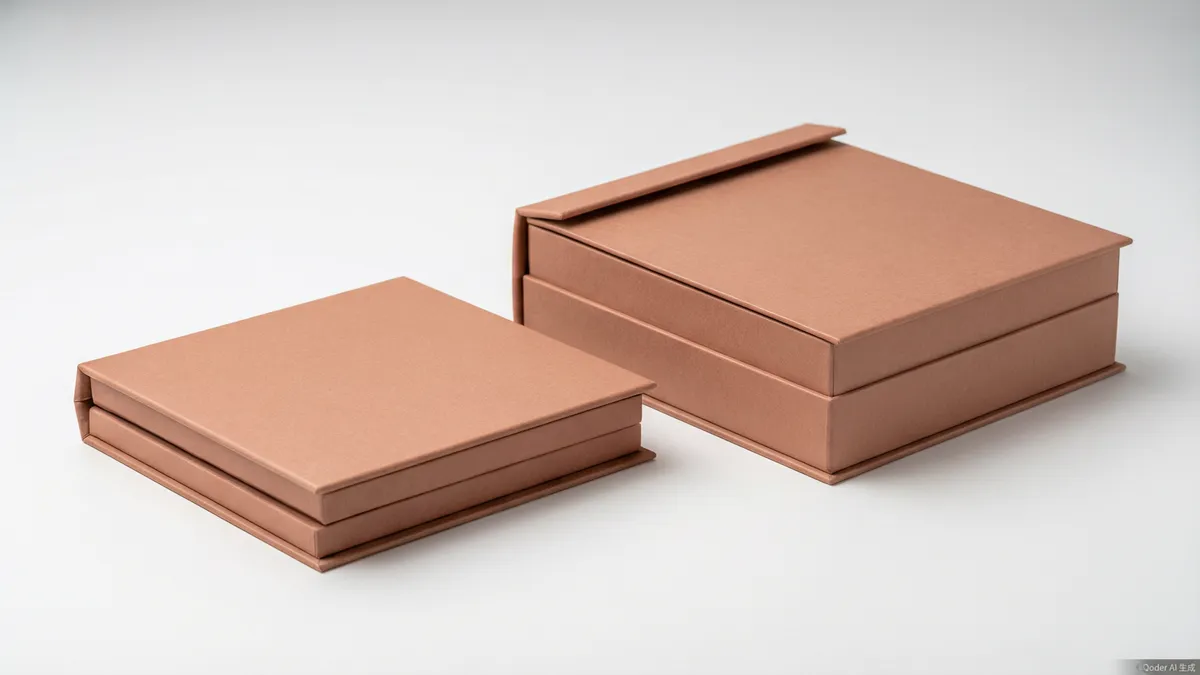
A collapsible rigid box is a stiff-walled gift box engineered to fold flat or partly collapse for transport, then be formed at its destination. It uses the same core materials as a standard rigid box: a greyboard wall, usually covered with wrapped paper, film, or fabric. The difference sits in the construction. Hinges, corner blocks, or a foldable base let the box lose most of its volume when empty and regain a firm shape when assembled.
Because the walls stay rigid, a collapsible box protects contents better than a thin coated board does. It is not the same as a folding carton. A folding carton is typically die-cut and creased from paperboard, shipped flat, and formed before filling. A collapsible rigid box retains thicker, self-supporting greyboard panels while using foldable joints or panels to reduce its shipping volume.
Buyers usually choose a collapsible format for items that ship long distances, storage space is limited, or the box needs to return flat after use. The value depends on the exact structure, so treat these as reasons to evaluate the format, not proof that it fits your product.
What Is a Pre-Assembled Rigid Box?
A pre-assembled rigid box arrives already glued into its final shape. The factory forms the greyboard, wraps it, sets the corners, and ships a finished box that you fill and close. Nothing on your side needs to be built before packing. This is the traditional way rigid gift boxes reach a brand, and it remains common for premium and retail-ready packaging.
The trade-off is space. A box that is already formed travels as a fixed volume of air until it holds a product, so more trucks, containers, and shelf space go to empty packaging. The structure is also set for good; if the box is damaged in transit, there is no re-forming step to recover it.
Pre-assembled boxes suit programs where fill-line speed, presentazione, or a fixed premium shape matters more than freight and storage density. As with the collapsible format, the fit is a decision to test, not a default for every product.
How Do Shipping and Storage Requirements Compare?
The two formats differ most before the product goes in. The table below contrasts the general logistics direction of each. Read it as a tendency, not a fixed rate, because carton dimensions, stack height, and the shipping lane all shift the outcome.
| Logistics Factor | Scatola rigida pieghevole | Pre-Assembled Rigid Box |
|---|---|---|
| Freight volume (empty) | Lower, ships flat or partly formed | Higher, ships as a fixed 3D box |
| Storage footprint | Compact until assembled | Takes space before filling |
| In-transit risk | Formed corners are less exposed, but folded panels and wrapped surfaces still require protection | Formed corners and wrapped surfaces may dent or scuff during transit |
| Handling step added | Assembly before filling | None before filling |
No fixed saving belongs in this comparison. Freight and storage gains depend on how flat the collapsed box folds, how many units fit one outer carton, and the lane you ship. Ask your supplier for the packed dimensions and units-per-carton of the exact structure, then run those numbers against the assembled alternative for your order. If a supplier quotes a savings percentage, ask which structure, how many units per outer carton, and which lane produced that result. A figure from one program rarely transfers to another brand’s order.
Choosing Between Collapsible and Pre-Assembled Rigid Boxes?

How Much Assembly Work Is Required After Delivery?
A collapsible box moves labor from the factory to whoever forms it. Some designs snap into shape in a few seconds with no adhesive or tools; a foldable base tucks in, the walls rise, and the box is ready. Other designs need a manual step, such as setting corner blocks, applying an adhesive strip, or fitting a base insert before the box can hold a product.
Plan the assembly against your operation, not against a claim. A team packing a small run may not care about a few extra seconds per box. A fulfillment line packing thousands may need the assembly step documented and timed before the format saves anything. If you hope to feed boxes on a line, confirm with the supplier that the exact structure suits your equipment; do not assume every collapsible box runs automatically.
A pre-assembled box skips this step entirely. The labor you save on assembly is the labor the factory already spent, and it shows up in freight and storage instead. Which side of that trade is cheaper depends on your volume, your space, and your wage cost, so price both paths for your own case.
To map the assembly step, the box spec, and the sampling order in one pass, IL project workflow page shows how a packaging brief moves from structure to production.
One hidden cost sits in quality, not in time. A box formed by hand can be assembled well or poorly, and a rushed shift produces creases set at an angle or walls that never seat fully. If assembly happens at a third-party fulfillment center, add a written forming step and inspect the first units, because the team placing your product has never seen your box. A pre-assembled box removes this variable and carries it as freight instead.
How Do Product Weight, Inserti, and Closures Affect the Choice?
The product decides a lot of the format question. A collapsible wall can be strong, but a foldable base or hinged corner is the part that carries load, and that point varies across designs. Do not treat every collapsible box as fit for a heavy product. For dense goods such as glassware, metal hardware, or a full bottle, confirm the base and corner construction against the item weight before you commit.

Inserts pull the decision both ways. A fixed foam or plastic tray can locate a product and add support, which suits a pre-assembled box that never changes shape. An insert that also helps a collapsed box spring open, or that stores flat with the box, suits the collapsible path. Match the insert to the format, and test them together rather than picking each on its own.
Closures matter just as much. A magnetic closure holds a lid closed and can suit both formats. An adhesive strip that the customer tears once, or a ribbon and lid, changes the perceived quality and the assembly step. Ask how the closure behaves after the box has been collapsed and re-formed many times, because that is where a collapsible design earns or loses its fit.
Weigh the actual product with its insert, and treat the heaviest SKU in your line as the test case. A format that suits a light variant can fail on the heavy one, so let that variant set the base and corner spec.
What Should Buyers Test Before Approving the Structure?
Before approving a format, test the real box rather than relying on photos. Request samples of the exact structure and collapse and re-form them for the number of cycles expected during packing and customer use. Check for loose panels, visible whitening along the folds, misaligned closures, and a base that no longer seats correctly.

Pack the actual product and ship a sample carton to your warehouse, then inspect it for corner dents and surface scuffs. Where formal distribution testing is required, select an appropriate drop, vibrazione, or compression procedure based on the shipping method and package configuration. IL International Safe Transit Association publishes commonly used test procedures, but the applicable procedure should be agreed for the specific distribution environment.
Weigh the assembly too. Time how long one box takes to form, and note whether it needs adhesive, a tool, or training. Compare the units-per-carton and packed dimensions of the collapsible sample against the pre-assembled one so your freight estimate rests on real numbers rather than a general claim. Record what passes and what fails, and keep the approved sample as your reference for the bulk order.
When a defect appears, note the cycle at which it first showed and write it down with the sample. Send that record to your supplier before sign-off, so the correction targets the weak panel or joint instead of the whole structure.
Match the test to how the box actually travels and sits. A structure that survives a bench collapse test can still arrive with dented corners if the outer carton stacks too high. A box stored in a humid room can also behave differently from one kept dry. Note the storage conditions and the pack pattern you will use, then test a sample under those conditions so the approval reflects your operation rather than a laboratory best case.
You can review PK Paper Box’s rigid box capabilities, then request a structure and sampling review based on your product weight, inserire, chiusura, and shipping requirements.
Domande frequenti
Are collapsible rigid boxes the same as folding cartons?
NO. A collapsible rigid box retains thick, self-supporting greyboard panels connected by foldable joints or panels. A folding carton is typically die-cut and creased from paperboard, shipped flat, and formed before filling. The two formats differ in construction, shipping volume, assemblaggio, and product support.
Do collapsible rigid boxes arrive completely flat?
Some do and some arrive partly formed, depending on the structure. A foldable-base design may ship nearly flat, while a hinged box keeps a partial shape. Ask for the packed dimensions and a sample to see how flat the exact model folds before it is assembled.
Do collapsible rigid boxes require glue during assembly?
It depends on the design. Many snap or tuck into shape with no adhesive, while others use a pre-applied adhesive strip or corner blocks that need pressure to set. Confirm the assembly method for the exact structure before you build a packing routine around it.
Can collapsible rigid boxes use magnetic closures?
SÌ. Magnetic closures can be incorporated into both collapsible and pre-assembled rigid boxes, although the magnet position and supporting panels depend on the structure. Test the lid alignment and closing force after repeated forming to confirm that the closure remains consistent.
Are pre-assembled rigid boxes better for heavy products?
They are often chosen for heavy goods because the fixed glued structure does not rely on a foldable base to carry load. That is not a rule. A well-built collapsible box can hold weight, so match the base and corner construction to the product rather than the format label.
Which option normally requires more storage space?
The pre-assembled box normally takes more room before filling, because each unit keeps its full shape in the warehouse. A collapsible box stores flatter until someone forms it. The gap widens with order size and how long empty stock sits on the shelf.
Considerazioni finali
Neither format wins for every project. A collapsible box can cut empty freight and storage when you ship far and pack many. That holds only if its base and corners carry your product and your team accepts the assembly step. A pre-assembled box saves that step and protects a fixed premium shape, but it pays in space. Test both structures with your own product, peso, and lane, then let the measured fit decide.
If you are weighing the two formats for a specific product, send the item weight, target closure, and shipping profile to PK Paper Box. That way the sampling plan is built around your operation instead of a general rule.