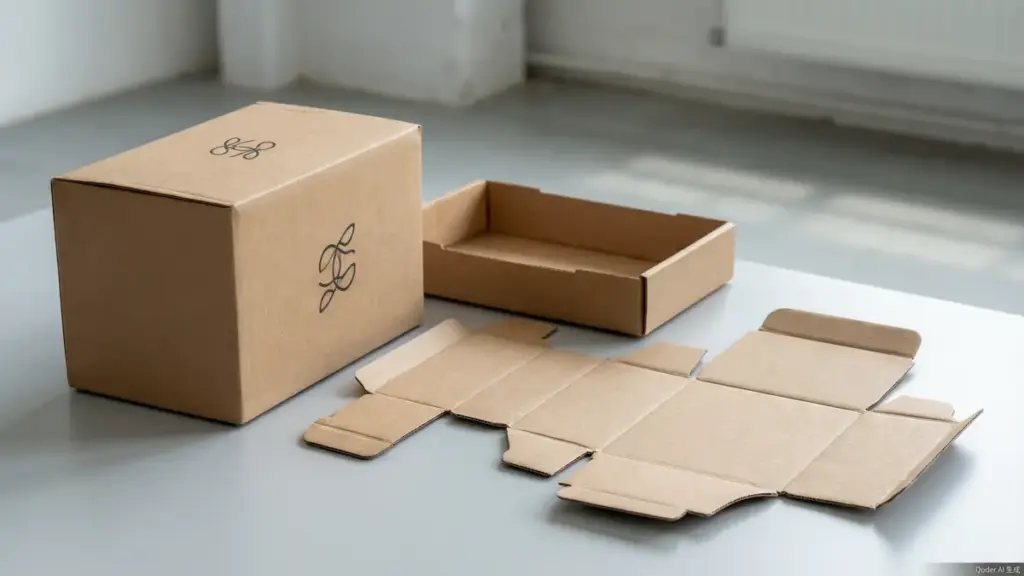
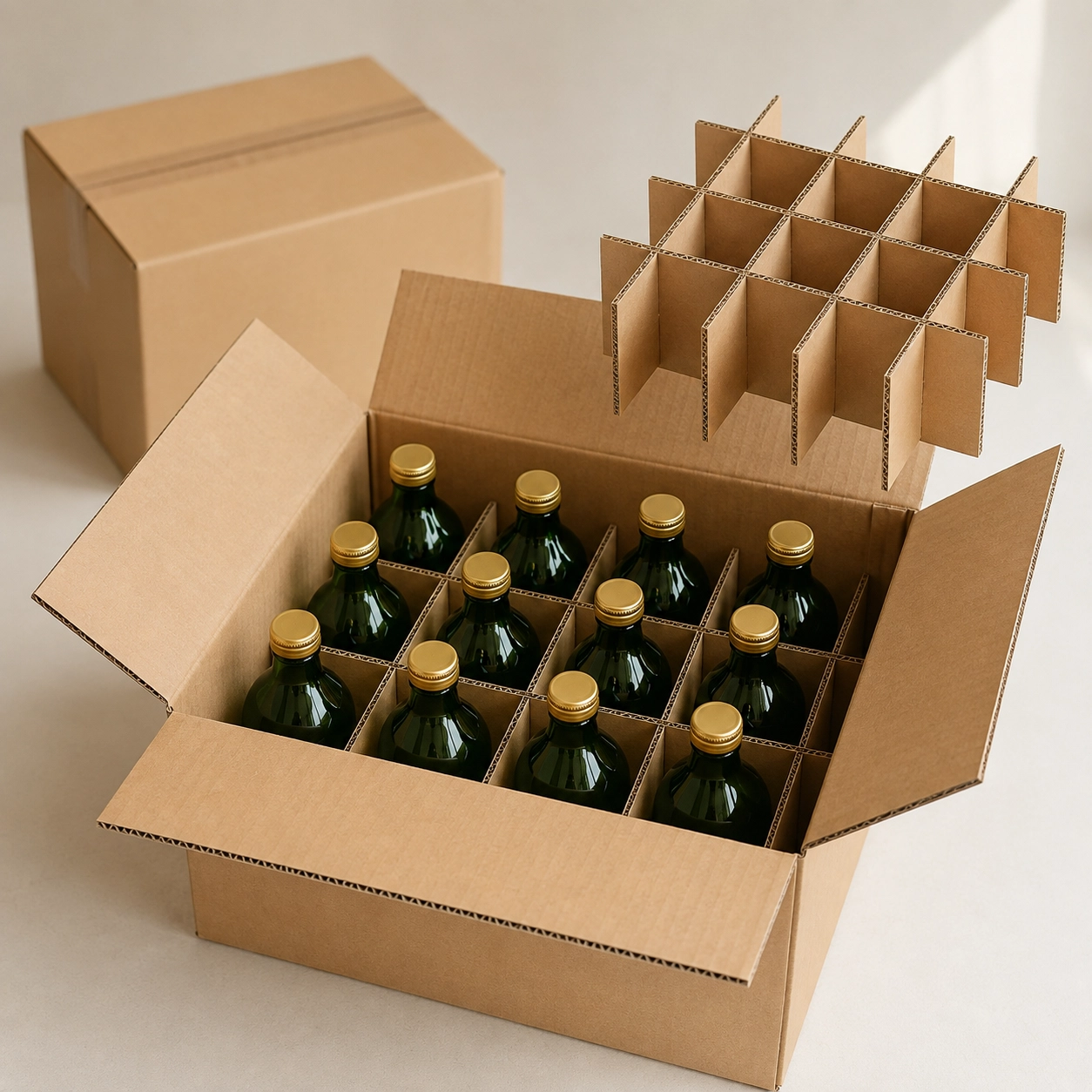
A glass bottle that leaves your warehouse intact and arrives chipped is usually a specification problem, not a luck problem. Wine raises the stakes. A filled 750 ml bottle is heavy, and its narrow neck is the weakest point. Each parcel becomes a small piece of freight that must survive drops, stacking and vibration. That is why a wine bottle shipping box is sized and built from the bottle outward. It is not picked from a generic carton list and adapted after the fact.
This guide walks through the buyer-side decisions in order. Start with sizing from measured bottles rather than nominal catalogue numbers. Then weigh single against multi-bottle configurations, and the failure modes glass packs meet in transit. Next come divider and insert structures, closure and unboxing, and moisture and cold-chain context. Finalmente, the inputs that make a wine-box RFQ quotable in one round. Everything here sits at specification level for procurement and fulfilment teams, not as a consumer packing tutorial.
Why Are Standard Wine Bottle Dimensions Not Standard?
750 ml is a standard volume, not a standard shape. Bordeaux bottles run tall and relatively slim. Burgundy bottles are wider through the shoulder. Sparkling bottles carry more glass and a deeper punt, and Alsatian or flute-style bottles stretch the height again. A box cut around one region’s bottle tends to reject another’s. A sparkling bottle may not drop into a still-wine cell, and a slim bottle may lean inside a cavity cut for Burgundy.
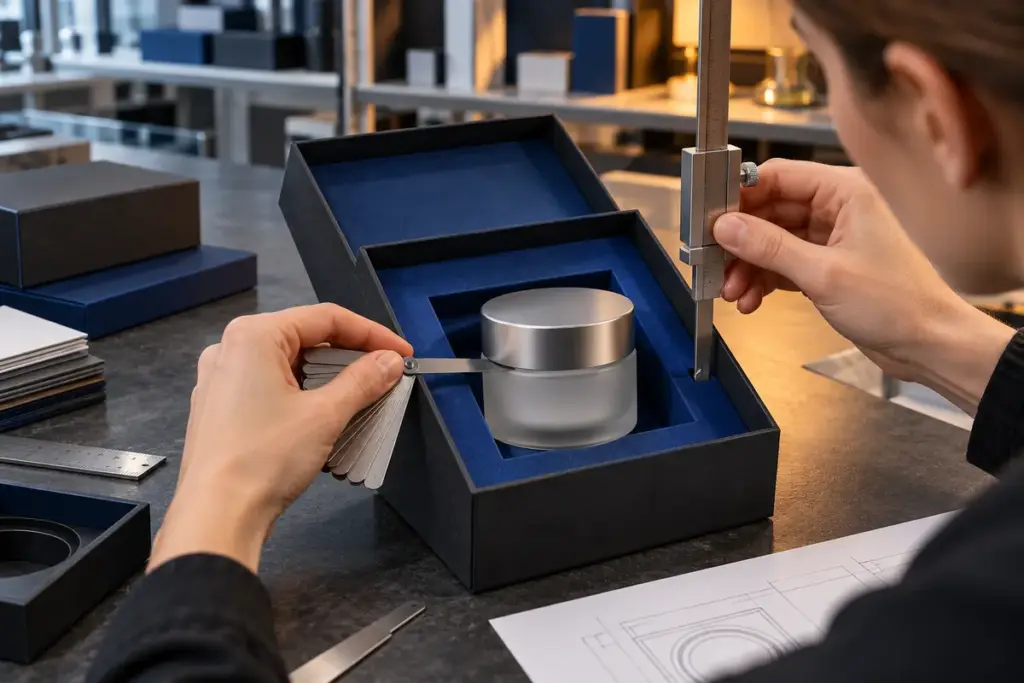
The workable method is measurement. Take production samples from every glass SKU you actually ship. Record the maximum diameter at the widest point, which is often the shoulder rather than the body. Record the total height including the closure, and the punt depth, because a deep punt changes the effective base plane. Log the smallest and the largest bottle in the range. Then derive the cavity from the maximum: the bottle envelope, plus divider wall thickness, plus a cushioning allowance around the glass, plus practical packing clearance.
We deliberately do not publish a fixed internal-dimension table as a standard. For illustration, most 750 ml still-wine bottles fall near 70–90 mm maximum diameter and 290–330 mm total height. Sparkling bottles trend wider and heavier. But the numbers that belong on your drawing are the ones measured from your own bottles. The mailer and shipping formats in our corrugated boxes line are then built inward from those measured inputs, not from a nominal size that happens to be nearby.
How Should You Choose Between One, Three, and Six Bottle Packs?
One-, three- and six-bottle packs change the geometry conversation, the total weight and the divider design at the same time.
| Pack size | Layout and structural notes |
|---|---|
| Single-bottle boxes | The footprint is close to the bottle plus cushion. Two approaches dominate: a die-cut mailer with an integral cell, or a simple carton with a bottom pad and a wrap that holds the bottle off the walls. Neck support still matters at this size. |
| Three-bottle boxes | A two-plus-one layout saves footprint but complicates the divider cut, while a single row is simpler to die-cut. State which layout the drawing assumes. |
| Six-bottle boxes | The familiar two-by-three upright grid, and the configuration where board and closure carry the highest loads. |
Total packed weight is the other fork. A filled bottle typically weighs around 1.2–1.5 kg depending on the glass. A six-bottle carton can then sit near 8–10 kg including the box. Treat both as illustrative figures, and let your measured bottles decide. Heavier packs lift the board requirement and change how the closure must work. They can also move the parcel into different handling and rate bands with your carrier. Specify bottles per box as a maximum, not an average. You may be weighing a taped shipping case against a die-cut mailer for the same pack. Nostro RSC box versus die-cut corrugated box comparison covers the tooling, unit cost and packing-speed trade.
Where Do Wine Bottle Shipping Boxes Fail in Transit?
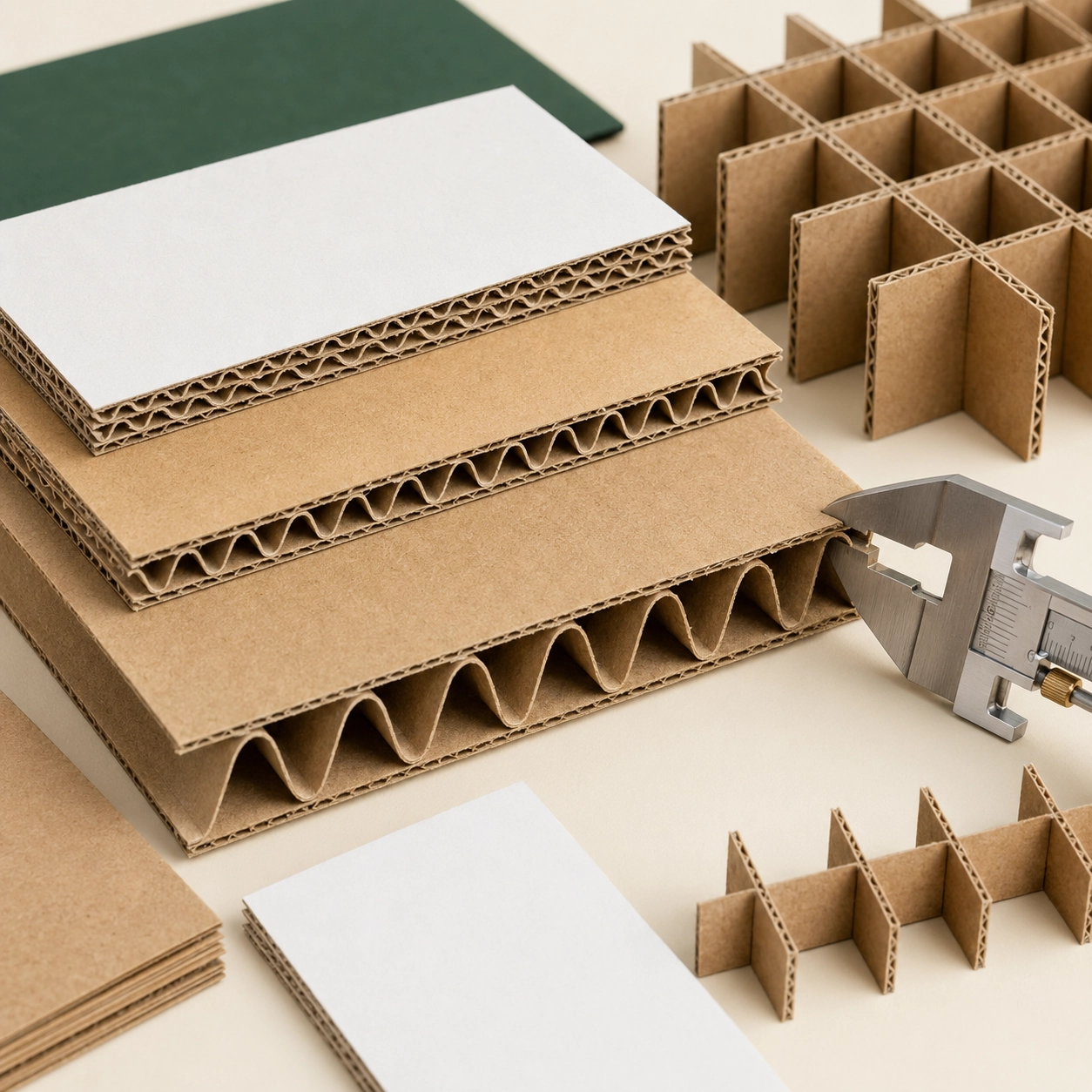
We will not restate board-strength theory here, since our guida alla resistenza della scatola di cartone ondulato already covers board ratings and stacking behaviour. Read the transit problem of a wine pack as three failure modes. Match each one to a design response.
| Failure mode | Design response |
|---|---|
| Neck and closure impact | A drop onto the base drives load through the column of liquid into the neck, the weakest feature in the glass. The pack should support the base firmly and keep load out of the neck unless the cell is designed to cradle it. |
| Bottle-to-bottle contact | Two bottles that can touch will chip rims and shoulders and scuff labels long before the box wall fails. Isolation between cells is what stops this, not extra void fill. |
| Corner crush | Corner impacts and pallet-edge compression remove the support a bottle shoulder rests against near the box corner. Flap overlap, board ply and pad layering change how that energy reaches the glass. |
Carrier packaging guidance sets the baseline your pack has to satisfy. UPS advises cushioning appropriate to the contents, and sealing bottles and containers inside plastic or spill-proof bags, as in the packaging tips UPS publishes for shippers. Your internal dimensions and divider design should satisfy those conditions rather than argue with them.
What Divider and Insert Options Protect Glass Bottles?
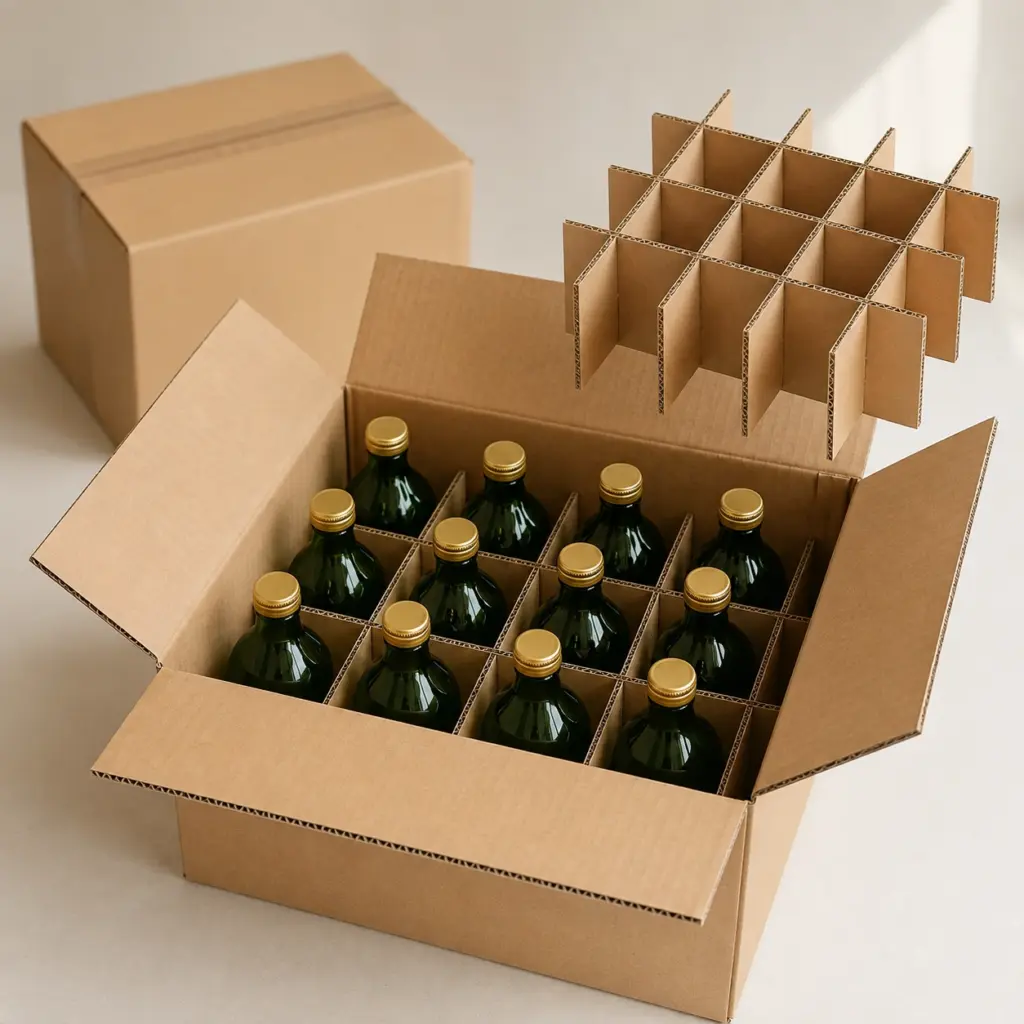
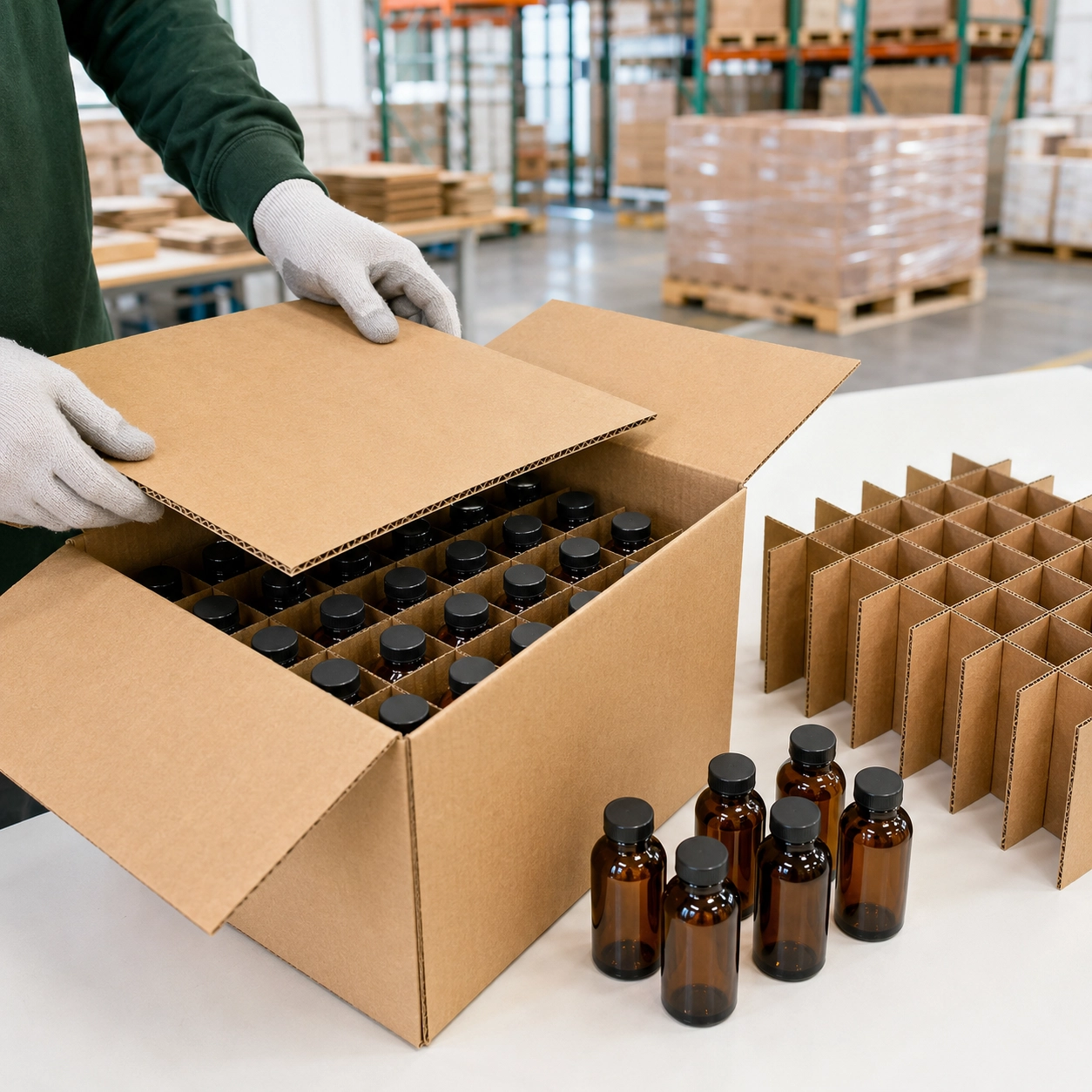
The divider structures we design and supply for bottle packs are fibre-based. These include die-cut paperboard dividers with cell openings sized to the bottle, corrugated partitions, bottom pads and neck-height cells. Two design variables do most of the protective work.
| Design variable | What it controls |
|---|---|
| Cell height | A bottom-only pad supports the base while the body can still lean. A half-height cell guides the body and resists tipping. A full-height cell adds neck support but consumes more board and internal space. |
| Divider thickness | Every divider wall sits between a bottle and a box wall, or between neighbouring bottles, so its thickness subtracts from your cavity and has to appear in the approved drawing. Pad layering at the base works the same way. |
Cell count, grain direction and pad layering all consume internal volume. So the divider drawing and the box drawing should be approved together rather than in isolation. Nostro insert and accessory structures page covers how this tooling is organised. Keeping the box and divider in one fibre stream also simplifies the recycling story where local paper streams accept it. Outside of fibre, EPE foam trays and vacuum-formed plastic inserts also circulate as general options for bottle packaging.
How Do Closure and Cushioning Choices Affect the Unboxing?
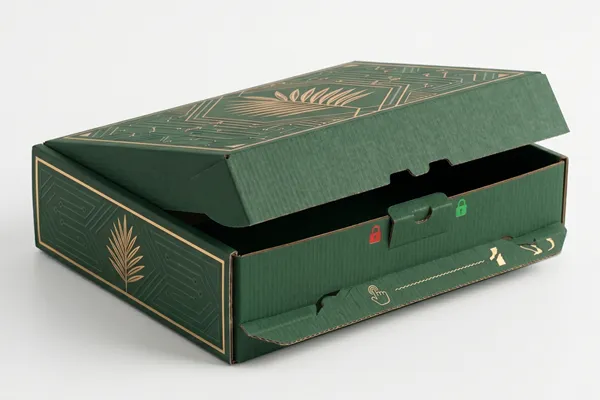
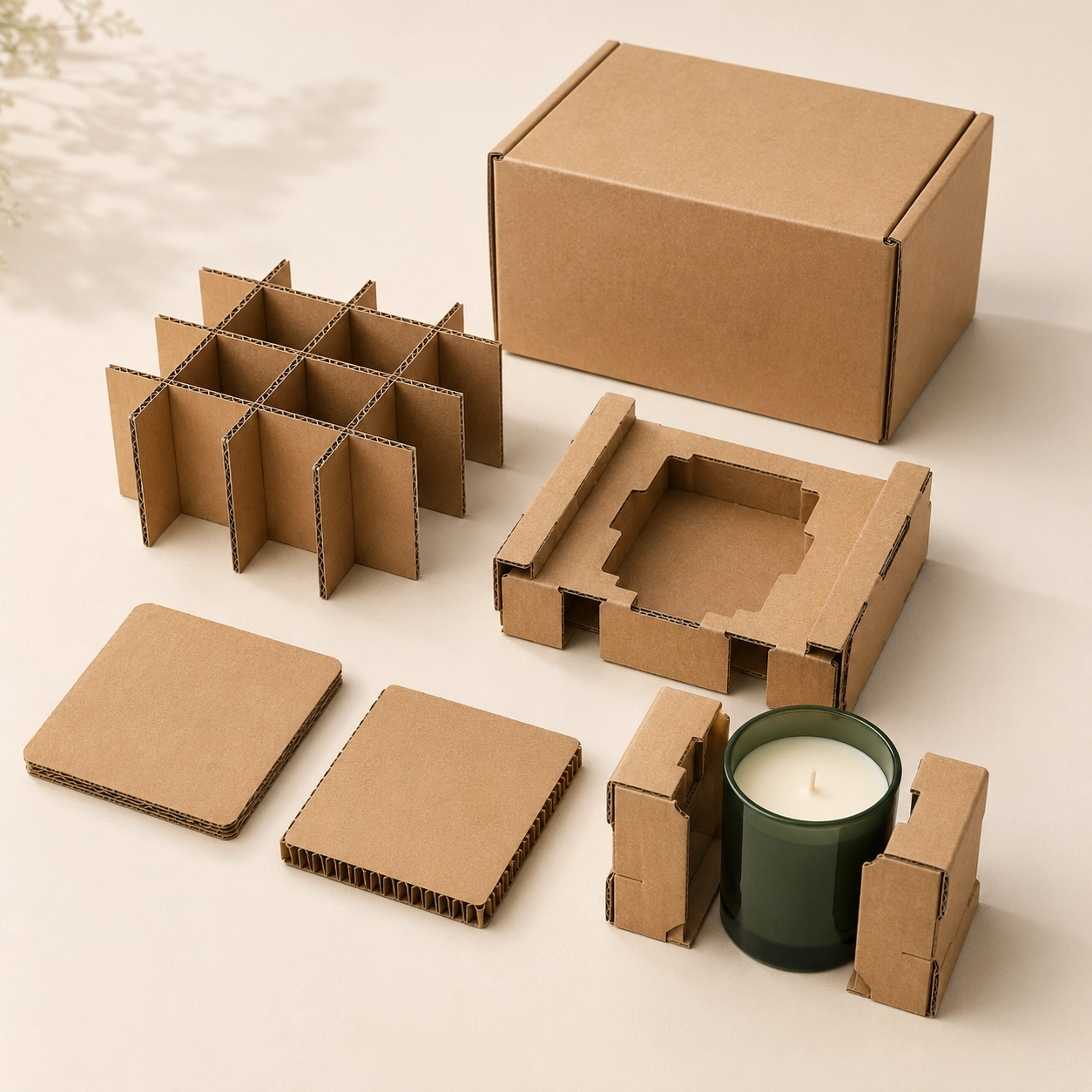
Closure choice should be read against packed weight. Full-overlap flaps taped on a shipping case keep a consistent top build. A tuck-in or lock-tab mailer is faster to erect and cleaner to open, but its ears carry real load on a multi-bottle parcel. Specify the closure against the maximum packed weight you defined, and validate it on the trial rather than on a flat sample. Headspace is part of the same decision. Too much clearance above the bottle lets the top panel deflect inward on impact, so the shoulder meets a weakened wall.
For gift wine, the unboxing is part of the product. Printed dividers, inside-lid graphics and a deliberate opening sequence all become specification items. On the branding side of that moment, Nostro luxury packaging finishing guide covers which print and finishing options suit corrugated surfaces.
How Do Moisture and Cold-Chain Conditions Change the Spec?
Moisture is a strength risk before it is a presentation risk. Damp corrugated softens and loses stacking ability. Wine packs meet humidity from several directions. Bottles pulled from cold storage can draw condensation against the board inside the closed box. Refrigerated first legs cycle the pack through temperature changes. Humid-season destinations and long dwells in unconditioned facilities do the rest. A cold-chain segment does not by itself predict failure, and a dry route does not by itself excuse a thin spec. What matters is declaring the real exposure and choosing the construction against it. Nostro corrugated moisture resistance guide covers the construction and treatment questions to raise for a given route.
What Should You Include in a Wine Box RFQ?
A wine-box RFQ that can be quoted without a second round of emails typically carries these fields:
- Measured bottle envelope per glass SKU: maximum diameter including shoulder, overall height including closure, punt depth, and the min/max spread across the bottles each box must accept.
- Bottles per box, the assumed layout, and whether orientation is upright or reclined.
- Maximum packed weight per configuration.
- Carrier or service profile, including parcel weight bands and dimensional limits you must respect.
- Season and destination climate, including any chilled first leg.
- Print, branding and finishing requirements, including divider printing if applicable.
- Trial quantity, reorder cadence and target lead time.
One item sits outside the packaging brief entirely. Rules governing alcohol shipments vary by carrier programme and destination. Confirm the carrier and destination requirements for your own shipments independently before finalising any specification above. This guide is a packaging reference, not legal advice.
Domande frequenti
What size box fits a standard wine bottle?
There is no single internal dimension we can publish as a standard, because 750 ml bottles differ enough across regions to make one fixed number wrong for part of your range. Size it from measurement: take the maximum diameter and overall height of your actual bottles, then add divider wall thickness, a cushioning allowance and packing clearance. Illustrative starting ranges sit near 70–90 mm diameter and 290–330 mm height for still wine, but your measured values govern the drawing.
Do I need dividers for a single-bottle box?
The requirement is isolation, and a divider is one way to get it. A snug integral cell, or a bottom pad combined with cushioning that holds the bottle off all four walls, can each do the job in a single-bottle pack. What under-protects is a bottle free to shift inside an open cavity, because repeated wall contact over a route is what produces chips and label scuff.
How thick should the board be for a two-bottle pack?
Treat board as an output of the RFQ rather than an input you fix yourself. It depends on measured bottle weight, the two-bottle layout, the parcel weight band and the stacking your route imposes. Two-bottle packs generally land between a sturdy single-wall and a double-wall construction; ask the supplier to propose a grade against your packed weights and validate it on a trial shipment.
Are paperboard dividers protective enough for glass bottles?
Paperboard and corrugated cell structures work by immobilising each bottle, isolating it from its neighbours and transferring base impact through the pad rather than the glass. Their performance depends on cell height, board grade and the accuracy of the fit, so when a trial shows a gap the first lever is usually geometry, such as cell height or pad layering, before it is a material change.
Can one box design cover different bottle shapes?
SÌ, with conditions. A shared outer size with SKU-specific divider cuts reduces tooling and inventory, provided every cell accepts the widest and tallest bottle assigned to it. Test the smallest and largest bottle of each glass SKU in the proposed configuration before committing, and state on the drawing which SKUs may share which box.
Should bottles ship upright or on their side?
Orientation is a specification input, not a packing preference decided at the packing station. Upright packs put base impact through the bottom pad and let cells guide the body; reclined packs distribute contact along the bottle’s length but change cell shape, closure loads and the footprint. Each approach has valid use cases; the choice should come from your glass profile and be confirmed on a transit trial.
What information do you need to quote a wine shipping box?
Send the measured bottle envelope with min/max values, bottles per box and layout, maximum packed weight, the carrier profile and destination climate, your print and finishing requirements, and trial plus annual quantities. With those fields on the table, we can propose the box size, board and divider layout in one pass.
Considerazioni finali
Specifying wine bottle shipping boxes well means reversing the usual order of work. Measure the bottles you actually ship. Derive the cavity inward from the largest of them, with cushioning and divider walls accounted for. Then assign each protection job to the part of the system that can carry it. Cells prevent bottle-to-bottle contact and support the base. Board and closure carry weight and stacking. The construction answers the moisture exposure of your real routes.
Before locking artwork, run a trial shipment of the worst-case configuration. Use the heaviest glass, the maximum bottle count, and a route that resembles your real season. That single test settles fit, closure and protection questions faster than any datasheet.
Inviare PK Paper Box your measured bottle envelope, bottles per box, and destination climate, and we will propose the box size, asse, and divider layout for a trial shipment.