Vai al contenuto
Choosing chocolate paper tube packaging may seem easy at first. After all, you only need an attractive tube, a printed logo and a lid, right?
Well, not exactly.
Chocolate brands must also consider heat sensitivity, moisture, aroma protection, food-contact safety, breakage, presentation, shipping cost and delivery time. Meanwhile, premium buyers expect the packaging to look beautiful from the first moment they see it.
That is why the best chocolate paper tube packaging is not simply decorative. It must protect the chocolate, communicate the brand story and remain practical throughout filling, storage, transport and retail display.
This guide explains how to choose the right materials, liners, structures, inserts and printing finishes for custom chocolate paper tubes.
Quick Answer
Chocolate paper tube packaging is a rigid cylindrical packaging solution used for chocolate bars, truffles, pralines, chocolate-coated snacks and premium gift sets.
The outer paper tube provides structure, visual impact and branding space. However, the complete food-protection system may also require an approved inner pouch, food-grade liner, foil layer, insert or individual chocolate wrapping.
The right solution depends on:
- Chocolate size and shape
- Whether the chocolate touches the packaging directly
- Fat and moisture content
- Expected shelf life
- Storage and transport conditions
- Target market
- Required retail presentation
- Order quantity and budget
So, before choosing a structure, buyers should evaluate the actual chocolate product rather than selecting packaging based only on appearance.
What Is Chocolate Paper Tube Packaging?
Chocolate paper tube packaging is a rigid cylindrical container made from multiple layers of paperboard.
Manufacturers normally wind or form the paperboard into a strong round body. They then apply a printed outer wrap, specialty paper or kraft paper to create the final appearance.
Depending on the product, the tube may also include:
- A removable paper lid
- A telescopic upper lid
- A food-grade inner pouch
- A grease-resistant liner
- A foil-based barrier
- A molded pulp insert
- A paperboard tray
- Individual chocolate compartments
- A protective sleeve
- A tamper-evident label
The outer tube usually provides strength and brand presentation. In contrast, the liner, pouch or primary wrapper often manages direct food contact and barrier performance.
This difference matters.
A beautiful chocolate paper tube packaging should not automatically be described as suitable for direct chocolate contact. Instead, the complete material structure must match the chocolate type, intended contact conditions and destination-market requirements.
In the European Union, packaging materials intended to contact food, including paper, plastic, glass and metal, must follow applicable food-contact safety requirements. The packaging should not release substances that could endanger health, alter the food or affect its taste and smell. re Paper Tubes Popular for Chocolate Packaging?
Chocolate is strongly connected with gifting, celebration and emotion. Therefore, the opening experience matters almost as much as the product itself.
A rigid paper tube can help brands create a more memorable experience than a standard lightweight carton.
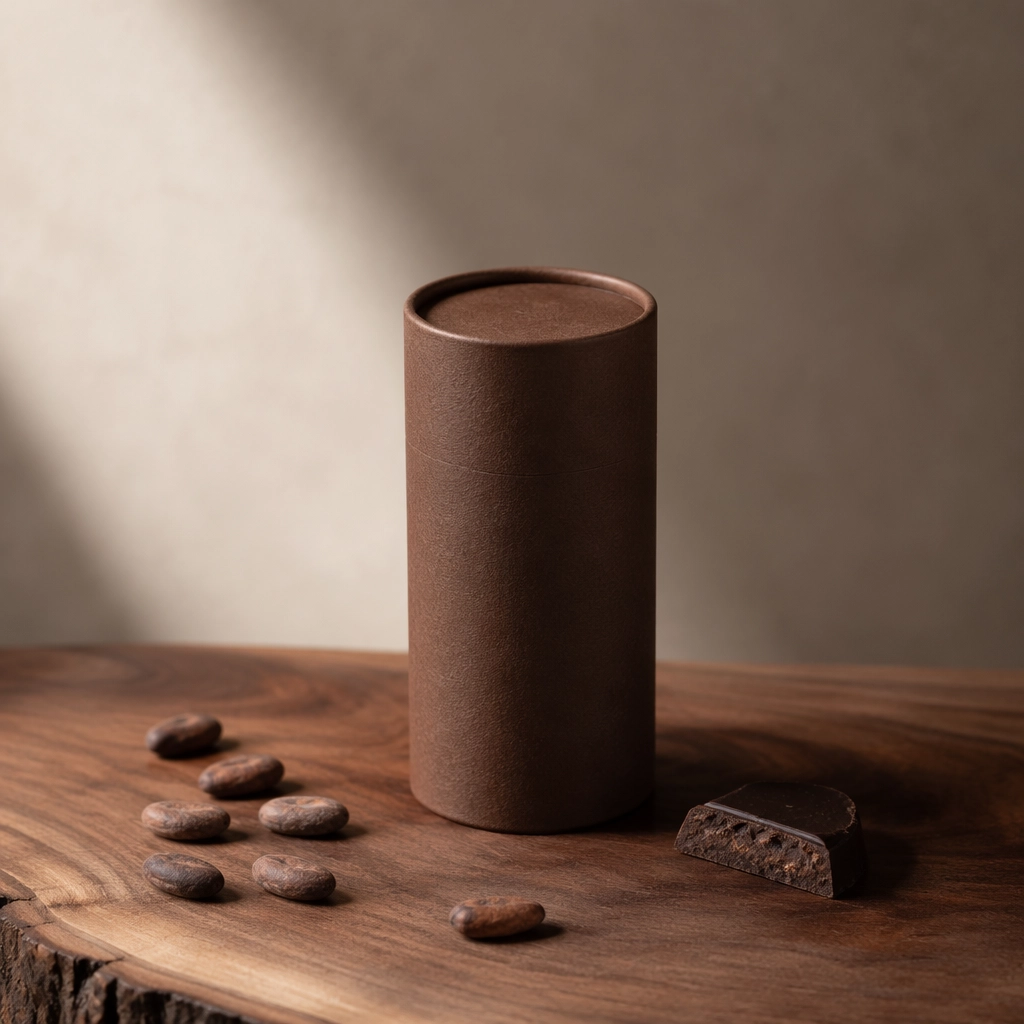
Most chocolate products use rectangular boxes or flexible pouches. A cylindrical tube creates a different silhouette, which can help the product stand out on a crowded retail shelf.
Strong Shelf Recognition
Large Branding Area
The round body provides space for illustrations, brand stories, product information, seasonal graphics and decorative patterns.
Brands can create either a minimalist design or a highly detailed retail presentation.
Premium Opening Experience
A fitted lid creates a slower and more deliberate opening process. This feeling works especially well for luxury chocolates, seasonal collections and corporate gifts.
Structural Protection
A rigid paperboard wall can provide resistance to side pressure and help protect chocolate products during retail handling.
However, the tube alone cannot prevent every type of damage. Delicate pralines and truffles may still require inserts, dividers and suitable outer shipping cartons.
Flexible Customization
Brands can customize the tube diameter, height, lid depth, materiale, stampa, surface finish and internal structure.
Consequently, the same packaging format can support several product sizes, price levels and sales channels.
Common Applications
chocolate paper tube packaging can support many confectionery products. Nevertheless, each application needs a different internal structure.
Chocolate Bars
Long paper tubes can hold individually wrapped chocolate bars or several smaller bars.
A paperboard tray or folded insert can prevent the bars from moving. In addition, a printed sleeve can separate different flavors or seasonal versions.
For rectangular bars, the internal space must be planned carefully. Otherwise, a round tube may contain too much empty space.
Chocolate Truffles
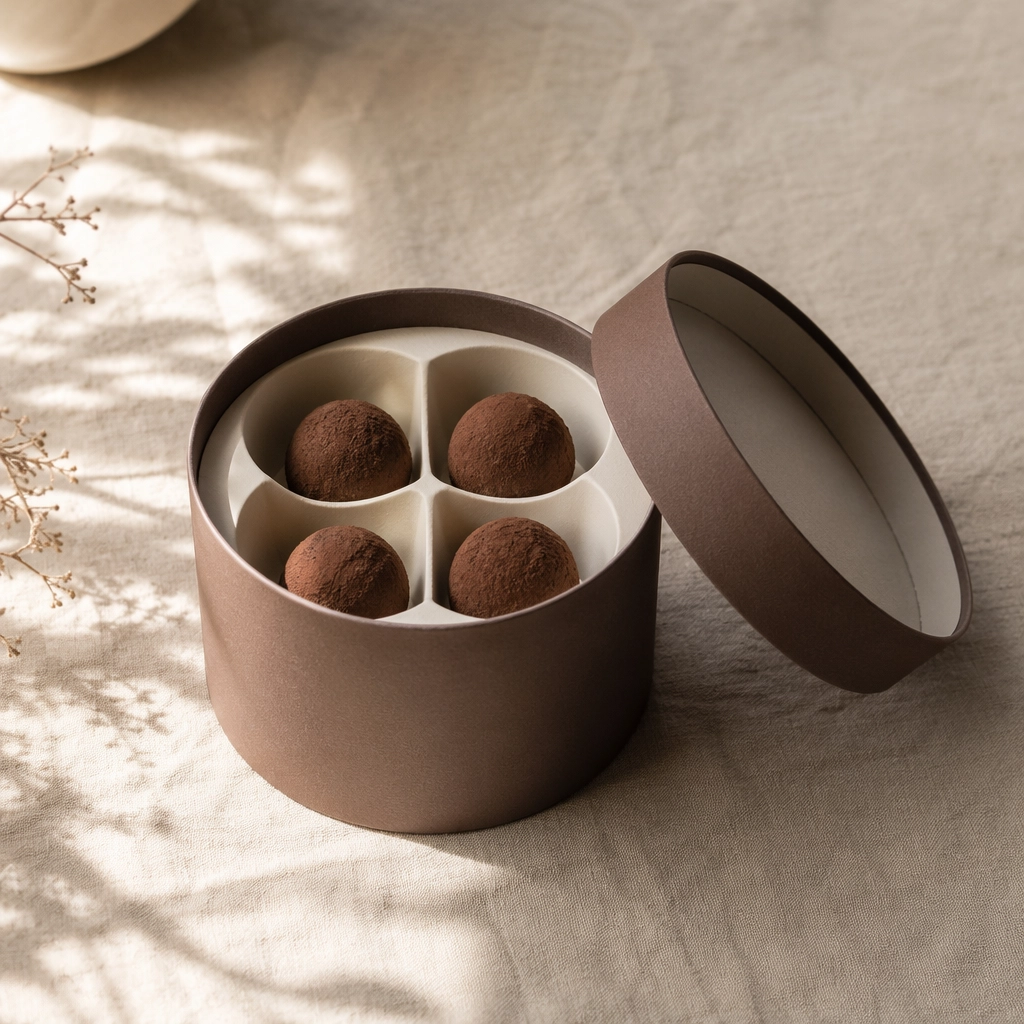
Premium truffles usually need individual compartments because the chocolate surface can mark, crack or rub during transportation.
A molded pulp tray, food-grade paperboard insert or approved plastic tray can hold each truffle separately.
The insert should fit the truffle diameter and height. It should also allow customers to remove each piece easily.
Pralines and Bonbons
Pralines and bonbons often feature delicate decoration, colored cocoa butter or fine toppings.
Therefore, the insert must prevent movement while avoiding excessive pressure on the chocolate.
Brands may arrange the chocolates in one circular layer or several separated levels, depending on the tube height.
Chocolate-Coated Nuts and Snacks
Chocolate-coated nuts, raisins, biscuits and coffee beans can be packed in a sealed inner pouch before placement inside the paper tube.
This solution often simplifies filling and helps keep the decorative outer tube separate from the primary food-contact package.
Cocoa Powder and Drinking Chocolate
Cocoa powder and drinking chocolate normally require a suitable sealed inner pouch or barrier liner.
The paper tube then provides the exterior structure and branding surface.
For powdered products, the closure and filling method should receive extra attention because fine powder can enter lid gaps and affect the opening experience.
Chocolate Gift Sets
A larger chocolate paper tube packaging can contain multiple chocolates, small bars or individually wrapped products.
Brands may also combine chocolate with coffee, tea, biscuits or promotional gifts.
In this case, internal dividers help organize the products and create a more premium presentation.
Seasonal Chocolate Collections
Chocolate tubes are suitable for:
- Christmas gifts
- Valentine’s Day collections
- Easter chocolate
- Lunar New Year gifts
- Wedding favors
- Mother’s Day products
- Corporate holiday gifts
- Limited-edition launches
A standard tube structure can sometimes remain unchanged while the outer printed wrap, sleeve or label changes for each season.
This approach can reduce repeated structural development work.
Corporate and Promotional Gifts
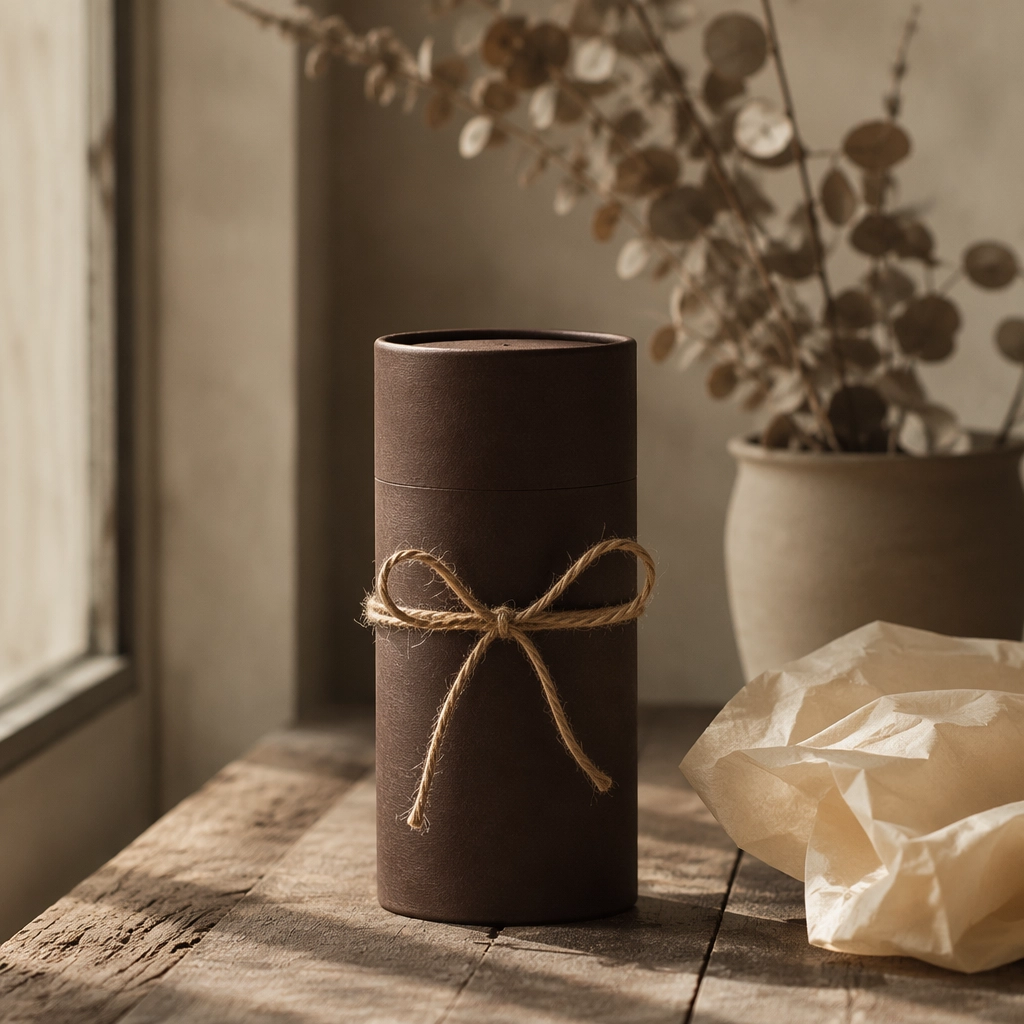
Hotels, luxury retailers, event companies and corporate buyers often need custom chocolate paper tube packaging with their own logo.
Stampa a caldo, embossing and personalized sleeves can create a professional gift without redesigning the entire package.
Material Options
The material combination affects appearance, strength, barrier performance, cost and recyclability.
Therefore, material selection should begin with the product requirements, not only the visual design.
Rigid Paperboard Core
The main body normally uses multiple layers of paperboard to create the cylindrical wall.
The required wall thickness depends on:
- Tube diameter
- Tube height
- Chocolate weight
- Insert structure
- Stacking requirements
- Transport method
- Target price
A thicker wall may provide greater rigidity. However, it can also increase material use, packaging weight and freight cost.
The best specification should balance protection and efficiency.
Natural Kraft Paper
Natural kraft paper creates an organic and environmentally focused appearance.
It suits:
- Handmade chocolate
- Organic chocolate
- Bean-to-bar products
- Vegan chocolate
- Artisan confectionery
- Natural ingredient brands
Kraft paper also works well with simple black printing, white ink and understated foil details.
However, colors printed on brown kraft may appear darker or less saturated than colors printed on white coated paper.
White Kraft Paper
White kraft offers a cleaner printing background while retaining a natural paper texture.
It works particularly well for modern food brands that want a simple, fresh and environmentally focused image.
Coated Art Paper
Art paper supports detailed CMYK printing, photographs, illustrations and smooth color blocks.
It is a practical option for retail chocolate packaging that requires:
- Bright colors
- Accurate graphics
- Detailed product illustrations
- Seasonal artwork
- Consistent brand presentation
A matte or gloss lamination can be added to improve the surface appearance and handling resistance.
Specialty Paper
Specialty papers can create a more tactile and luxurious finish.
Available options may include:
- Textured paper
- Pearl paper
- Metallic paper
- Linen paper
- Soft-touch paper
- Embossed paper
- Colored uncoated paper
Specialty paper can improve perceived value. Still, brands should approve a physical sample because paper texture can influence printed colors, small text and foil-stamping details.
Food-Grade Inner Paper
Food-grade inner paper may be suitable for specific indirect or direct-contact applications when the complete material complies with the relevant requirements.
Nevertheless, suitability depends on the chocolate type and intended conditions of use.
Chocolate contains fat, and some products also include fillings, nuts, fruit, caramel or flavoring. Therefore, buyers should confirm whether the inner material requires grease resistance or a stronger functional barrier.
Grease-Resistant Liner
A grease-resistant liner can help reduce oil marks and migration into the structural paper layers.
This may be useful for chocolates that are not individually wrapped.
However, the complete package must still be evaluated for the actual food-contact application.
Foil-Based Liner
A foil-based or multilayer liner may provide stronger protection against moisture, aroma transfer and external odors.
This structure can be useful for products that require greater barrier performance.
However, a foil liner does not automatically guarantee a specific shelf life. The chocolate brand should validate the final package with the actual product, sealing method and storage conditions.
Sealed Inner Pouch
For many chocolate products, a sealed inner pouch is a practical solution.
The pouch acts as the primary food-contact package, while the chocolate paper tube packaging acts as the rigid outer container.
This arrangement can offer several advantages:
- Easier filling
- Better separation between food and printed surfaces
- Flexible barrier selection
- Simpler tube cleaning requirements
- Easier product replacement
- Stronger protection against loose crumbs or cocoa powder
Even so, the brand should clearly communicate how customers should separate and dispose of the different packaging components.
Molded Pulp
Molded pulp can hold chocolates in fixed positions while maintaining a paper-based appearance.
It works well for premium truffles, pralines and gift assortments.
However, complex molded pulp inserts may require tooling and larger minimum quantities.
Food-Grade Paperboard Inserts
Folded paperboard inserts provide a flexible option for holding chocolate bars, wrapped pieces and gift-set components.
They can also carry printed instructions, flavor names or product stories.
Structure Options
The tube structure should match the chocolate shape, filling process and desired opening experience.
Lid-and-Base Paper Tube
A lid-and-base tube includes a main body and a removable top lid.
It is one of the most common structures because it is simple, recognizable and suitable for many retail applications.
The lid depth can be adjusted depending on the desired appearance and opening resistance.
Telescopic Paper Tube
A telescopic tube includes an upper lid that slides over part or most of the lower body.
A short-overlap lid creates a convenient retail structure.
Meanwhile, a full or long-overlap lid can create a more luxurious gift presentation.
Shoulder and Neck Tube
A shoulder and neck structure creates a visible inner section between the lid and base.
This construction can produce a more precise and premium opening experience.
Brands may use a contrasting color on the exposed neck to highlight the package design.
Compartment Insert
Individual compartments prevent truffles and pralines from touching each other.
The insert can be designed as:
- One circular tray
- Multiple stacked trays
- A removable drawer-like layer
- A folded paper grid
- A molded pulp tray
- A combination of dividers and layer pads
The insert should support the product without damaging decorative chocolate surfaces.
Layered Structure
A tall tube can hold several layers of chocolate.
Each level may include a tray, separator or pull tab. This structure can create an enjoyable discovery experience because customers reveal one layer at a time.
However, layered structures require careful tolerance control. If the trays fit too tightly, customers may struggle to remove them.
Window Tube
A transparent window allows customers to see the chocolate inside.
This can increase visual appeal in retail environments. Nevertheless, the window may influence structural strength, light protection, recyclability and barrier performance.
For that reason, brands should evaluate whether the window creates enough sales value to justify the added material complexity.
Paper Sleeve
A removable paper sleeve can carry:
- Seasonal artwork
- Flavor information
- Multilingual labels
- Promotional messages
- Retail barcodes
- Corporate branding
Using a sleeve may allow one standard tube to support several product variations.
Tamper-Evident Seal
A paper label, shrink band or other suitable seal can show whether the package has been opened.
The correct option depends on the tube structure, filling process and target market.
Push-Up and Twist-Up Structures
Push-up and twist-up paper tubes are mainly associated with solid cosmetics, lip balm and similar products.
Although special chocolate concepts may use unusual dispensing structures, these formats are not normally the first choice for delicate chocolates.
For most chocolate products, lid-and-base, telescopic or compartment structures provide a more practical solution.
Printing and Finishing Options
Packaging finishes help customers understand the product’s price level before they even open it.
However, premium design does not mean adding every available effect. In fact, a restrained finish often looks more sophisticated than an overcrowded surface.
CMYK Printing
CMYK printing supports:
- Photographs
- Gradients
- Illustrations
- Multi-color artwork
- Seasonal graphics
- Detailed chocolate imagery
It is suitable for colorful retail packaging and brands with complex designs.
Pantone Color Printing
Pantone color matching helps brands achieve more consistent solid colors.
This is especially useful when the brand uses a recognizable signature color across boxes, tubes, bags and retail displays.
Because paper type and surface coating can change the final appearance, buyers should approve a physical sample or production proof.
Hot Foil Stamping
Hot foil stamping creates a reflective metallic or colored detail.
Common choices include:
- Gold foil
- Silver foil
- Copper foil
- Rose-gold foil
- Holographic foil
- Matte foil
- Custom-colored foil
Foil works well on logos, borders, product names and limited-edition details.
Embossing
Embossing raises the selected artwork above the paper surface.
It can highlight:
- Logos
- Cocoa illustrations
- Decorative patterns
- Product names
- Brand symbols
The effect becomes especially noticeable under soft retail lighting.
Debossing
Debossing presses the artwork into the surface.
It creates a subtle, tactile appearance that suits minimalist and luxury chocolate brands.
Spot UV
Spot UV adds gloss to selected areas while the surrounding surface remains matte.
Brands can use it to highlight melted chocolate graphics, cocoa beans, logos or decorative patterns.
Matte Lamination
Matte lamination creates a smooth, understated surface.
It is one of the most common choices for premium chocolate paper tube packaging because it provides a refined appearance without excessive reflection.
Gloss Lamination
Gloss lamination makes printed colors appear brighter and more reflective.
It can work well for children’s chocolate, colorful seasonal products and mass-market retail packaging.
Soft-Touch Finish
Soft-touch finishing creates a velvety surface.
It can increase the sensory value of luxury packaging. However, buyers should evaluate the cost, handling resistance and recycling goals before selecting it.
Anti-Scratch Finish
Dark chocolate packaging often shows scratches, fingerprints and rubbing marks more clearly than light-colored packaging.
An anti-scratch surface can help reduce visible handling marks, although no coating can prevent every type of damage.
Compliance and Sustainability
Compliance should never be treated as a decorative line of logos.
Professional buyers usually want to know:
- Which organization issued the certificate
- Which production site it covers
- Which activities are included in its scope
- Whether the certificate remains valid
- Whether the material matches the tested construction
- Whether the report applies to direct or indirect food contact
Food-Contact Safety
First, determine whether the chocolate directly touches the liner, insert, pouch or paper tube.
When direct contact occurs, the relevant material must be suitable for the intended food and conditions of use.
EU food-contact rules require materials to avoid transferring substances into food at levels that could endanger health, cause unacceptable changes in composition or affect taste and odor. e, buyers should request documents that match the final material structure rather than relying only on a general food-grade statement.
BRCGS Packaging Materials
BRCGS Packaging Materials provides a framework for packaging manufacturers to manage product safety, qualità, legal compliance and operational controls.
The current BRCGS Packaging Materials standard is Issue 7, and its scope includes packaging used for food and other applications. a site-level BRCGS certificate does not automatically prove that every packaging material is suitable for every chocolate product.
Buyers should review:
- Certificate scope
- Production-site information
- Material specifications
- Food-contact documents
- Final package construction
IFS Food and IFS PACsecure
Buyers should confirm the exact type of IFS certification.
IFS Food focuses on food-processing operations. In contrast, IFS PACsecure specifically covers packaging material manufacturing and converting processes related to safety, quality and regulatory requirements. e, suppliers should provide the actual certificate and scope rather than referring only to a general IFS logo.
FSC-Certified Paper Options
FSC-certified paper options can support responsible fiber-sourcing objectives.
When a project requires an FSC label or claim, the supplier should confirm:
- Chain-of-custody scope
- Material availability
- Claim type
- Artwork approval
- Logo-use requirements
FSC certification and logo use should be confirmed before mass printing, not added after production.
EUDR Considerations
EUDR aims to reduce the EU market’s connection with deforestation and forest degradation. Its relevant commodities include cocoa and wood-derived products. olate brands, EUDR questions may involve both the cocoa supply chain and certain paper or wood-derived packaging products.
However, packaging applicability depends on factors such as product classification, whether the packaging is traded as a product in its own right and the latest exemptions or scope updates.
In July 2026, the European Commission announced targeted product-scope clarifications and exemptions for certain packing materials. Therefore, buyers should confirm the current CN code and market role instead of describing EUDR as a simple packaging certificate. nded Producer Responsibility
EPR means producers may bear financial or organizational responsibility for managing the waste stage of a product’s life cycle. aging, the responsible party may be the brand owner, importer, distributor or another entity placing the packaged product on the market.
A packaging manufacturer can provide information such as:
- Material composition
- Component weight
- Packaging dimensions
- Recyclability information
- Separation instructions
Nevertheless, the chocolate brand or importer should confirm its own registration, reporting and fee obligations in each target market.
Packaging and Packaging Waste Regulation
The EU Packaging and Packaging Waste Regulation applies to packaging placed on the EU market and introduces requirements related to packaging design, waste prevention, recyclability, labeling and producer responsibility. ult, chocolate brands should avoid unnecessary packaging space and consider how consumers will separate each component after use.
Practical Sustainability
Sustainable packaging involves more than replacing plastic with paper.
Brands should consider:
- Total material weight
- Number of combined materials
- Empty space inside the tube
- Product protection
- Food-waste prevention
- Transport efficiency
- Material sourcing
- End-of-life separation
- Local recycling infrastructure
For example, an all-paper appearance may look environmentally friendly. However, if the package does not protect the chocolate properly, product damage and food waste may increase.
On the other hand, a removable inner pouch may provide the necessary barrier while allowing customers to separate the pouch from the paper tube.
Therefore, the best solution balances product protection, material efficiency and clear disposal instructions.
Related Products
Custom Paper Tubes
Explore rigid paper tubes for chocolate, coffee, tea, cookies, cosmetics and gift products.
Imballaggio alimentare
Discover custom food packaging structures with optional food-grade liners, pouches, trays and inserts.
Imballaggio cosmetico
View premium paper tubes and rigid boxes for skincare, profumo, essential oils and beauty products.
Add crawlable internal links to the relevant category pages using descriptive anchor text. Google uses internal links to discover pages and understand their relationship and context. o Customize Chocolate Paper Tube Packaging
A successful custom project begins with clear product information.
Honestly, the more details the supplier receives at the beginning, the fewer revisions buyers usually face during sampling.
Step 1: Share the Chocolate Information
Provide:
- Chocolate type
- Product dimensions
- Individual weight
- Total packing weight
- Number of pieces
- Filling or ingredient information
- Whether each piece is individually wrapped
- Expected shelf life
- Storage conditions
Physical chocolate samples are especially useful for truffles, pralines and handmade products because actual dimensions may vary.
Step 2: Confirm Direct or Indirect Food Contact
Explain whether the chocolate will:
- Touch the liner directly
- Sit inside an individual wrapper
- Remain inside a sealed pouch
- Sit inside a tray or compartment
- Use several packaging layers
This information helps the manufacturer recommend an appropriate material structure.
Step 3: Provide the Target Market
Different markets may have different requirements for:
- Food-contact documentation
- Recycling labels
- Packaging waste registration
- Language
- Barcodes
- Product warnings
- Import information
Therefore, provide the target country before confirming materials.
Step 4: Select the Tube Size
The tube diameter and height depend on:
- Chocolate dimensions
- Product arrangement
- Insert thickness
- Number of layers
- Required headspace
- Lid structure
- Opening method
The internal dimensions matter more than the external dimensions because the insert and liner reduce the usable space.
Step 5: Choose the Material
Select from:
- Natural kraft paper
- White kraft paper
- Art paper
- Specialty paper
- Food-grade inner paper
- Grease-resistant liner
- Foil-based liner
- Sealed inner pouch
The team should recommend the structure based on both the chocolate and brand positioning.
Step 6: Design the Insert
Provide physical samples or accurate product drawings.
The insert should:
- Hold each chocolate securely
- Prevent movement
- Avoid surface damage
- Allow easy removal
- Fit the tube consistently
- Support efficient filling
For handmade chocolate, allow a reasonable dimensional tolerance.
Step 7: Prepare the Artwork
Preferred files normally include:
- Adobe Illustrator files
- Editable PDF files
- EPS vector files
- High-resolution linked images
- Pantone color references
The artwork should include:
- Bleed
- Cutting line
- Barcode
- Logo
- Ingredient or product information
- Required legal text
- Disposal instructions
- Target-market language
Step 8: Confirm the Sample Type
A plain sample can confirm:
- Misurare
- Struttura
- Lid fit
- Insert position
- Product arrangement
A digital printed sample can review:
- Artwork layout
- General color direction
- Text size
- Visual balance
A production-standard sample may be necessary for:
- Pantone color matching
- Stampa a caldo
- Embossing
- Debossing
- Specialty paper
- Complex inserts
Step 9: Confirm MOQ
MOQ depends on:
- Tube diameter
- Tube height
- Paper material
- Printing process
- Liner
- Insert
- Surface finish
- Packing method
Request prices at several quantity levels. This makes it easier to compare unit cost, tooling cost, inventory risk and freight efficiency.
Step 10: Confirm Lead Time
Lead time normally includes:
- Artwork preparation
- Structural sampling
- Sample approval
- Material purchasing
- Printing
- Tube forming
- Insert production
- Assembly
- Inspection
- Export packing
Seasonal chocolate packaging should begin early because Christmas, Valentine’s Day and Easter projects often share similar production periods.
Step 11: Approve Production Details
Before mass production, confirm in writing:
- Final dimensions
- Materials
- Printing colors
- Surface finishes
- Insert structure
- Packing quantity
- Carton size
- Inspection standard
- Required documents
- Delivery schedule
This step may feel detailed. However, it gives both the buyer and manufacturer a clear production reference.
Why Choose Pack Packaging?
Chocolate packaging must look premium, but it must also work during filling, storage and shipping.
Pack Packaging supports brands with structure development, material selection, artwork review, sampling, printing and mass production.
20,000 Square Meter Manufacturing Base
Our manufacturing base supports custom paper tube and paper box projects for food, cosmetici, gifts and other consumer products.
2,000 Square Meter Food-Grade Workshop
Our dedicated food-grade production area supports packaging projects that require stronger hygiene and production controls.
Monthly Capacity of More Than 10,000,000 Paper Tubes
Large-scale production capacity supports:
- Retail launches
- Seasonal programs
- Private-label orders
- Promotional campaigns
- Repeat purchasing
- Multi-market projects
More Than 20 Packaging Designers
Our design team can support:
- Tube structure development
- Insert engineering
- Artwork adaptation
- Color matching
- Material selection
- Surface-finishing recommendations
- Sample preparation
OEM and ODM Customization
Customers can customize:
- Diameter
- Height
- Lid depth
- Paper material
- Inner liner
- Insert
- Printing
- Logo
- Surface finish
- Packing method
We can develop packaging from the initial product concept rather than limiting brands to standard stock sizes.
Flexible Sampling Support
Samples help buyers evaluate the size, structure, appearance and opening experience before mass production.
Our team can recommend a suitable sampling method according to the project stage.
Compliance Document Support
Available documents depend on the material, production scope, target market and final construction.
Therefore, our team reviews each project individually and helps organize the relevant certificate, test report and material information.
Export Packaging Experience
Export projects require more than an attractive retail package.
The outer carton, packing quantity, carton dimensions and transport protection can directly influence freight cost and damage risk.
Our team can discuss the retail package and export packing together.
Frequently Asked Questions
1. Can chocolate directly touch the inside of a paper tube?
Chocolate should only touch a material that is suitable for the intended food-contact application. Depending on the product, the package may use a food-grade liner, grease-resistant paper, approved tray or sealed inner pouch. The final structure should be confirmed with the actual chocolate and destination market.
2. Does a paper tube keep chocolate fresh?
The rigid tube provides structure and exterior protection. However, freshness depends mainly on the complete barrier and sealing system. A sealed wrapper, inner pouch or higher-barrier liner may be required. The chocolate brand should validate shelf life using the final packed product.
3. Can you make inserts for chocolate truffles?
SÌ. Inserts can be customized according to the truffle diameter, height, shape and arrangement. Available options may include paperboard trays, dividers, molded pulp and other suitable materials.
4. Can the tube hold several layers of chocolate?
SÌ. A tall tube can use multiple trays or separator layers. However, each layer must remain easy to remove and strong enough to protect the chocolates underneath.
5. Can you customize any tube diameter and height?
SÌ. The diameter and height can be developed according to the chocolate dimensions, insert structure and required capacity. Providing physical samples helps improve the fit.
6. What is the MOQ for custom chocolate paper tubes?
MOQ depends on the dimensions, paper, stampa, liner, insert and finishing process. Send the required quantity and specifications to receive a project-based quotation.
7. Can I receive a sample before placing a bulk order?
SÌ. Plain structural samples, digitally printed samples and production-standard samples may be available. The recommended sample type depends on the structure and finishing requirements.
8. Which artwork files should I provide?
Editable AI, PDF or EPS vector files are preferred. Please include the logo, text, barcode, required market information and Pantone references when accurate brand colors are important.
Explore More Custom Packaging Solutions
Looking for more packaging options? Discover our complete range of custom packaging products designed for different industries and applications.
Scatole pieghevoli – Lightweight and fully customizable cartons for retail packaging.
Scatole rigide – Premium rigid gift boxes for luxury brands.
Scatole di cartone ondulato – Durable shipping and e-commerce packaging solutions.
Scatole a prova di bambino – Secure packaging for regulated products.
Accessori – Custom inserts, tissue paper, ribbons, labels, and more.
Paper Tubes – Explore our dedicated collection of custom paper tube packaging for tea, coffee, cosmetici, candele, spirits, and other premium products on our specialized website.
Need custom packaging? Contact our team today for a free quote and expert consultation.