
Thistubo de papel de qualidade alimentar case study follows a granola and nut snack brand that wanted to leave rigid plastic canisters behind — without letting their product go stale or greasy on shelf. Fat migration, moisture pickup, and retailer audits all landed on the table at once. So the interesting work sat in the liner, not the printed wrap everyone photographs.
Below, we walk through how the project actually ran: the brief, the barrier decisions, the compliance paperwork, and the shelf-life trial that forced us back to the drawing board once.
🔘 [Obtenha orçamento de embalagem personalizada →]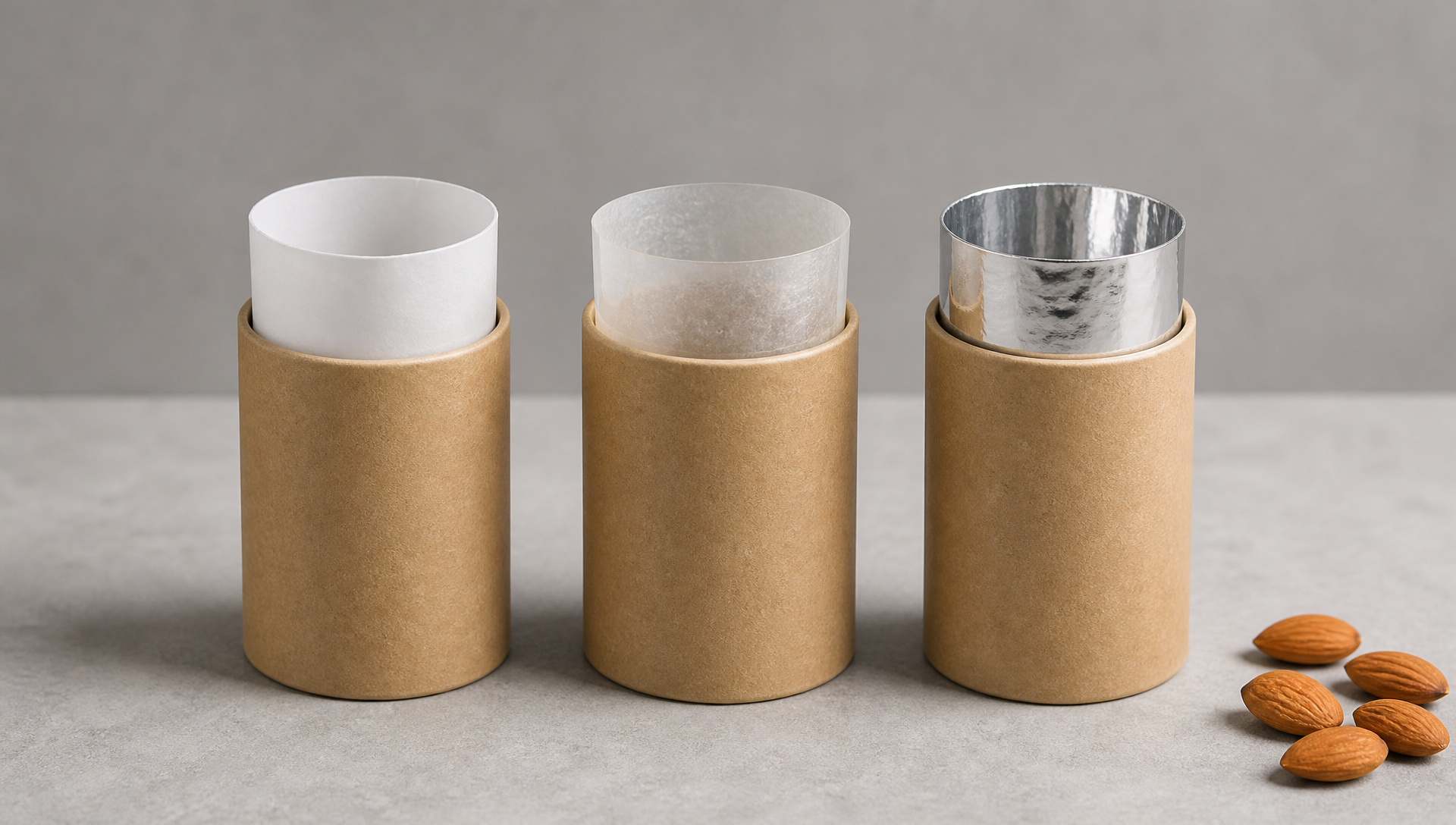
The Brief and Its Constraints
What the Brand Wanted
A 250g granola and coated-nut range in a cylindrical format. No rigid plastic canister. Reclosable for multi-serve use. And it had to pass a UK retailer’s supplier audit before listing.
The Tension in That Request
Here’s the awkward part though. Nuts carry oil, coated snacks carry sugar and fat, and both attack bare paperboard over time. Removing plastic entirely was never realistic. Em vez de, the question became how little plastic we could use, and how cleanly it could separate afterwards.
Why They Chose a Tube
Cylindrical formats stand apart in a snack aisle dominated by flexible pouches and rigid canisters. Além disso, a tube stands upright at home and reads as premium rather than disposable. Our relatedestudo de caso de embalagem de tubo de papel de perfume covers the same construction applied to glass fragrance bottles.
What a Food Grade Paper Tube Actually Is
Construction Basics
The body is wound or seamed paperboard, wrapped in printed paper, with a base disc and a lid. No entanto, the part that matters for edibles sits inside: a compliant inner layer that separates food from board, adesivo, and ink.
Where the “Food Grade” Part Lives
Calling something atubo de papel de qualidade alimentar is not a description of the paper alone. It covers the liner, the adhesive, the printing inks, the base disc seal, and the manufacturing environment. Consequentemente, a certificate covering only the board tells you very little.
Direct Contact Versus Indirect Contact
If snacks touch the inner wall, you need a direct-contact specification throughout. Enquanto isso, if the product sits in a sealed inner bag, the tube becomes secondary packaging and the requirements ease considerably. This distinction drove nearly every decision on the project.
Where a Food Grade Paper Tube Applies Beyond Snacks
Tubes suit far more than granola, so it’s worth seeing where else the construction earns its keep:
- Chá e café — Loose leaf and whole bean around a sealed pouch or foil liner. Ver Embalagens de alimentos sustentáveis para chá, Café e Lanches for barrier detail.
- Nozes, dried fruit and confectionery — Oxygen and grease drive the specification here more than moisture.
- Spices, powders and supplements — Aroma retention and moisture control matter most, and tubes handle both well.
- Biscuits and baked goods — Greaseproof liners prevent staining that would otherwise ruin the printed wrap.
- Beauty, candles and fragrance — Non-food applications where a liner is unnecessary. Read Ideias de embalagens sem plástico para cosméticos e cuidados com a pele.

Material Decisions for This Food Grade Paper Tube
The Body and Wrap
We specified a heavier board wall than their reference sample, because a 250g fill needs rigidity when a shopper grips it one-handed. On the wrap, coated art paper carried their photographic artwork cleanly. No entanto, we flagged that standard lamination would complicate their recycling story, so we moved to an aqueous coating instead.
The Liner Options We Weighed
Three candidates went on the table. Plain food-grade white paper handled dry goods but offered almost no grease resistance. Greaseproof paper managed the oil but not oxygen. Foil laminate solved everything technically, yet it undermined the brand’s fibre-forward positioning.
What We Landed On
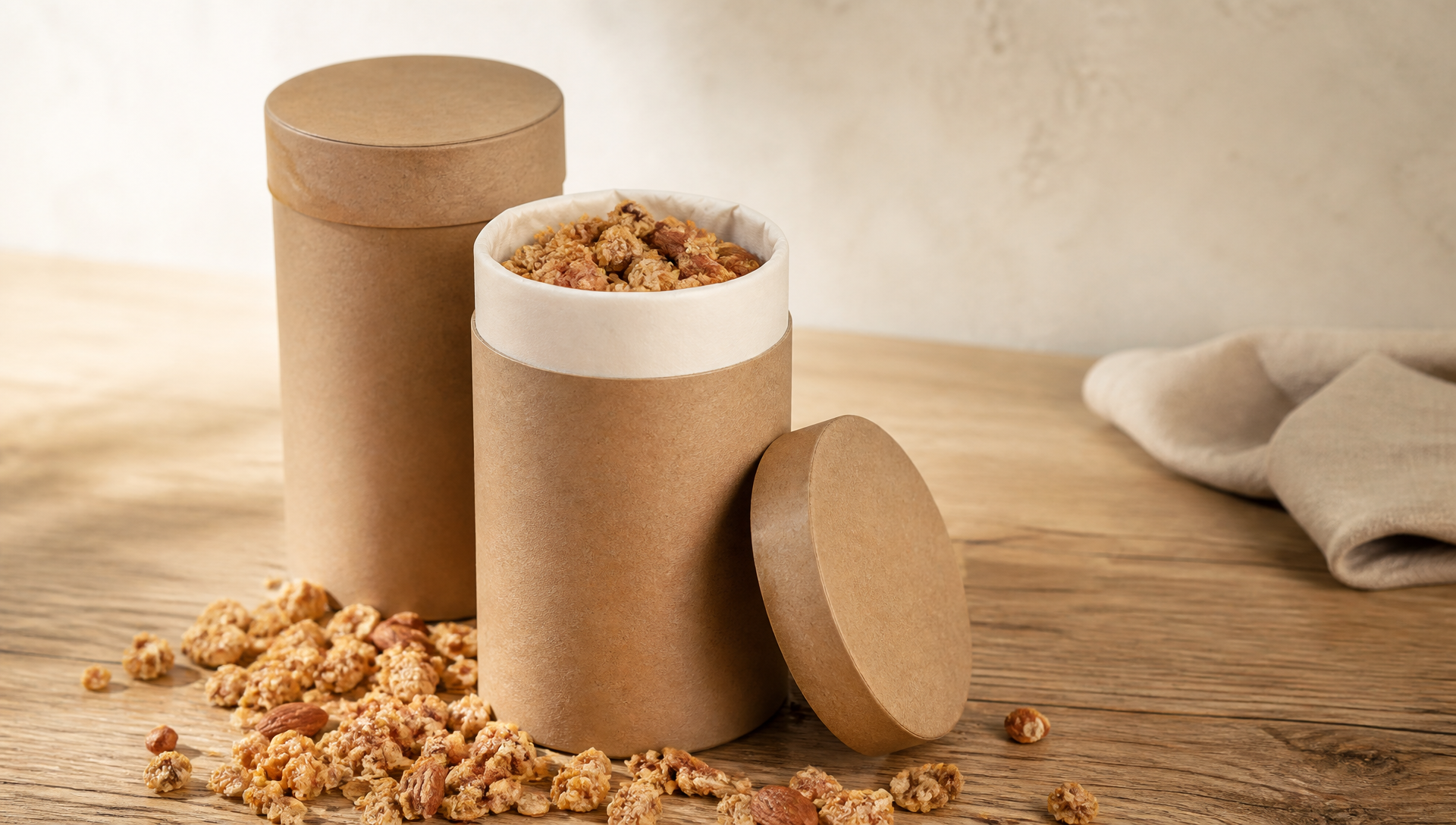
For the granola SKU, a greaseproof liner proved sufficient. For the coated-nut SKU, oxygen exposure drove rancidity risk, so that variant kept a sealed inner pouch inside the tube. So the same outer structure carried two different internal specifications — which, honestamente, is a very common outcome.
Fibra Certificada
Their retailer required FSC-certified material. Our guide on Embalagem de papel certificada FSC explains chain of custody, enquanto Embalagem de tubo de papel biodegradável covers fibre options in more depth.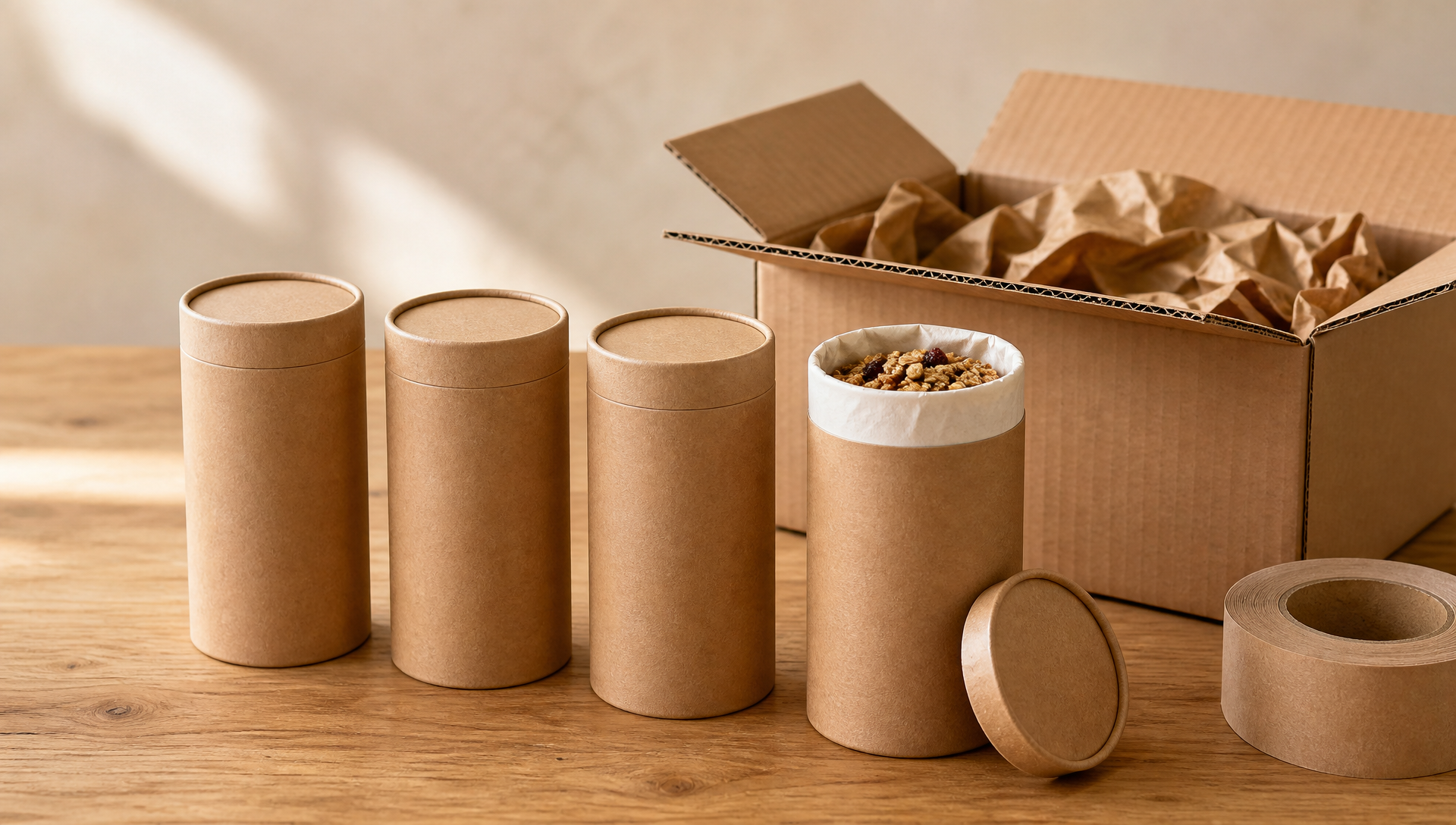
Food Grade Paper Tube Structures We Tested
Telescopic Lid and Base
The simplesttubo de papel de qualidade alimentar build: a deep lid over a deep base. Simples, protective, and reclosable enough for multi-serve snacking. This became the final choice.
📦Produtos Relacionados: Tubos de papel personalizados / Embalagem de alimentos / Embalagens Cosméticas
Metal Ends and Tin-Tie Alternatives
A metal push-lid gave the best reseal but added a mixed material and raised the EPR fee band. Enquanto isso, a tin-tie closure suited coffee better than a rigid snack tube. Both went aside.
Shoulder-Neck and Window Options
A shoulder-neck build looked premium yet added tooling cost the brand couldn’t justify at launch volume. A film window would have shown the granola attractively, though it reintroduced plastic — so we proposed showing product through photography instead.
Alternatives Considered
They also pricedcaixas rígidas ecaixas dobráveis. Both worked commercially, although neither delivered the standing shelf presence they wanted.
Printing and Finishing on a Food Grade Paper Tube
Ink Systems Come First
Here’s something specific to edibles. Ink choice is not purely aesthetic, because migration through board is a genuine consideration. Portanto, we ran low-migration ink systems and documented them for the audit file.
Print Methods Used
CMYK offset carried their photographic granola imagery, while a Pantone spot handled the brand green so it stayed consistent across both SKUs and every production run.
Finishes That Worked
Embossing on the lid added tactile quality with no added material. Adicionalmente, a matte aqueous coating gave scuff resistance without plastic film. We skipped hot stamping on this range, since the brand wanted an honest, unfussy look rather than a luxury one.
What We Removed
Their original artwork specified gloss lamination. Removing it improved the recycling story and reduced cost, though it did soften the colour slightly. A small print adjustment compensated for that.
Testing: Where the Food Grade Paper Tube Nearly Failed
The First Shelf-Life Trial
We ran an accelerated trial with the real coated-nut product rather than an empty sample. After several weeks, faint oil shadowing appeared along the base seam — not through the liner itself, but at the join where the liner met the base disc.
The Diagnosis
The liner stopped short of full coverage at the base. Consequentemente, oil crept into the seam and wicked outward into the board.
The Fix
We extended the liner to overlap the base disc fully and switched the base adhesive to a food-grade grade rated for fatty contact. So the seam stopped being the weak point.
Second Round
The revised build ran clean through the repeat trial. We also ran compression testing, since these ship stacked in master cartons and snack retailers stack aggressively on shelf.
The Transit Layer
For e-commerce orders, tubes travel inside aondulado mailer with paper void fill, keeping the outbound experience free of plastic.
Compliance for a Food Grade Paper Tube
Snack retailers audit this component thoroughly, so we assembled documentation before production rather than after:
- Segurança em contato com alimentos — Regulamento da UE (CE) Não 1935/2004 on food contact materials, plus Good Manufacturing Practice under Regulation (CE) Não 2023/2006. We supplied declarations of compliance covering liner, adesivo, and inks — not just the board.
- Materiais de embalagem BRCGS - Edição atual 7. Their UK retail partner requested evidence before listing.
- IFS PAC seguro — A packaging-specific standard recognised across EU retail, worth holding for food applications.
- FSC — Certified fibre with chain of custody through the converter.
- RPE — The brand registers and pays fees per EU market. We supplied component weights split by material, since the pouch-lined SKU carries a different fee profile. Ver Conformidade de embalagens EPR.
- PPWR and EUDR — PPWR applies from 12 Agosto 2026 em toda a UE. Enquanto isso, As obrigações do EUDR recaem sobre 30 dezembro 2026 para grandes e médias operadoras, e 30 Junho 2027 para micro e pequenas operadoras.
- Claims wording — We advised “paper-based tube with a separable liner” rather than a blanket plastic-free claim, because the pouch-lined SKU would not survive that scrutiny. Nosso Embalagem de papel reciclável guide covers wording properly.
How to Customize a Food Grade Paper Tube: Etapas 1–3
Etapa 1: Describe the Product Honestly
Primeiro, tell us fat content, umidade, aroma sensitivity, target shelf life, and whether the snack touches the wall directly. For atubo de papel de qualidade alimentar, these answers determine the liner before anyone discusses artwork.
Etapa 2: Decide Where the Barrier Sits
Próximo, choose between a lined tube and a sealed inner pouch. Both are legitimate. No entanto, they produce different claims, different EPR weights, and quite different costs.
Etapa 3: Structure and Dieline
Then we recommend diameter, espessura da parede, tipo de tampa, and closure, and supply a dieline for your artwork team.
Sampling and Production: Etapas 4–6
Etapa 4: Amostra Branca
Every project starts with an unprinted structural sample to validate fit, rigidez, and closure feel. Honestamente, skipping this causes more delays than any other decision.
Etapa 5: Shelf-Life and Transit Testing
Then a finished pre-production sample. Run your shelf-life trial with the actual product, because fats and aromatics behave nothing like an empty tube. As this project proved, seams fail before surfaces do.
Etapa 6: Quantidade mínima, Lead Time and Documentation
MOQ for atubo de papel de qualidade alimentar typically starts at 500–1,000 units depending on diameter and liner. Lead time usually runs 25–35 days after sample approval. We supply compliance documentation alongside delivery for your audit file.
Why Choose Pack Packaging for Your Food Grade Paper Tube
Food-Safe Manufacturing
- 2,000㎡ oficina de qualidade alimentar — A dedicated, separated production environment. For any tubo de papel de qualidade alimentar, this is the single most important thing to verify in a supplier.
- 20,000㎡ fábrica — Tube winding, embrulho, resina, corte e vinco, e montagem tudo em casa, so we control every contact surface.
- 10,000,000+ capacidade mensal — We scale from a 5,000-unit pilot to millions without changing supplier.
Design and Documentation
- 20+ designers internos - Nunca terceirizado. Structural development, liner selection, criação dieline, e obras de arte prontas para impressão.
- Audit-ready paperwork — Declarations of compliance, low-migration ink documentation, Cadeia de custódia FSC, and component weights for EPR filings.
- Iterative testing — This project ran two full shelf-life trials. We’d rather find a seam failure in a trial than in a retailer’s warehouse.
- 60+ mercados de exportação — Incoterms e alfândegas tratados diariamente.
Uma nota honesta
We won’t tell you every snack can sit directly against fibre. High-fat, high-oxygen products often still need a sealed inner pouch, and pretending otherwise leads to rancidity complaints. So we’d rather design a genuinely separable structure and word the claim accurately.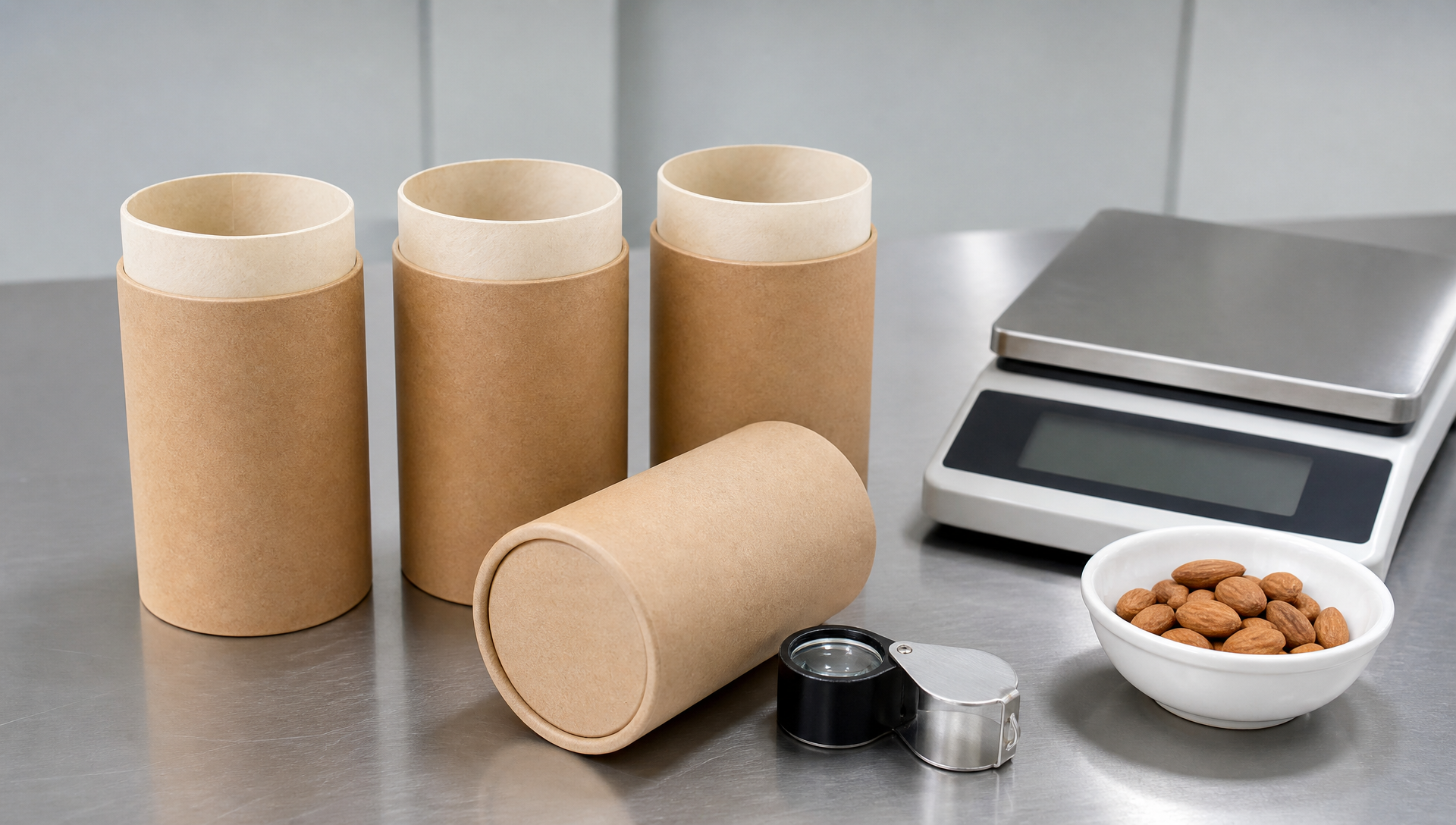
Perguntas frequentes: Food Grade Paper Tube Safety and Shelf Life
1º trimestre: Can snacks touch the paper tube directly? Only with a compliant direct-contact liner covering every contact surface, including the base seam. Dry, low-fat products manage this comfortably. No entanto, oily or coated snacks usually need a stronger barrier or a sealed inner pouch.
2º trimestre: How long will my product stay fresh? That depends on your product, the barrier specification, and storage conditions — so nobody can quote a number without testing. Consequentemente, we always recommend a real shelf-life trial with your actual recipe.
3º trimestre: Will oil stain through the printed wrap? It can, and this project proved it. Faint shadowing appeared at the base seam during our first trial. Extending liner coverage and changing the base adhesive resolved it entirely.
4º trimestre: Is a lined tube recyclable? It depends on the liner and your local stream. A greaseproof paper liner generally recycles with the tube, whereas a foil laminate or bonded film usually does not. Portanto, describe the construction rather than making a blanket claim.
Perguntas frequentes: Conformidade, Cost and Sourcing
Q5: What documentation should I request? Ask for declarations of compliance under Regulation 1935/2004, migration testing where applicable, and documentation covering liner, adesivo, and inks. Adicionalmente, check whether the supplier holds BRCGS Packaging Materials or IFS PACsecure certification.
Q6: Does a food-safe specification cost much more? Moderately. Liner choice and low-migration inks add cost, while removing lamination reduces it. Overall, the bigger driver is usually diameter and tooling rather than the food-safe element itself.
Q7: Can one tube design serve several products? Muitas vezes sim. This brand ran one outer structure with two internal specifications across their range. Enquanto isso, a shared dieline keeps artwork and tooling costs down considerably.
P8: O que você precisa para iniciar uma cotação? Send your product type, fill weight, dimensões, quantidade, mercado-alvo, prazo de validade necessário, e arquivo de logotipo. Then we’ll recommend the righttubo de papel de qualidade alimentar estrutura, forro, e terminar.
Guias Relacionados
This project touched several topics we’ve covered separately:
- Estudo de caso de embalagem de tubo de papel para perfume — The same construction applied to glass fragrance bottles.
- Embalagens de alimentos sustentáveis para chá, Café e Lanches — Barrier options across food categories.
- Ideias de embalagens sem plástico para cosméticos e cuidados com a pele — Fibre-only construction principles.
- Embalagem de papel certificada FSC — Proving fibre origin.
- Embalagem de tubo de papel biodegradável — Tube construction and material detail.
- Conformidade de embalagens EPR para marcas que vendem para a UE — Registration and fees per market.
- Como as embalagens de papel ajudam as marcas a construir uma imagem mais verde — Por que a mudança muda a percepção da marca.
Explore mais soluções de embalagens personalizadas
- Tubos de papel — Our dedicated collection for snacks, chá, café, beauty, and candles.
- Caixas dobráveis - Leve, caixas de varejo totalmente personalizáveis.
- Caixas Rígidas — Premium gift boxes for hampers and assortments.
- Caixas de papelão ondulado — Embalagem durável para comércio eletrônico e remessa.
- Caixas resistentes a crianças — Embalagem segura para produtos regulamentados.
- Acessórios – Inserções personalizadas, papel de seda, fitas, e rótulos.
Ready to Start Your Food Grade Paper Tube Project?
What made this project work wasn’t the printed wrap, honestamente. It was testing with the real product early, catching a seam failure in a trial rather than on shelf, and being willing to run two internal specifications when one wasn’t enough. That’s usually the difference between atubo de papel de qualidade alimentar that protects a snack properly and one that only photographs well.
Diga-nos o tamanho do seu produto, quantidade, arquivo de logotipo, e mercado-alvo. Nossa equipe irá então recomendar a estrutura certa, material, and finish — plus the compliance documentation your retail buyers will ask for.
✉️ [Envie-nos seu briefing → Obtenha um orçamento personalizado em 24 Horas] Include: product type · fill weight · quantity · target market · logo file
Embalagem de pacote | 20,000㎡ Fábrica | 2,000㎡ Workshop de qualidade alimentar | Materiais Certificados FSC | 60+ Mercados de exportação
Note on this case study: This walkthrough describes a representative project. We have anonymised client identity and commercially sensitive details, and consolidated certain specifics for clarity. Technical processes, testing sequences, Intervalos de pedido, and lead times reflect our standard practice. Figures quoted are typical ranges rather than guarantees, and your project specifications may differ.
Isenção de responsabilidade: As informações regulatórias refletem fontes publicamente disponíveis em agosto 2026 and does not constitute food safety or legal advice. Requirements vary by product, recipe, and market. Portanto, confirm your specific obligations with a qualified food-contact compliance advisor before production.