This食品グレードの紙管 case study follows a granola and nut snack brand that wanted to leave rigid plastic canisters behind — without letting their product go stale or greasy on shelf. Fat migration, moisture pickup, and retailer audits all landed on the table at once. So the interesting work sat in the liner, not the printed wrap everyone photographs.
Below, we walk through how the project actually ran: the brief, the barrier decisions, the compliance paperwork, and the shelf-life trial that forced us back to the drawing board once.
The Brief and Its Constraints
What the Brand Wanted
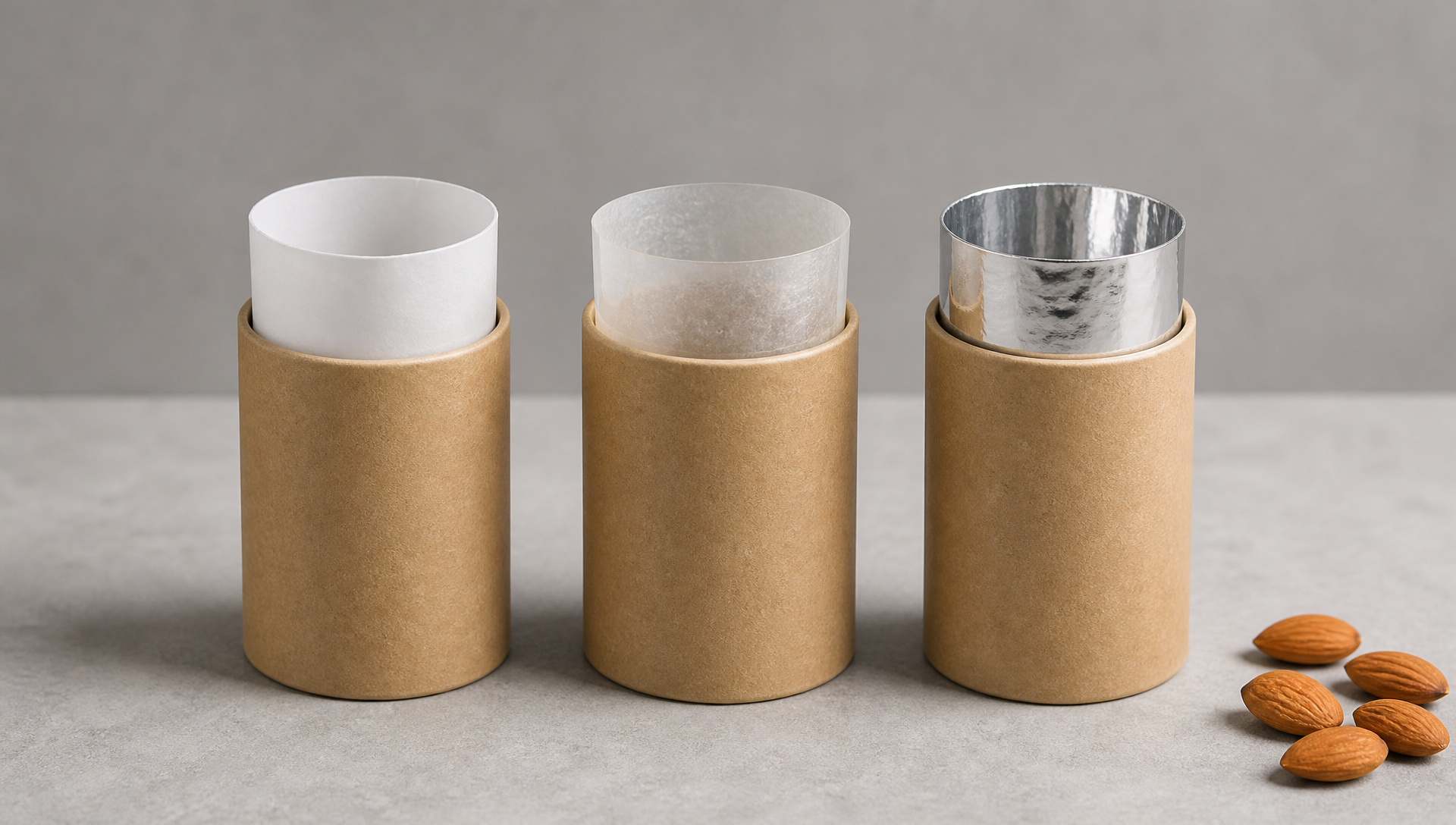
A 250g granola and coated-nut range in a cylindrical format. No rigid plastic canister. Reclosable for multi-serve use. And it had to pass a UK retailer’s supplier audit before listing.
The Tension in That Request
Here’s the awkward part though. Nuts carry oil, coated snacks carry sugar and fat, and both attack bare paperboard over time. Removing plastic entirely was never realistic. その代わり, the question became how little plastic we could use, and how cleanly it could separate afterwards.
Why They Chose a Tube
Cylindrical formats stand apart in a snack aisle dominated by flexible pouches and rigid canisters. さらに, a tube stands upright at home and reads as premium rather than disposable. Our related香水紙管包装ケーススタディ covers the same construction applied to glass fragrance bottles.
What a Food Grade Paper Tube Actually Is
Construction Basics
The body is wound or seamed paperboard, wrapped in printed paper, with a base disc and a lid. しかし, the part that matters for edibles sits inside: a compliant inner layer that separates food from board, 接着剤, and ink.
Where the “Food Grade” Part Lives
Calling something a食品グレードの紙管 is not a description of the paper alone. It covers the liner, the adhesive, the printing inks, the base disc seal, and the manufacturing environment. その結果, a certificate covering only the board tells you very little.
Direct Contact Versus Indirect Contact
If snacks touch the inner wall, you need a direct-contact specification throughout. その間, if the product sits in a sealed inner bag, the tube becomes secondary packaging and the requirements ease considerably. This distinction drove nearly every decision on the project.
Where a Food Grade Paper Tube Applies Beyond Snacks
Tubes suit far more than granola, so it’s worth seeing where else the construction earns its keep:
- 紅茶とコーヒー — Loose leaf and whole bean around a sealed pouch or foil liner. 見る 持続可能なお茶の食品包装, コーヒーと軽食 for barrier detail.
- ナッツ, dried fruit and confectionery — Oxygen and grease drive the specification here more than moisture.
- Spices, powders and supplements — Aroma retention and moisture control matter most, and tubes handle both well.
- Biscuits and baked goods — Greaseproof liners prevent staining that would otherwise ruin the printed wrap.
- Beauty, candles and fragrance — Non-food applications where a liner is unnecessary. Read Plastic-Free Packaging Ideas for Cosmetics and Skincare.

Material Decisions for This Food Grade Paper Tube
The Body and Wrap
We specified a heavier board wall than their reference sample, because a 250g fill needs rigidity when a shopper grips it one-handed. On the wrap, coated art paper carried their photographic artwork cleanly. それにもかかわらず, we flagged that standard lamination would complicate their recycling story, so we moved to an aqueous coating instead.
The Liner Options We Weighed
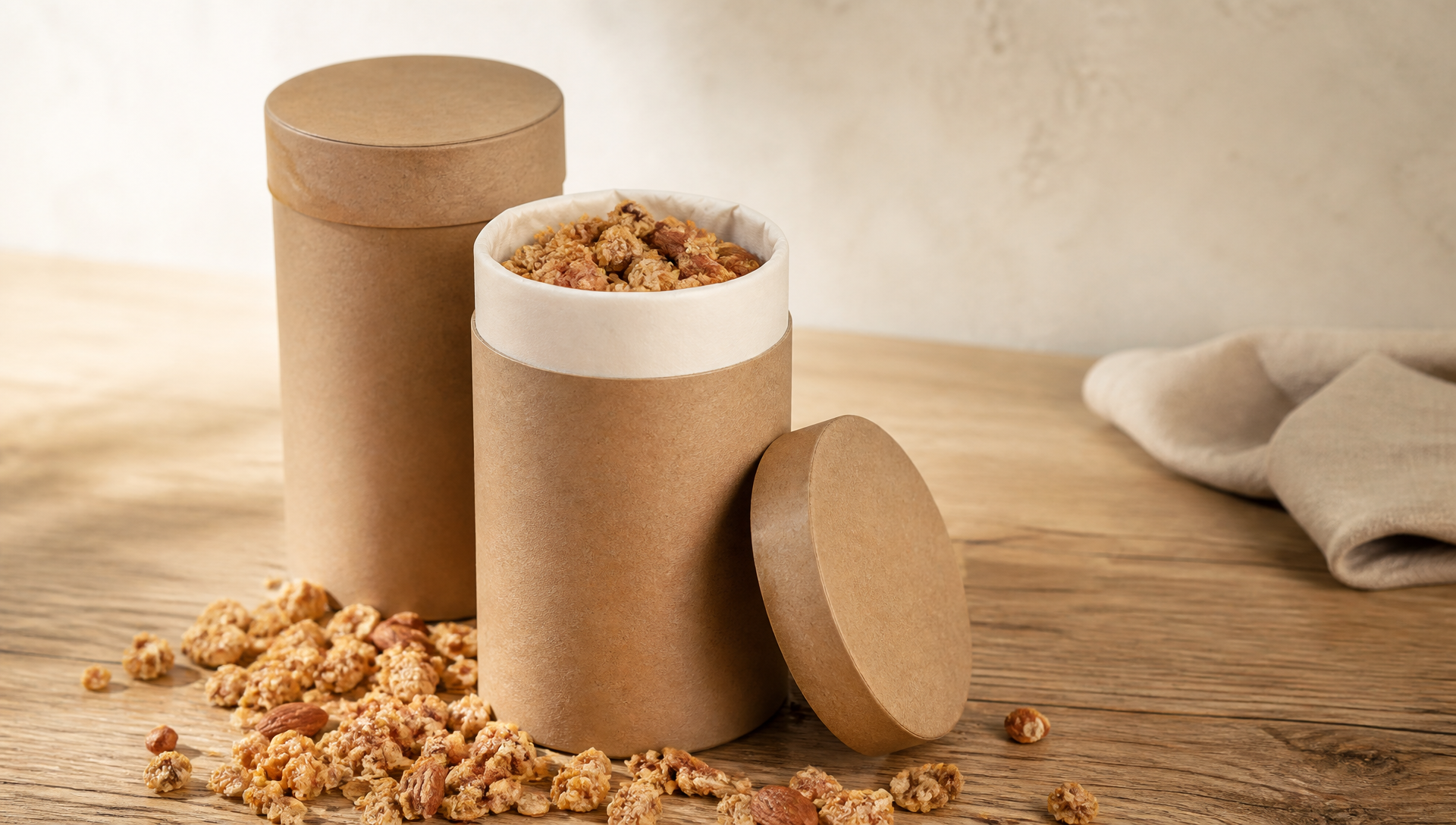
Three candidates went on the table. Plain food-grade white paper handled dry goods but offered almost no grease resistance. Greaseproof paper managed the oil but not oxygen. Foil laminate solved everything technically, yet it undermined the brand’s fibre-forward positioning.
What We Landed On
For the granola SKU, a greaseproof liner proved sufficient. For the coated-nut SKU, oxygen exposure drove rancidity risk, so that variant kept a sealed inner pouch inside the tube. So the same outer structure carried two different internal specifications — which, 正直に, is a very common outcome.
認定ファイバー
Their retailer required FSC-certified material. Our guide on FSC認証紙パッケージ explains chain of custody, その間 生分解性紙管包装 covers fibre options in more depth.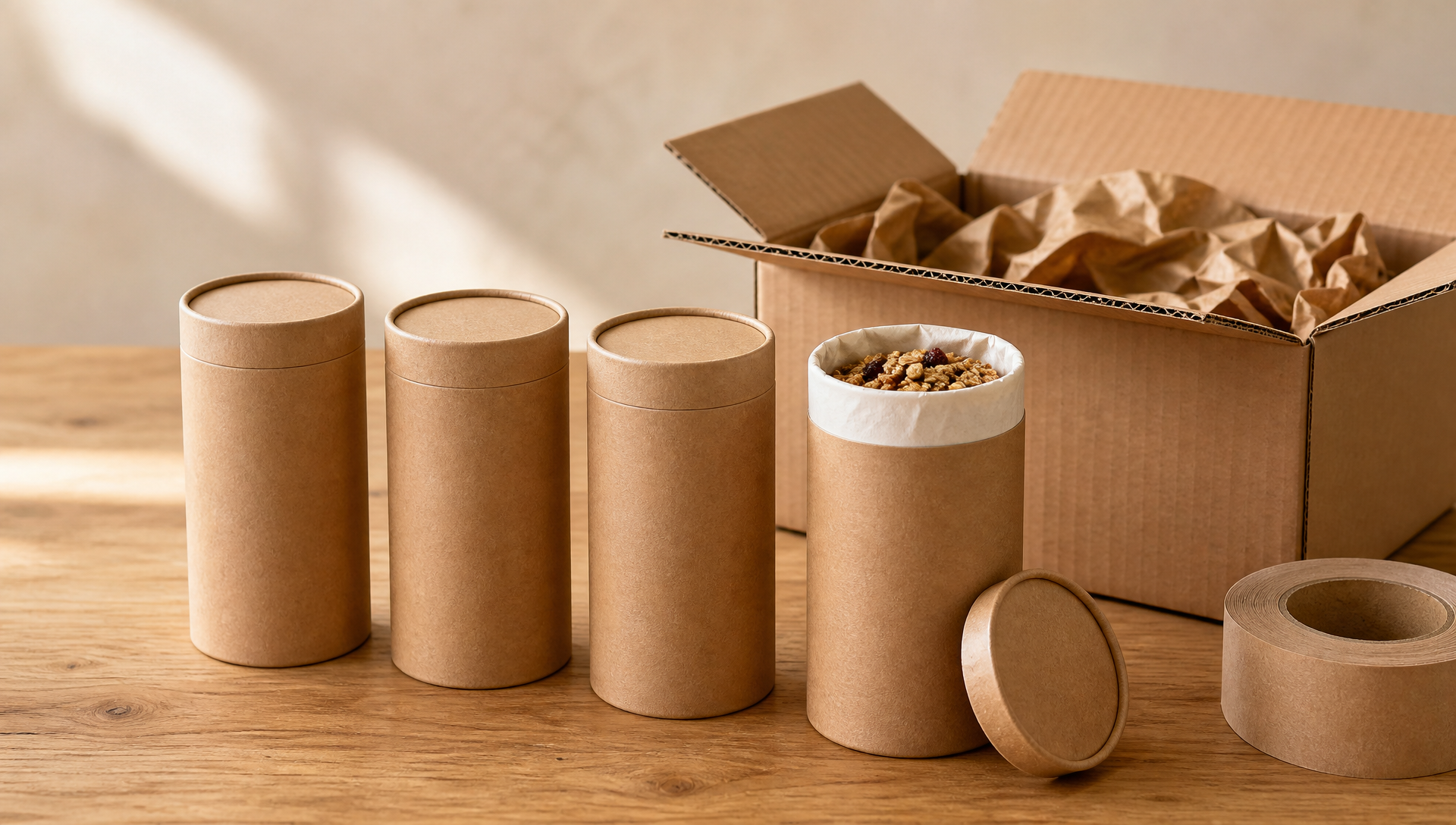
Food Grade Paper Tube Structures We Tested
Telescopic Lid and Base
The simplest食品グレードの紙管 build: a deep lid over a deep base. Simple, protective, and reclosable enough for multi-serve snacking. This became the final choice.
Metal Ends and Tin-Tie Alternatives
A metal push-lid gave the best reseal but added a mixed material and raised the EPR fee band. その間, a tin-tie closure suited coffee better than a rigid snack tube. Both went aside.
Shoulder-Neck and Window Options
A shoulder-neck build looked premium yet added tooling cost the brand couldn’t justify at launch volume. A film window would have shown the granola attractively, though it reintroduced plastic — so we proposed showing product through photography instead.
Alternatives Considered
They also priced硬い箱 そして折り畳みカートン. Both worked commercially, although neither delivered the standing shelf presence they wanted.
Printing and Finishing on a Food Grade Paper Tube
Ink Systems Come First
Here’s something specific to edibles. Ink choice is not purely aesthetic, because migration through board is a genuine consideration. したがって, we ran low-migration ink systems and documented them for the audit file.
Print Methods Used
CMYK offset carried their photographic granola imagery, while a Pantone spot handled the brand green so it stayed consistent across both SKUs and every production run.
Finishes That Worked
Embossing on the lid added tactile quality with no added material. さらに, a matte aqueous coating gave scuff resistance without plastic film. We skipped hot stamping on this range, since the brand wanted an honest, unfussy look rather than a luxury one.
What We Removed
Their original artwork specified gloss lamination. Removing it improved the recycling story and reduced cost, though it did soften the colour slightly. A small print adjustment compensated for that.
Testing: Where the Food Grade Paper Tube Nearly Failed
The First Shelf-Life Trial
We ran an accelerated trial with the real coated-nut product rather than an empty sample. After several weeks, faint oil shadowing appeared along the base seam — not through the liner itself, but at the join where the liner met the base disc.
The Diagnosis
The liner stopped short of full coverage at the base. その結果, oil crept into the seam and wicked outward into the board.
The Fix
We extended the liner to overlap the base disc fully and switched the base adhesive to a food-grade grade rated for fatty contact. So the seam stopped being the weak point.
Second Round
The revised build ran clean through the repeat trial. We also ran compression testing, since these ship stacked in master cartons and snack retailers stack aggressively on shelf.
The Transit Layer
For e-commerce orders, tubes travel inside a波形の mailer with paper void fill, keeping the outbound experience free of plastic.
Compliance for a Food Grade Paper Tube
Snack retailers audit this component thoroughly, so we assembled documentation before production rather than after:
- Food contact safety — EU規制 (EC) いいえ 1935/2004 on food contact materials, plus Good Manufacturing Practice under Regulation (EC) いいえ 2023/2006. We supplied declarations of compliance covering liner, 接着剤, and inks — not just the board.
- BRCGSの梱包材 — 現在発行中 7. Their UK retail partner requested evidence before listing.
- IFS PACsecure — A packaging-specific standard recognised across EU retail, worth holding for food applications.
- FSC — Certified fibre with chain of custody through the converter.
- EPR — The brand registers and pays fees per EU market. We supplied component weights split by material, since the pouch-lined SKU carries a different fee profile. 見る EPR 包装コンプライアンス.
- PPWR and EUDR — PPWR applies from 12 8月 2026 EU全域で. その間, EUDR 義務が適用される 30 12月 2026 大規模および中規模の事業者向け, そして 30 6月 2027 零細および小規模のオペレータ向け.
- Claims wording — We advised “paper-based tube with a separable liner” rather than a blanket plastic-free claim, because the pouch-lined SKU would not survive that scrutiny. 私たちの リサイクル可能な紙製パッケージ guide covers wording properly.
How to Customize a Food Grade Paper Tube: ステップ 1 ~ 3
ステップ 1: Describe the Product Honestly
初め, tell us fat content, 水分, aroma sensitivity, target shelf life, and whether the snack touches the wall directly. For a食品グレードの紙管, these answers determine the liner before anyone discusses artwork.
ステップ 2: Decide Where the Barrier Sits
次, choose between a lined tube and a sealed inner pouch. Both are legitimate. しかし, they produce different claims, different EPR weights, and quite different costs.
ステップ 3: Structure and Dieline
Then we recommend diameter, 壁の厚さ, lid type, and closure, and supply a dieline for your artwork team.
Sampling and Production: Steps 4–6
ステップ 4: 白いサンプル
Every project starts with an unprinted structural sample to validate fit, 剛性, and closure feel. 正直に, skipping this causes more delays than any other decision.
ステップ 5: Shelf-Life and Transit Testing
Then a finished pre-production sample. Run your shelf-life trial with the actual product, because fats and aromatics behave nothing like an empty tube. As this project proved, seams fail before surfaces do.
ステップ 6: MOQ, Lead Time and Documentation
MOQ for a食品グレードの紙管 typically starts at 500–1,000 units depending on diameter and liner. Lead time usually runs 25–35 days after sample approval. We supply compliance documentation alongside delivery for your audit file.
Why Choose Pack Packaging for Your Food Grade Paper Tube
Food-Safe Manufacturing
- 2,000㎡の食品グレードのワークショップ — A dedicated, separated production environment. For any 食品グレードの紙管, this is the single most important thing to verify in a supplier.
- 20,000㎡工場 — Tube winding, ラッピング, 裏地, 型抜き, 組み立てもすべて社内で, so we control every contact surface.
- 10,000,000+ 月間容量 — We scale from a 5,000-unit pilot to millions without changing supplier.
Design and Documentation
- 20+ 社内デザイナー — 決して外注化しない. 構造開発, liner selection, ダイラインの作成, 印刷可能なアートワーク.
- Audit-ready paperwork — Declarations of compliance, low-migration ink documentation, FSC の加工流通過程, and component weights for EPR filings.
- Iterative testing — This project ran two full shelf-life trials. We’d rather find a seam failure in a trial than in a retailer’s warehouse.
- 60+ 輸出市場 — インコタームズと税関は毎日処理されます.
正直なメモ
We won’t tell you every snack can sit directly against fibre. High-fat, high-oxygen products often still need a sealed inner pouch, and pretending otherwise leads to rancidity complaints. So we’d rather design a genuinely separable structure and word the claim accurately.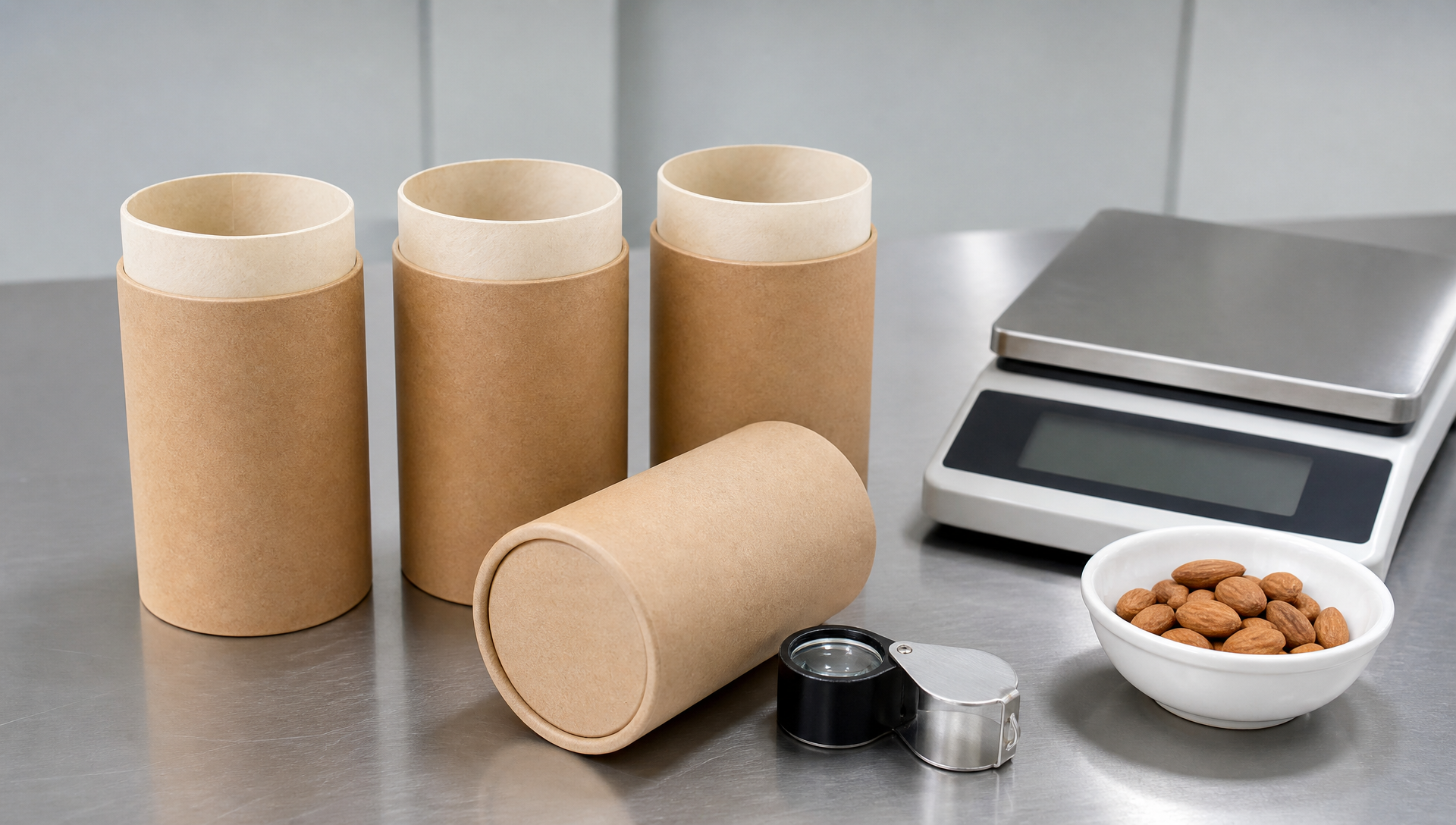
よくある質問: Food Grade Paper Tube Safety and Shelf Life
Q1: Can snacks touch the paper tube directly? Only with a compliant direct-contact liner covering every contact surface, including the base seam. Dry, low-fat products manage this comfortably. しかし, oily or coated snacks usually need a stronger barrier or a sealed inner pouch.
第2四半期: How long will my product stay fresh? That depends on your product, the barrier specification, and storage conditions — so nobody can quote a number without testing. その結果, we always recommend a real shelf-life trial with your actual recipe.
Q3: Will oil stain through the printed wrap? It can, and this project proved it. Faint shadowing appeared at the base seam during our first trial. Extending liner coverage and changing the base adhesive resolved it entirely.
Q4: Is a lined tube recyclable? It depends on the liner and your local stream. A greaseproof paper liner generally recycles with the tube, whereas a foil laminate or bonded film usually does not. したがって, describe the construction rather than making a blanket claim.
よくある質問: コンプライアンス, Cost and Sourcing
Q5: What documentation should I request? Ask for declarations of compliance under Regulation 1935/2004, migration testing where applicable, and documentation covering liner, 接着剤, and inks. さらに, check whether the supplier holds BRCGS Packaging Materials or IFS PACsecure certification.
Q6: Does a food-safe specification cost much more? Moderately. Liner choice and low-migration inks add cost, while removing lamination reduces it. Overall, the bigger driver is usually diameter and tooling rather than the food-safe element itself.
Q7: Can one tube design serve several products? Often yes. This brand ran one outer structure with two internal specifications across their range. その間, a shared dieline keeps artwork and tooling costs down considerably.
Q8: 見積もりを開始するには何が必要ですか? Send your product type, fill weight, 寸法, 量, ターゲット市場, required shelf life, とロゴファイル. Then we’ll recommend the right食品グレードの紙管 構造, ライナー, そして終わります.
関連ガイド
This project touched several topics we’ve covered separately:
- 香水紙管包装ケーススタディ — The same construction applied to glass fragrance bottles.
- 持続可能なお茶の食品包装, コーヒーと軽食 — Barrier options across food categories.
- Plastic-Free Packaging Ideas for Cosmetics and Skincare — Fibre-only construction principles.
- FSC認証紙パッケージ — Proving fibre origin.
- 生分解性紙管包装 — Tube construction and material detail.
- EU に販売するブランドの EPR 包装コンプライアンス — Registration and fees per market.
- 紙パッケージがブランドの環境に優しいイメージの構築にどのように役立つか — なぜスイッチがブランド認識を変えるのか.
カスタム パッケージング ソリューションをさらに詳しく見る
- 紙管 — Our dedicated collection for snacks, お茶, コーヒー, 美しさ, and candles.
- 折りたたみボックス — 軽量, 完全にカスタマイズ可能な小売用カートン.
- リジッドボックス — Premium gift boxes for hampers and assortments.
- 段ボール箱 — 耐久性のある電子商取引および配送用の梱包.
- 小児用安全ボックス — 規制対象製品の安全な梱包.
- 付属品 — カスタムインサート, ティッシュペーパー, リボン, とラベル.
Ready to Start Your Food Grade Paper Tube Project?
What made this project work wasn’t the printed wrap, 正直に. It was testing with the real product early, catching a seam failure in a trial rather than on shelf, and being willing to run two internal specifications when one wasn’t enough. That’s usually the difference between a食品グレードの紙管 that protects a snack properly and one that only photographs well.
製品のサイズを教えてください, 量, ロゴファイル, そしてターゲット市場. 私たちのチームが適切な構造を推奨します, 材料, and finish — plus the compliance documentation your retail buyers will ask for.
✉️ [概要をお送りください → カスタム見積もりを入手してください 24 営業時間] Include: product type · fill weight · quantity · target market · logo file
パック包装 | 20,000㎡工場 | 2,000㎡ 食品グレードのワークショップ | FSC認証素材 | 60+ 輸出市場
Note on this case study: This walkthrough describes a representative project. We have anonymised client identity and commercially sensitive details, and consolidated certain specifics for clarity. Technical processes, testing sequences, MOQ範囲, and lead times reflect our standard practice. Figures quoted are typical ranges rather than guarantees, and your project specifications may differ.
免責事項: 規制情報は 8 月時点で公開されている情報源を反映しています。 2026 and does not constitute food safety or legal advice. Requirements vary by product, recipe, and market. したがって, confirm your specific obligations with a qualified food-contact compliance advisor before production.