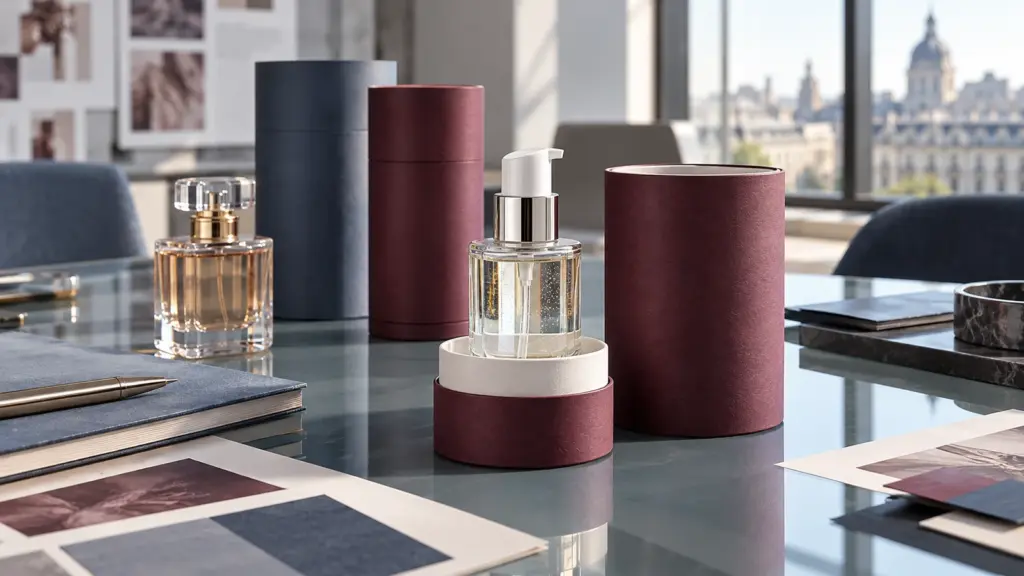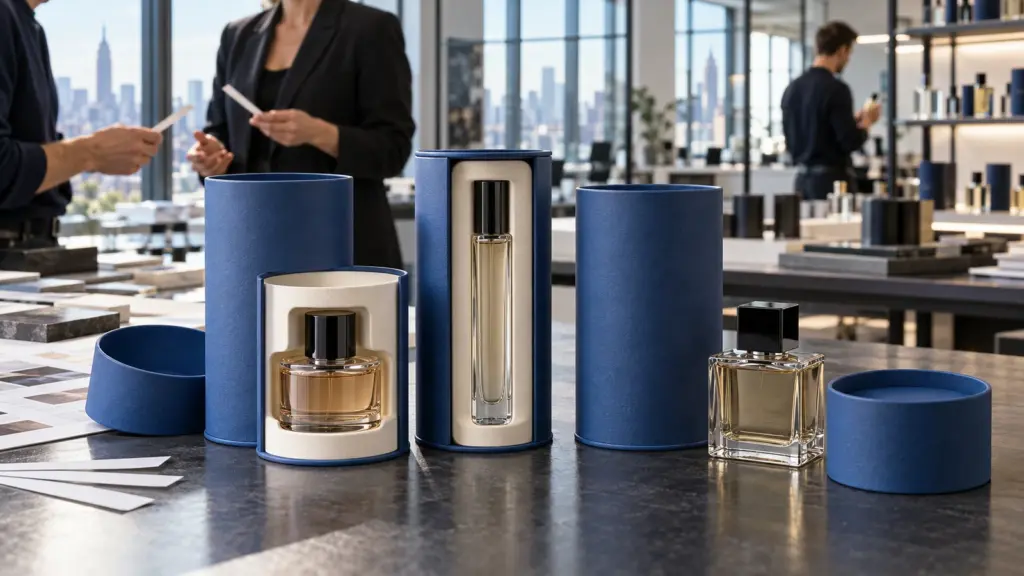
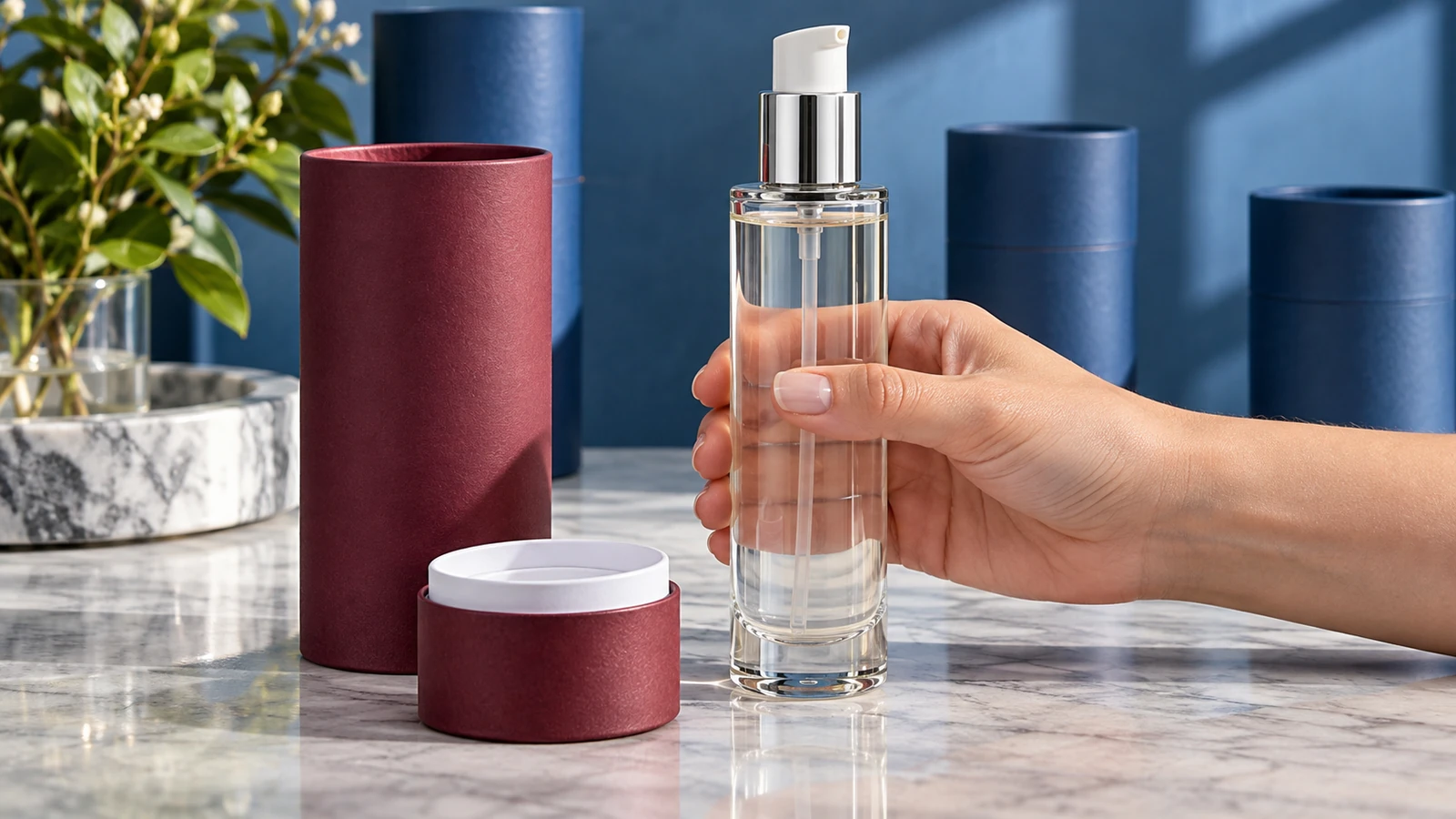
A tall skincare pump can fit inside a luxury cylinder and still be exposed to pressure from the lid. For a buyer, paper tube pump protection begins with identifying which parts may carry contact and which must remain clear. An attractive sample that closes successfully is only the beginning of that review.
This guide concerns secondary paper packaging around a filled, closed cosmetic or fragrance bottle. It provides a proposed contact-zone brief, sample review and approval record for discussion between the brand, dispensing supplier, tube manufacturer and packer. These recommendations are not a universal clearance standard, a laboratory test method or evidence that a particular pack prevents leakage.
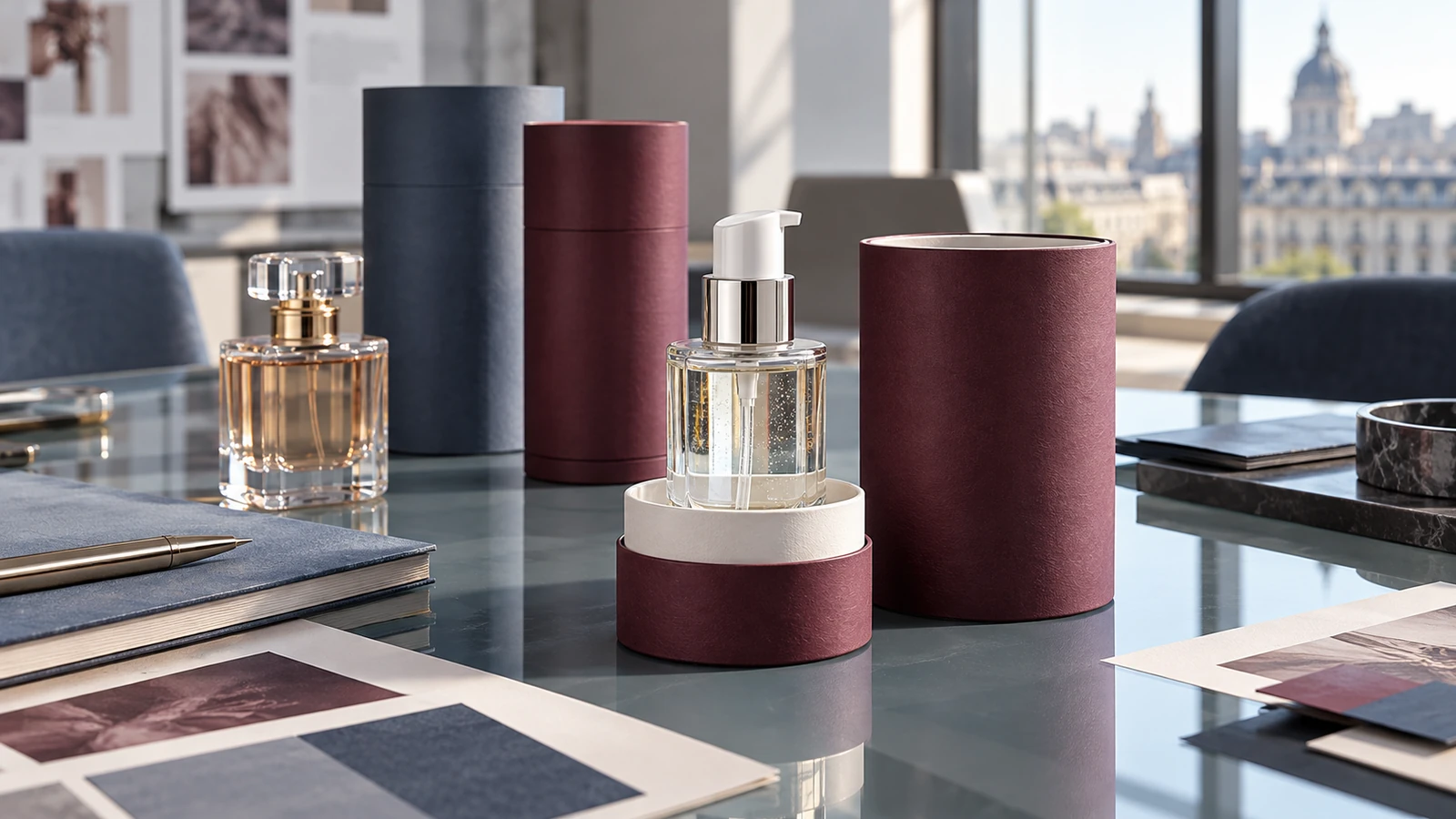
Separate the dispenser from the presentation tube
The pump, bottle and closure form the primary pack. The paper cylinder and its insert form a separate packaging system around it. Ask the dispensing supplier how the actuator should be locked, capped or otherwise prepared for distribution before developing the surrounding tube. Do not assume that an insert can substitute for a missing closure component.
Aptar Beauty’s omnichannel packaging overview describes clips and integrated locking features among its dispensing solutions. This is a useful manufacturer example of protection being addressed at the dispenser itself. It does not establish that all pumps lock in the same way, that your bottle uses those products, or that a custom paper tube inherits any supplier test result.
Ao discutir custom paper tubes and round boxes, supply the final assembled primary pack rather than an uncapped empty bottle. Include the overcap, transport clip, label and any decorative collar. All dimensions are developed around the project; nominal bottle capacity does not define a fixed tube size.
Write a contact-zone map before sizing the insert
For paper tube pump protection, the first useful drawing identifies permitted support areas and restricted areas. Ask the bottle and dispenser suppliers to review that map. A broad glass base, bottle shoulder, decorative collar and moving actuator are different interfaces; a drawing should distinguish them even when their outside diameters appear similar.
Use a marked photograph or annotated drawing with component references. State the actual packing orientation and show the pump in its specified transport condition. If a twist lock changes the nozzle direction, include that orientation. If a removable clip is required, give it a part reference and identify who installs it.
| Zone to review | Question for the supplier team | Approval evidence to retain |
|---|---|---|
| Actuator and nozzle | Which surfaces must avoid insert or lid contact? | Annotated assembled-pump view and transport-state instructions |
| Collar and closure | Can this area accept support, or would contact disturb assembly? | Primary-pack supplier confirmation for the actual component |
| Bottle body and label | Where can the holder locate the bottle without unacceptable marking? | Contact map and inspected decorated samples |
| Base | How should the filled bottle sit and remain accessible? | Approved platform geometry and removal demonstration |
This is a communication worksheet, not a claim that any named zone is inherently load-bearing. Retain unresolved questions on the drawing. Where contact is uncertain, request component guidance rather than tightening the fit until the bottle stops moving.
Check the vertical stack with the tube fully closed
Pump bottle paper tube packaging needs a vertical stack review. Record the assembled bottle height in the approved transport state, the insert platform elevation, the usable internal height of the fully seated lid and the variation assigned to each component. External tube height alone cannot answer whether the actuator remains clear.
A useful geometric starting point is available internal height minus platform elevation minus assembled bottle height. Define the measurement datums first. The result is an initial clearance calculation, not proof of protection: insert movement, deformation and component variation still need review. Do not choose a universal millimeter allowance from a photograph.
Ask the supplier to show how the proposed range behaves with the actual finished components. Nosso packaging tolerance buying guide explains why nominal dimensions and permissible variation belong in the same approval discussion. For a pump project, the specific concern is whether the closest permitted assembly introduces unwanted contact above the dispenser.
Review the lid in its intended closed position. A sample that stays slightly open may conceal an interference problem. Equally, pressing harder to force closure can obscure where contact occurs. If the closure cannot seat normally, stop and identify the interference instead of accepting the sample because its exterior looks aligned.
Choose support around the bottle, then review lateral movement
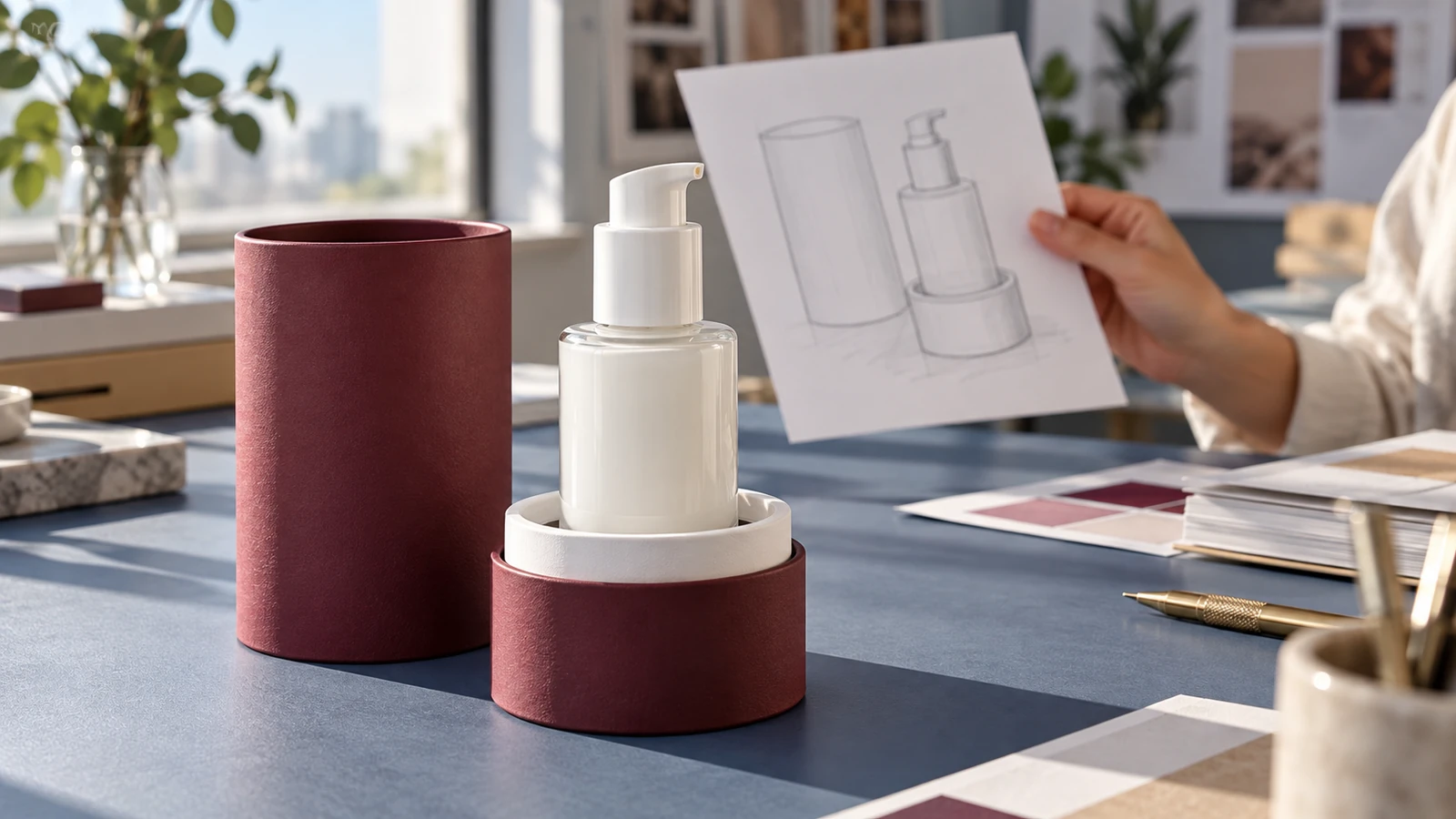
A cosmetic bottle insert design should be discussed in terms of contact geometry before selecting a material name. A lower cradle may position the base, while another feature may limit movement at an approved body area. Whether one or several supports are appropriate depends on the actual primary pack and the distribution requirements.
Use the paper tube insert guide to compare general holder approaches, then add the dispenser-specific restrictions. Do not request a neck opening simply because it looks neat: confirm whether its edges touch a moving component, decorative surface or closure feature when the bottle shifts.
Fragrance pump clearance also has a lateral dimension. Check the nozzle projection and cap envelope through the packing and removal sequence, not only while the bottle stands centered. A holder can leave room above an actuator yet bring the nozzle near the tube wall when the bottle tilts. Record that observation without turning an informal hand check into a quantified performance claim.
For a range of bottles, do not assume identical neck finishes mean identical pump envelopes. Use separate component references and confirm which holder revisions apply. The aim here is dispenser clearance for one approved assembly, rather than establishing a shared outer format across a collection.
Review packing and removal without pressing the actuator
During paper tube pump protection review, observe where people naturally place their fingers. Ask the packer to load the production-intent bottle using the proposed holder, then ask another person to remove it without coaching. If the obvious grip is the actuator, revisit body exposure or finger access.
Write the demonstrated sequence into the packing instruction: identify the transport condition, grip location, insertion orientation and closure step. Confirm that an operator can distinguish an installed clip from an absent one, where applicable. Keep the directions specific to the supplied dispenser; a generic instruction to “lock the pump” may not describe the real mechanism.
Luxury skincare tube packaging can still present the bottle prominently while leaving a practical grip. Resolve that balance with samples rather than assuming that maximum concealment looks more premium. Decorative shoulders, slippery labels and short exposed body sections deserve review with the actual bottle.
For related presentation formats, o perfume bottle paper tube collection offers category references. Product photographs are useful for discussing appearance; they cannot confirm your pump clearance or validate a shipping configuration.
Distinguish a fit review from distribution testing
A pump actuator clearance check can reveal an obvious interference or an awkward removal path. It cannot predict all movements during shipping. Agree the complete shipping configuration, including the retail tube, filled bottle, holder, master carton and any separation components, before requesting a laboratory plan.
ISTA’s design and testing guidance connects procedure selection with the actual distribution environment and test objective. It also calls for damage criteria to be defined before evaluation. Discuss those decisions with the laboratory and relevant trading partners rather than picking a test solely because its name appears on another supplier’s page.
For this project, proposed review outcomes might include actuator condition, closure state, visible product release, bottle condition and ability to remove and use the product afterward. The brand and laboratory must decide the appropriate methods and acceptance limits. A supplier’s separate dispenser result does not establish performance of the complete tube-and-carton assembly.
Keep informal investigative checks separate from the formal protocol. Do not interrupt a laboratory sequence to open the package unless the agreed procedure permits it. When components change, ask whether the original evaluation remains applicable; keep the change visible in the approval record.
Keep one approval record for the complete assembly
Paper tube pump protection approval should identify the bottle, bombear, cap or clip, holder drawing, tube construction and packing instruction revisions together. Add the sample date, transport condition and photographs of the closed and open pack. Record any unresolved issue with its owner and required next step.
Usar structural sampling to resolve fit questions before treating decoration as final. A replacement pump, thicker platform or altered cap may require another fit review even when the printed tube remains unchanged. Preserve the approved assembly as a reference and withdraw superseded packing directions.
Frequently asked questions
Can the paper lid serve as the pump lock?
Do not assume so. Obtain the dispensing supplier’s transport instructions and develop the secondary pack around that condition. Any alternative restraint needs specific engineering review and evidence for the actual assembly.
How much empty space should remain above the pump?
There is no universal value established by this guide. Agree the internal datums, component variation, contact restrictions and distribution evaluation. Check the fully closed finished sample instead of relying on overall tube height.
Does a snug insert prove the bottle will not leak?
Não. Holder fit, closure integrity and dispenser behavior are separate questions. Review them together with the primary-pack supplier and assess the complete shipping configuration under an agreed plan.
What should we send for an initial packaging discussion?
Provide assembled filled-product samples where practical, component drawings, transport-state instructions, permitted contact areas, quantidade, presentation requirements and shipping route. Identify samples that differ from final production parts.
Brief PACK Packaging on the complete bottle assembly
For a paper tube pump protection discussion, send your bottle and dispenser references, dimensões, artwork and quantity, together with the contact map and packing requirements. PACK Packaging can discuss a fully customized paper tube structure and sample plan around that brief. Confirm project-specific specifications, commercial terms and required validation before approving production.