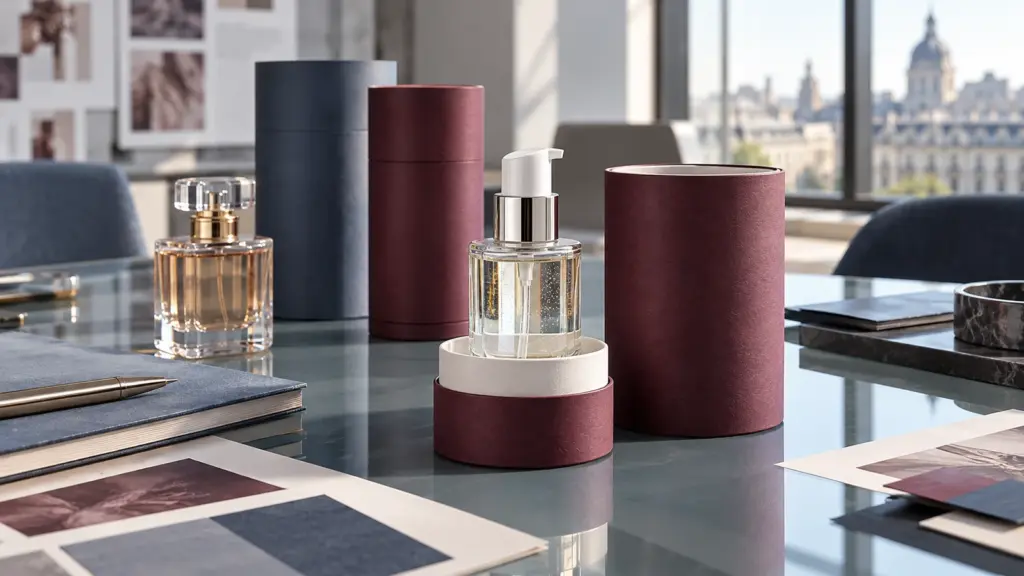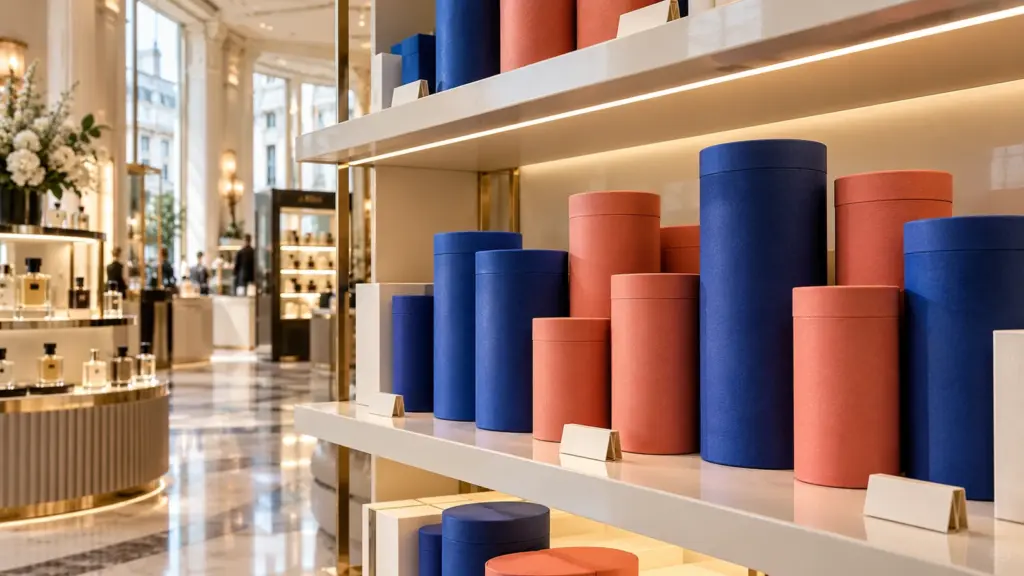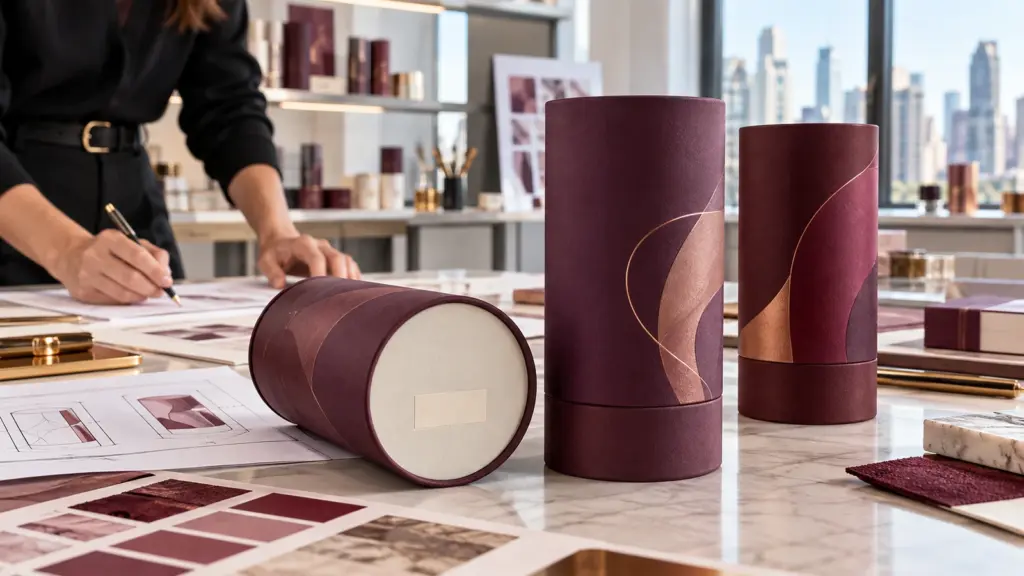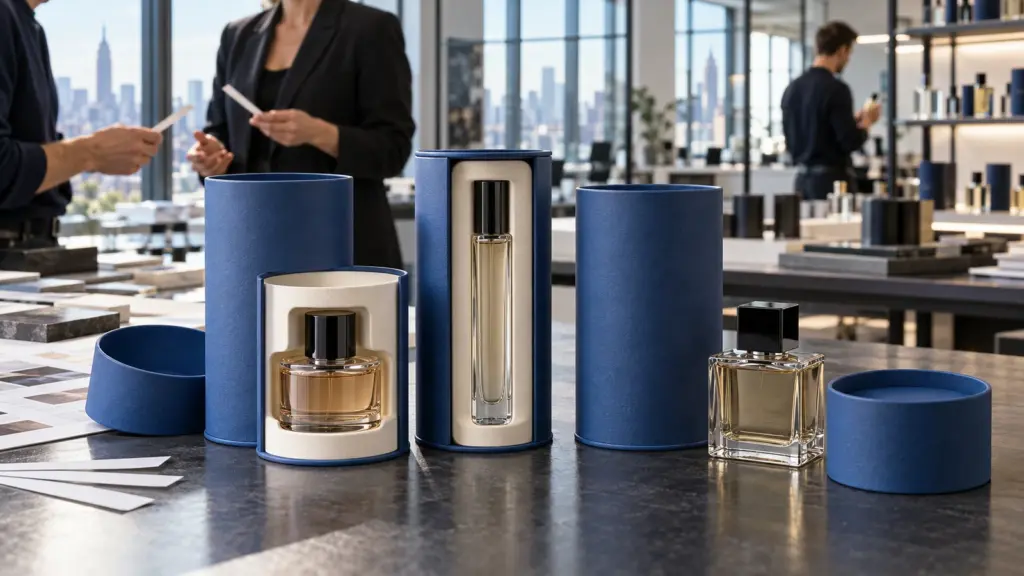
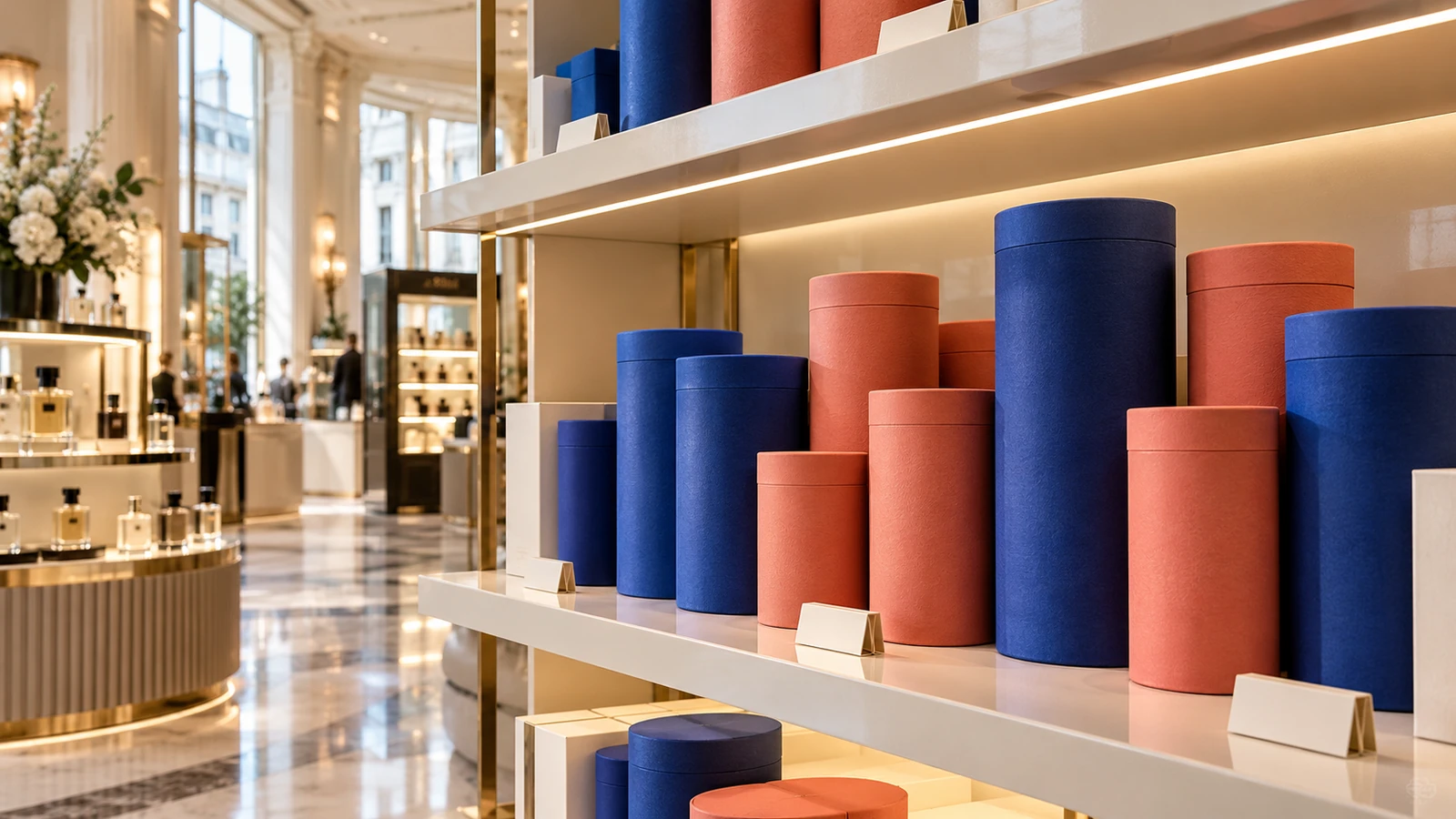
Paper tube shelf fit should be resolved before a luxury fragrance or skincare range reaches its final artwork approval. A cylinder can accommodate the bottle perfectly yet occupy too much selling space, sit awkwardly behind a price rail, or leave too little room for a shopper to remove it. Those problems belong in the purchasing brief, alongside the product dimensions and decorative finish.
This guide addresses closed presentation tubes used as secondary packaging around finished products. Its output is a retailer-facing sample approval record: what is measured, how the pack is displayed, and how it is removed and returned. The review steps below are project recommendations, not a universal retail standard or evidence of tested performance.
Start paper tube shelf fit with two separate drawings
Use one drawing for the package and another for the retail location. The package drawing describes the finished tube, tampa, base and any external accessories. The location drawing describes the usable shelf bay, neighboring products, front rail and shelf above. Keeping these records separate prevents an internal cavity measurement from becoming an accidental shelf specification.
GS1 Sweden’s product measurement guidance explicitly directs users to measure external dimensions for shelf planning and transport. The practical distinction is essential: a supplier’s internal diameter describes available product space, while a retailer needs the dimensions of the complete sale unit.
Begin with our custom round boxes and paper tubes as format references. Request project drawings rather than treating a photographed tube as a mandatory stock size. Establish the actual bottle and insert fit separately, then reconcile it with the retailer’s permitted envelope.
Distinguish nominal data from the merchandising arrangement
The current GS1 Package and Product Measurement Standard, Release 3.3 ratified in August 2026, provides a consistent measurement framework. It explains that the measurement orientation does not necessarily match the way an item is merchandised. Its cylindrical-item section also notes that which two dimensions are nominally equal depends on the default front.
For paper tube shelf fit, maintain both the applicable product-data record and a separate shelf arrangement sketch. Mark the intended upright orientation, selling face and any tilted or stepped display. A photograph of a horizontal tube should not silently change the product dimensions submitted to a trading partner.
Ask the retailer which data rules and submission process apply. Do not use a merchandising sketch as a substitute for its product-data requirements. Da mesma maneira, a nominal data tolerance is not automatically an acceptable manufacturing tolerance or an allowance for extracting a tube from a tight shelf.
Measure the largest finished outside envelope
For a closed upright cylinder, record overall height and the widest finished external feature. The lid may be wider than the body, and a ribbon, label edge or decorative sleeve may extend farther still. Identify the feature that governs each measurement instead of quoting only the winding-core diameter.
A paper tube external diameter specification should identify the finished configuration, drawing revision, measurement locations and agreed production limits. Include the actual wrap and finish. Ask the supplier to explain how samples will be checked without compressing the paper wall or ignoring a local projection.
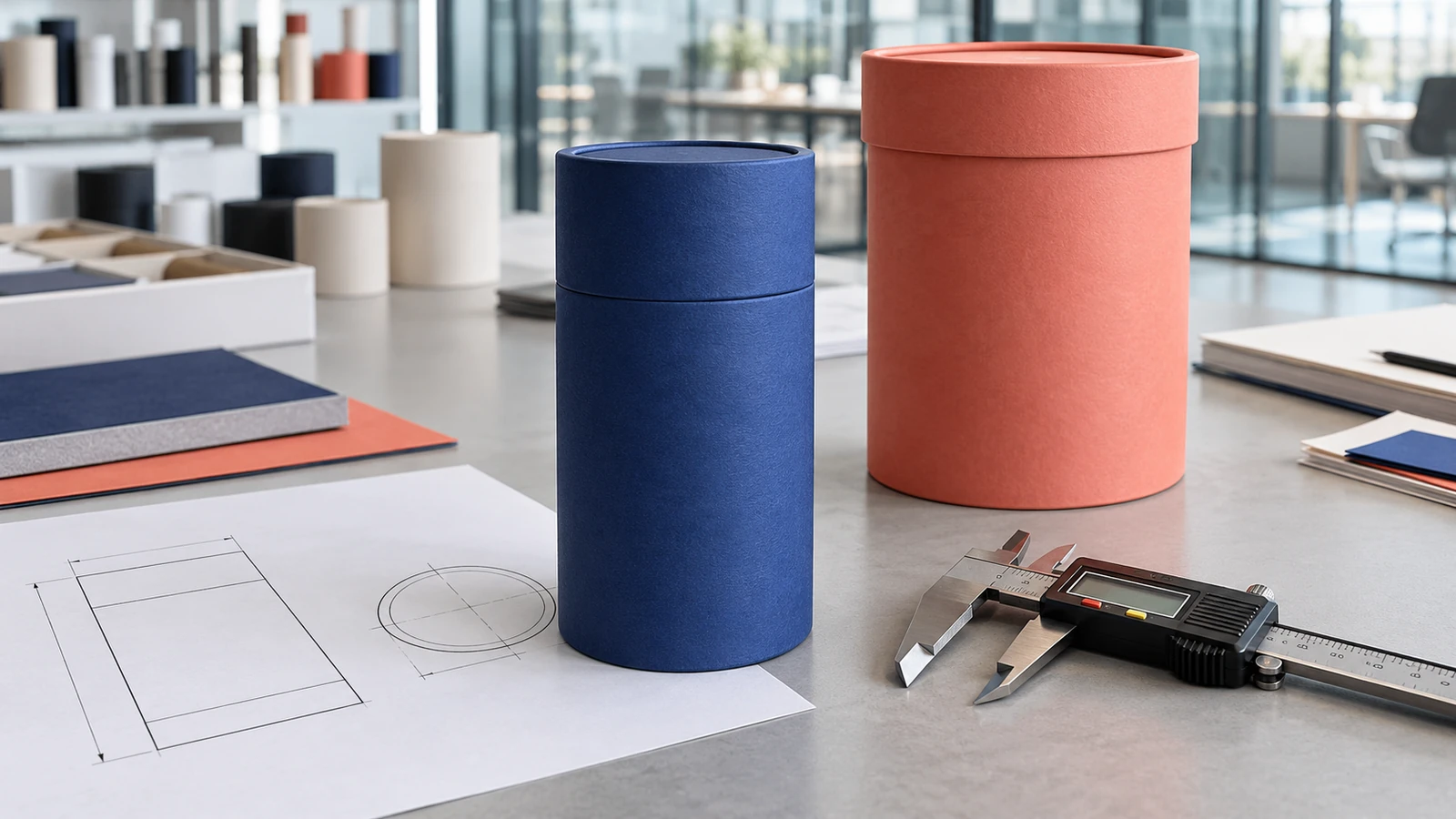
Keep a sample reference with the dimensional record. If the lid and base differ visibly in diameter, show both dimensions on the drawing and identify which controls adjacent-pack spacing. Review the packaging tolerance principles against the specific construction; agree the supplier’s proposed method before adopting any limit.
Use a simple facing calculation as a screening tool
For a straight row of identical upright tubes, a preliminary width check is n × D + (n − 1) × g + L + R ≤ W. Here n is the proposed facing count, D is the agreed maximum finished outside diameter, g is the planned gap between neighboring packs, L and R are side allowances, and W is usable bay width. All dimensions must use the same units.
This is a layout calculation, not a stability or access test. For illustration only, four 80 mm envelopes with three 5 mm gaps and 10 mm allowed at each side require 355 milímetros. These invented project dimensions are arithmetic examples, not recommended tube sizes or clearance requirements. Confirm the arrangement with physical samples and the retailer.
Check retrieval clearance, not just standing height
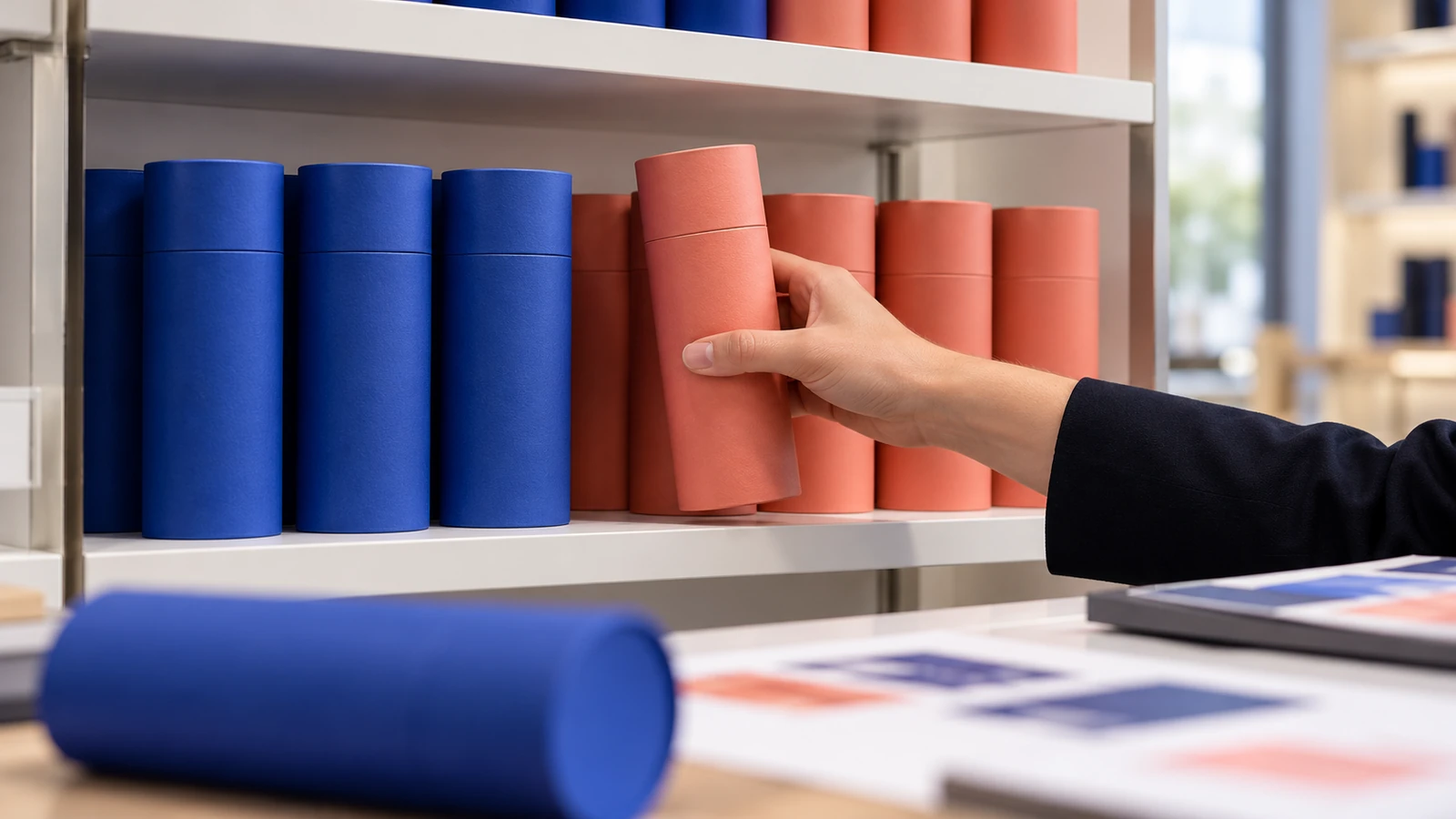
A tube that stands within a shelf bay may still be difficult to retrieve. Define whether customers should lift the entire closed pack from the shelf, pull it forward first, or ask an assistant for access. Include shelf-edge lips, adjacent packs and any front-facing security device in the review.
For long-lid paper tube clearance, distinguish whole-pack retrieval from in-place opening. Removing a long lid vertically can require space beyond the closed height. If opening on the shelf is not intended, make that operational decision clear and assess the closed pack’s grip and removal instead.
Nosso lid fit and unboxing approval guide covers the separate opening assessment. Shelf approval should refer to the approved package without reopening every fit decision. Neither assessment proves shipping protection or suitability for a particular security attachment.
Keep the selling face visible on a curved surface
For cylindrical perfume packaging retail display, show the preferred front orientation on the merchandising sketch. A round body can be returned at a different angle after handling. Review what remains identifiable when a sample is slightly rotated, rather than relying on a perfectly staged hero photograph.
Place the mockup behind the actual shelf rail or a representative replica. Observe whether the rail hides the variant name, volume statement or important design feature. Have the responsible compliance team review required information separately; this visual exercise does not establish labeling compliance.
Review neighboring variants together. A taller lid may conceal the identifying band on a pack behind it, while a broad front-facing logo may curve out of view at the sides. Coordinate the artwork with the paper tube artwork seam placement record so the intended selling face, wrap join and supporting information share one reference.
Approve the individual tube and its support separately
A luxury tube planogram brief should state whether the package stands loose, in a retailer’s existing tray, or in a purpose-designed merchandising support. Do not assume a tube supplier also supplies the fixture. Identify which party owns each drawing and who approves the combined arrangement.
Smurfit Westrock’s retail-ready packaging overview describes formats intended to move from transit into shelf presentation. It provides useful context for distinguishing a sale unit from its outer merchandising pack. It does not establish that a decorative paper tube, or a separate tray proposed for it, can function as a validated shipping system.
For a paper tube merchandising tray, check the support with complete retail packs and agreed stock positions. Record whether the support remains in store, whether it changes visible height, and how staff replace one variant. Quote any tray, separators, assembly and outer transport pack as explicit scope items.
Build a retailer sample approval record
Use the following paper tube shelf fit review with representative finished samples. The brand, retailer and packaging supplier should agree the conditions and acceptance criteria before production. Retain photographs of both accepted arrangements and identified problems.
| Approval item | Review action | Record to retain |
|---|---|---|
| Finished envelope | Check closed height and widest external feature | Drawing revision, sample IDs and measurement method |
| Allocated space | Recreate usable width, depth, rail and upper shelf | Fixture reference and agreed arrangement |
| Retrieval | Remove and return the complete closed pack | Grip, movement sequence and observed obstructions |
| Visibility | View the range from agreed shopper positions | Front orientation and obscured information |
| Replenishment | Refill the approved support with the intended variants | Assortment, support parts and responsibility |
Run the review through our structure and sampling process. Agree which changes trigger another shelf check: lid diameter, altura total, wrap build, accessory, product weight or support design. Avoid accepting an undocumented substitution because it fits the bottle internally.
Frequently asked questions
Should a quotation use internal or external tube dimensions?
Provide both and label them clearly. Internal dimensions support product and insert development; external finished dimensions support fixture planning. Require the supplier to connect them on the approved drawing rather than treating them as interchangeable.
Does a long lid always require a taller shelf?
Não. The answer depends on the complete closed height and intended handling sequence. A pack removed before opening differs from one opened in position. Demonstrate that sequence with the retailer instead of applying a universal clearance allowance.
Can every fragrance variant use the same shelf envelope?
Evaluate each complete pack, including bottle, insert and external accessories. Shared outside dimensions can simplify a range layout, but each variant still needs its own product-fit and handling approval. Record permitted combinations rather than assuming visual similarity proves compatibility.
Is a shelf mockup a transport test?
Não. It addresses presentation, access and store operations under the agreed review conditions. Distribution hazards require a separate assessment of the filled product and complete shipping pack. Do not attach a transport certification claim to a shelf review.
What should a retail quotation request include?
Send product samples or dimensions, peso cheio, usable bay measurements, rail details, planned facing count, front orientation, quantity by design and delivery destination. Add the retailer’s instructions and identify whether any merchandising support is included.
Send a shelf brief with the product brief
Reliable paper tube shelf fit starts with the relationship between the finished package and the place where it will be sold. Share your product details and retail constraints with PACK Packaging to develop a controlled sample brief. Nosso perfume bottle paper tube formats offer structural references; the approved dimensions, finish and acceptance criteria should belong to your actual project.