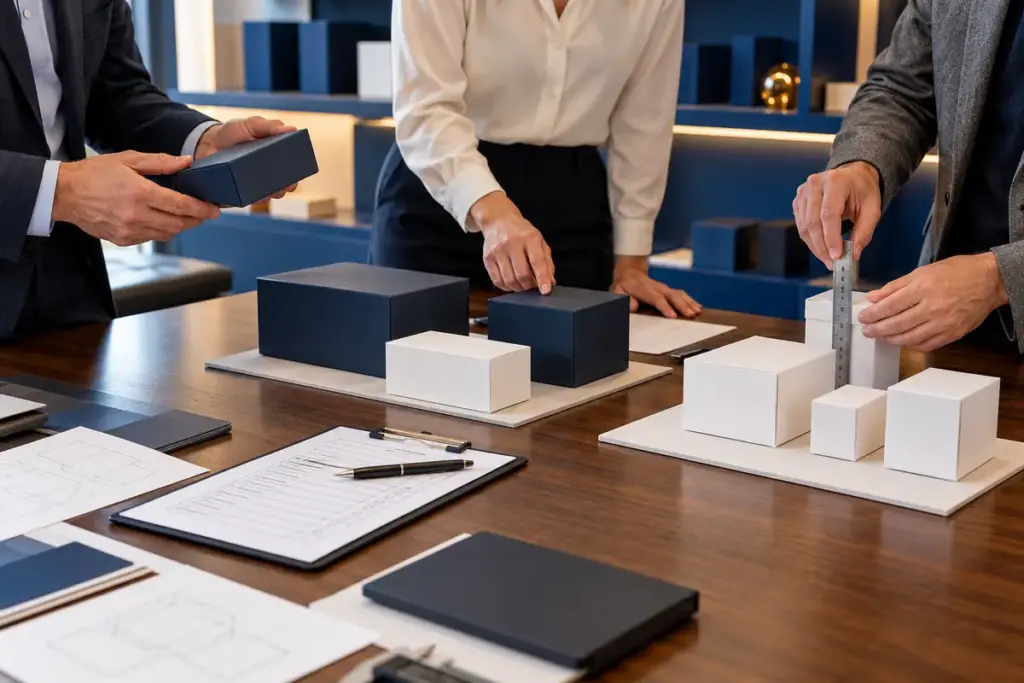
A brand that has outgrown plain packaging usually reaches the same milestone: the boxes move to a factory under the brand’s own name. Private label packaging looks simpler than full custom development — the structures exist, the tooling is proven, and the supplier owns the dieline. En la práctica, projects stall for three reasons. Structures may not match the product line. Brand artwork and structural drawings may arrive as one flattened file. A reorder months later may not trace back to a signed reference.
This guide treats the private label process as four decision points. They cover product-line consistency, where brand art goes, the approval path before the first batch, and how runs and reorders are handled. It closes with a brief template that collects what a factory needs.

What Does Private Label Mean in Paper Packaging?
Three terms get used interchangeably, often by suppliers quoting against different assumptions. In private label, a factory produces packaging carrying your brand on structures it already develops and tooles for multiple customers. In OEM work, the packaging is engineered around your product from the start, usually with a dieline created for you alone. In white label, packaging stays unbranded or keeps the factory’s generic design, so it moves between customers without artwork changes.
| Model | Who owns the structure | What changes per project | Mejor ajuste |
|---|---|---|---|
| Private label | The factory, from existing tooled structures | Brand artwork and mandatory panels | A branded line on proven boxes |
| OEM / ODM | Engineered around your product | dieline, tooling and format | A new structure you need alone |
| White label | The factory, generic design | Nothing, or a small sticker layer | Fast, unbranded volume |
The OEM and ODM distinction carries more detail than this article needs; nuestro OEM/ODM packaging manufacturer guide sets that out. If your product needs a new structure rather than a branded version of an existing one, el OEM & ODM solutions page describes how that route is arranged.
What Still Sits With the Brand Owner
Handing the structure to a factory does not hand over the decisions. Four of them stay yours, and each is cheaper to settle early:
| Decision | What stays with you |
|---|---|
| Line scope | which box types carry which SKUs, and whether the line reads as one brand across formats |
| Artwork split | what belongs to the brand layer and what belongs to the structural layer |
| Approval baseline | what gets signed, by whom, and what the signed unit is for afterwards |
| Supply frame | run sizes, reorder cadence, and how version changes are recorded |
How Do You Keep a Private Label Line Consistent Across Box Types?
Private label rarely stops at one box: a skincare line might need a carton for a jar, a mailer for direct orders and a tube for refills. Consistency is what makes those formats read as one brand rather than three separate purchases, and it has to be defined before artwork is placed.
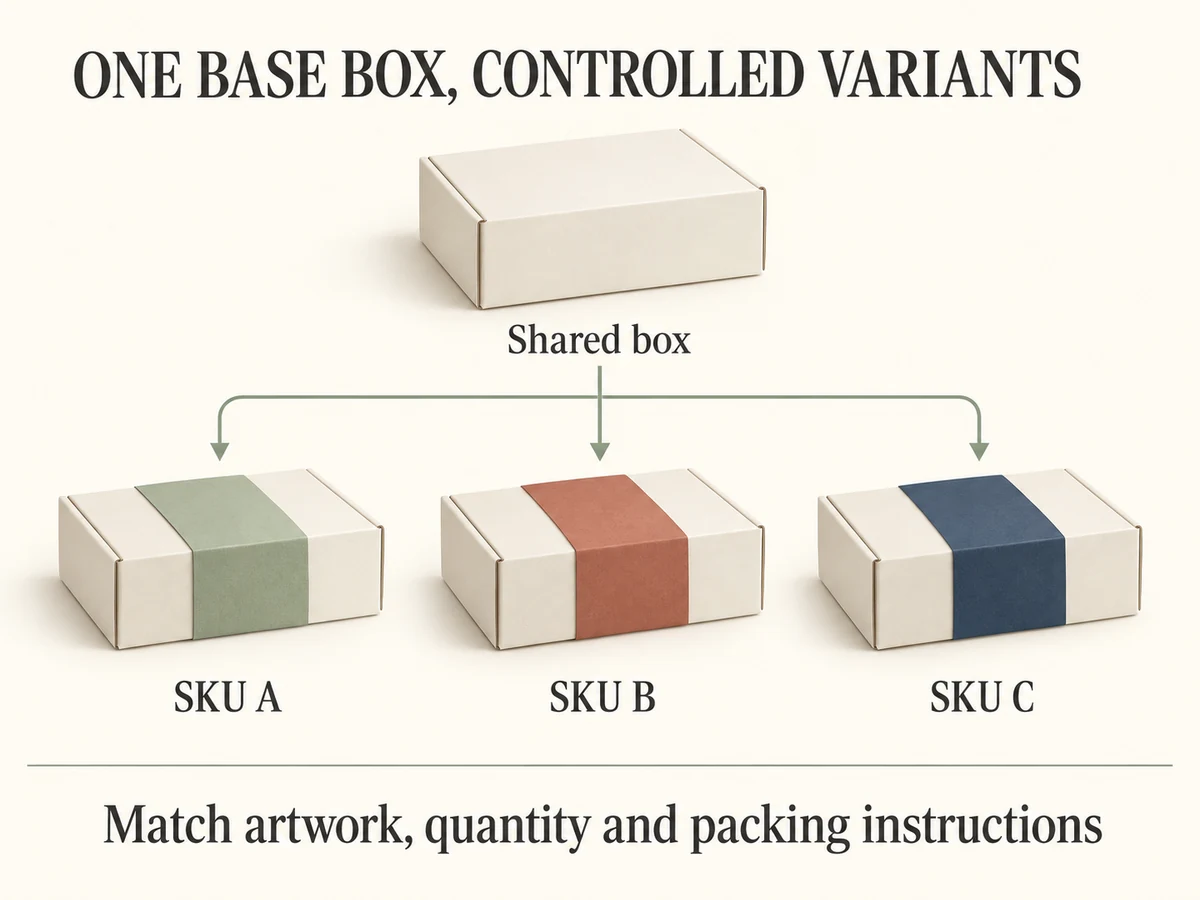
Fix a small number of rules once for the whole line, then let each format adapt within them:
- Logo lockup and the minimum reproduction size that survives scaling down
- Colour references — Pantone or CMYK per element, plus what works on uncoated or kraft faces
- Typography hierarchy — product name, descriptor and body copy, and how far each compresses
- Panel conventions — where the claim goes, where mandatory text goes, which panel stays quiet
- Finish palette — matte or gloss, and where varnish or foil is permitted
- Opening logic — lid direction, what the customer sees first, and whether interior print counts
Where formats relate physically, shared dimensions matter more than any individual size. A carton may sit inside a mailer, or a sleeve over a tube. nuestra guía para choosing the right packaging size covers setting those relationships from the product outward.
The barcode area is the rule most often broken in production. Bar module width and quiet-zone allowance depend on print process, board face and printed size. A lockup that scans on a proof can fail on a kraft-lined carton. GS1 publishes the barcode standards behind those rules. Placement, sizing and sign-off belong in our barcode printing and approval checklist.
Where Should Your Brand Artwork Go?
The second decision is structural in a different sense: separating the two artwork layers you send. Buyers routinely merge them into one file, and that choice causes most re-approval pain in a private label line.
Brand Layer vs Structural Layer
- Brand layer — logo, colour system, tipografía, graphic motifs, tagline and claim blocks. Reusable across formats and independent of any one dieline.
- Structural layer — dieline, sangrar, score and cut lines, glue flaps, ventanas, insert registration, barcode frame and mandatory-text geometry. Owned with the factory and changed with the format.
Keep them separable and a size change, new format or print-process switch touches only the structural layer, while brand elements are repositioned rather than redrawn. Merge them and every format change becomes a new artwork project with its own approval round. The file formats, colour spaces and bleed details the factory needs are in our artwork file requirements article.
Which Panel Carries What
Then decide placement, because a private label line is constrained by the stock structure: window position, tuck-flap orientation and glue panel may already be fixed by the tooling.
| Panel | What it carries |
|---|---|
| Front face | product identity and the one claim you want read at arm’s length |
| Back panel | body copy, barcode and mandatory text blocks left as dimensioned placeholders |
| Side panels | usage or series storytelling; check which side stays visible once the box is shelved |
| Interior surfaces | the unboxing moment and any insert print, which cost more to change late |
Write placement rules into the brand layer. Set clearspace from a cut edge, keep nothing crossing a fold, and place no critical text under a window. The designer then works inside boundaries rather than reproducing a picture.
Which Approvals Come Before the First Batch?
The stage-by-stage project sequence, from enquiry through sampling and approval to shipment, is documented in our flujo de trabajo del proyecto de embalaje personalizado. This section stays narrower: which approvals a private label line needs before its first batch, and how they hold across SKUs. What each sample type proves, and how manufacturers handle sampling and quality checks, is covered in our high-volume folding carton manufacturing guide.
Approving a Line, Not a Box
A five-SKU line does not need five independent approval chains, and getting that wrong is why launches slip. Decide the approval unit first:
| Approval unit | What one signed check covers |
|---|---|
| Structure and fit | one signed check per format family, tested with the largest and smallest product using it. |
| Brand layer | one signed colour and placement reference per print process and board face, since identical artwork behaves differently on coated card and on kraft. |
| SKU content | names, claims and variants reviewed against the signed brand reference, which keeps each extra SKU short. |
Then fix acceptance criteria before the sample is requested, not when it arrives on your desk:
- Colour tolerance on the actual stock, and the reference it is measured against
- Placement tolerance for logo and barcode, stated in millimetres on the drawing
- Finish and scuff behaviour, judged on an assembled unit, not a flat printed sheet
- Fit performance with the real product, inserts and packing materials in place
- The named approver, and the revision rounds you intend to allow
Keep the signed unit with a written approval carrying a revision number and date. That pair is what later batches are compared against. Without it, a dispute becomes an argument rather than a check. Whether approval releases the whole line or one SKU belongs in that record, because it changes how fast production starts.
How Are Runs, Reorders, and Version Changes Handled?
The fourth decision is the one first-time buyers defer, and the costliest to defer. Minimum order quantities in private label paper packaging follow the economics of the run, not a fixed rule. They turn on print process, junta, estructura, and how many formats share a plate or tooling set. Thresholds also differ between directly printed corrugated, litho-laminated structures and digitally printed short runs. How those thresholds behave is the subject of our MOQ guide for custom paper packaging; any figure should come from the quote for your chosen structure.
Reorders depend on reproducibility. A repeat order should not re-open the file discussion. That means the dieline revision and tooling position stay unchanged. The signed reference must still be on file and valid, and it should be clear who holds stock between runs. Our article on reorders, inventory and version control covers the record-keeping and storage side.
Version Changes Come in Two Kinds
- Content revision — a new claim, scent name, mandatory-panel text or refreshed logo. The structure is untouched; the brand layer is re-approved against the same signed reference.
- Physical revision — a size change, board substitution, new window, new insert or altered finish. Structural and colour approvals normally need re-running, and the tooling position needs checking.
Mark the revision number on the artboard itself, in a defined corner. Require it on the approval record and purchase order too. That convention lets you answer, two years later, which version a batch belongs to.
Decide the cadence before the first order, not after the first stockout. Set the forecast per SKU and the target run size per format. Define who stores the gap between production and sales, and what happens to partially used stock when a version changes.
How Do You Write the Private Label Packaging Brief?
A brief that collects the four decision points into one document makes quotes comparable between suppliers and stops a first batch from becoming an experiment. Send it as a single file with attachments, in this order:
| Brief section | What to include |
|---|---|
| Product and SKU list | per SKU: dimensions at the widest, puntos más largos y más altos, peso empaquetado, fragile surfaces, packing orientation. |
| Format scope | which box types you expect per SKU, whether formats must nest or ship together, and where you want a recommendation instead. |
| Brand layer | logo files, colour references, tipografía, finish preferences, prohibited placements. |
| Structural layer status | existing dielines or format selections, size flexibility allowed, ventana, insert or closure needs. |
| Mandatory markings | barcode placement and size, text-panel placeholders with dimensions, country-of-origin or handling copy supplied later. |
| Approval plan | what you sign, who signs, acceptance criteria per format family, revision rounds allowed. |
| Commercial frame | target first-run quantity per format, expected reorder cadence, storage or kitting expectations, launch window, destination markets. |
| Version rules | how revisions are numbered, and which changes trigger a fresh approval on your side. |
A complete brief costs an afternoon and returns a comparable answer: which formats carry your line, what the quote depends on, and what the approval path looks like. An incomplete one returns a number against assumptions you did not authorise.
Preguntas frecuentes
What is the difference between private label and custom packaging?
Private label means your brand on structures the factory already develops and tooles. Custom packaging normally implies the structure itself is designed around your product. Many projects sit between the two, so state which parts must stay fixed and which can move.
Who owns the tooling and artwork in a private label deal?
It depends on the project. Confirm the position in the contract before production starts. Set out who holds the tooling, who holds the files, and what you can take with you. Ownership is best settled in writing rather than left to convention.
Can I change one SKU’s box size later?
Generalmente, subject to the structure and tooling supporting it and to re-approval. A size change affects the dieline, the pallet and courier maths, and sometimes the insert. Treat it as a physical revision with its own record.
Do all SKUs in a line need their own approval samples?
No necesariamente. Approving structure per format family and brand layer per print process keeps later SKUs short. Per-SKU attention is mainly needed on the content panel, covering names, claims and mandatory text.
Can I reorder the same box without a new approval?
If the dieline revision, material, print process and finish are unchanged and the signed reference is still valid, a reorder should normally follow the existing baseline. If any of those moved, ask for a fresh check.
What is the minimum order for private label paper packaging?
There is no single number. MOQ typically turns on print process, junta, estructura, format count and whether runs are consolidated across SKUs. Your quote for the chosen format is the meaningful answer.
What happens to leftover stock when the artwork changes?
Plan for it in the brief. Decide whether old stock is consumed, re-labelled or written off, and who makes that call. A revision landing mid-inventory is where private label lines usually lose money.
Pensamientos finales
Private label paper packaging fails least often in production and most often in the decisions before it. Fix the line scope so formats are chosen against a written consistency rule. Separate brand art from structural files before anything is drawn. Set the approval unit at format-family level, with tolerances and a named approver recorded alongside the signed reference. Then settle run size, reorder cadence and revision marking before the first batch.
Those four decision points also produce the brief almost by themselves. Each section generates fields you can paste into one document. That is what makes supplier quotes comparable and your first batch predictable.
Send your SKU list, brand guidelines, and expected reorder cycle to PK Paper Box. We will map which box types can carry your line and what the approval path looks like.