
Here’s the tension every food brand runs into. You want packaging that looks and feels responsible — but coffee goes stale, tea loses its aroma, and biscuits go soft. So the moment you strip out the barrier layer, you’ve got a beautiful box protecting a disappointing product.
That’s the honest challenge withimballaggio alimentare sostenibile: it has to satisfy two masters at once. Fortunately, there’s usually a smart middle path — and it starts with understanding which of your products actually needs a barrier, and which ones don’t.
🔘 [Ottieni un preventivo per l'imballaggio personalizzato →]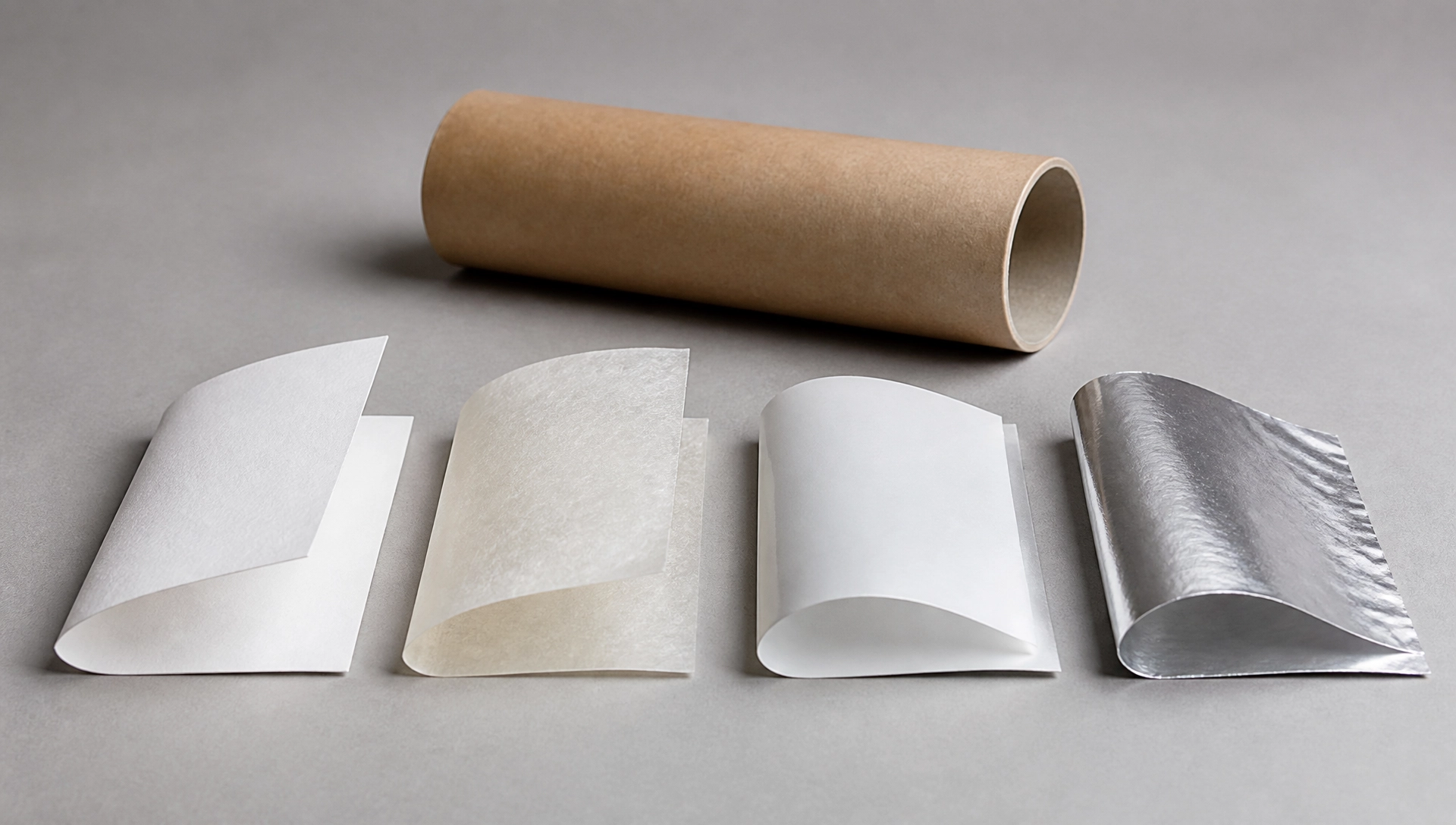
What Is Sustainable Food Packaging?
A Working Definition
Sustainable food packaging means fibre-forward packaging that protects food properly, meets food-contact safety law, and reduces material impact wherever the product genuinely allows it. Notice that “protects food properly” comes first — because packaging that fails its job creates food waste, which is far worse environmentally than a bit of extra material.
Why Food Is Harder Than Beauty or Retail
Cosmetics packaging mostly protects against knocks. Food packaging fights oxygen, umidità, leggero, grasso, and aroma loss simultaneously. Di conseguenza, you can’t simply copy a beauty packaging approach across.
The Two-Layer Mindset
So most successful projects split the problem. The barrier layer does the technical work. Nel frattempo, the fibre layer does the branding, struttura, and sustainability work. And once you separate those two jobs, the options open up considerably.
Common Applications Across Food and Beverage
Different categories need very differentimballaggio alimentare sostenibile approaches, so let’s go through them properly.
Tè
Loose leaf, pyramid bags, and sachets. Bagged tea sits comfortably inside a plain paper carton or tube. Tuttavia, loose leaf touching bare board needs a moisture and aroma barrier.
Caffè
Whole bean and ground. Onestamente, this is the toughest category — coffee off-gasses CO₂ after roasting and oxidises fast. Perciò, a sealed high-barrier pouch inside a kraft tube or carton usually beats trying to make the fibre do everything.
Biscotti, Cookies and Baked Goods
Grease is the main enemy here. Greaseproof or coated liners handle it, while the outer carton carries the brand story.
Cioccolato e dolciumi
Temperature-sensitive and aroma-absorbing. Individually wrapped pieces inside a rigid box work beautifully. Inoltre, gift assortments give you room for pulp or paperboard inserts.
Noci, Dried Fruit and Snacks
Oxygen drives rancidity in nuts particularly. So a sealed inner pack remains necessary, though the outer layer converts to fibre easily.
Spices, Supplements and Powders
Moisture and aroma control matter enormously. Tuttavia, paper tubes with an appropriate liner handle many of these formats well.
Gift Sets and Hampers
Where imballaggio alimentare sostenibile is easiest, frankly — because each item already carries its own primary protection.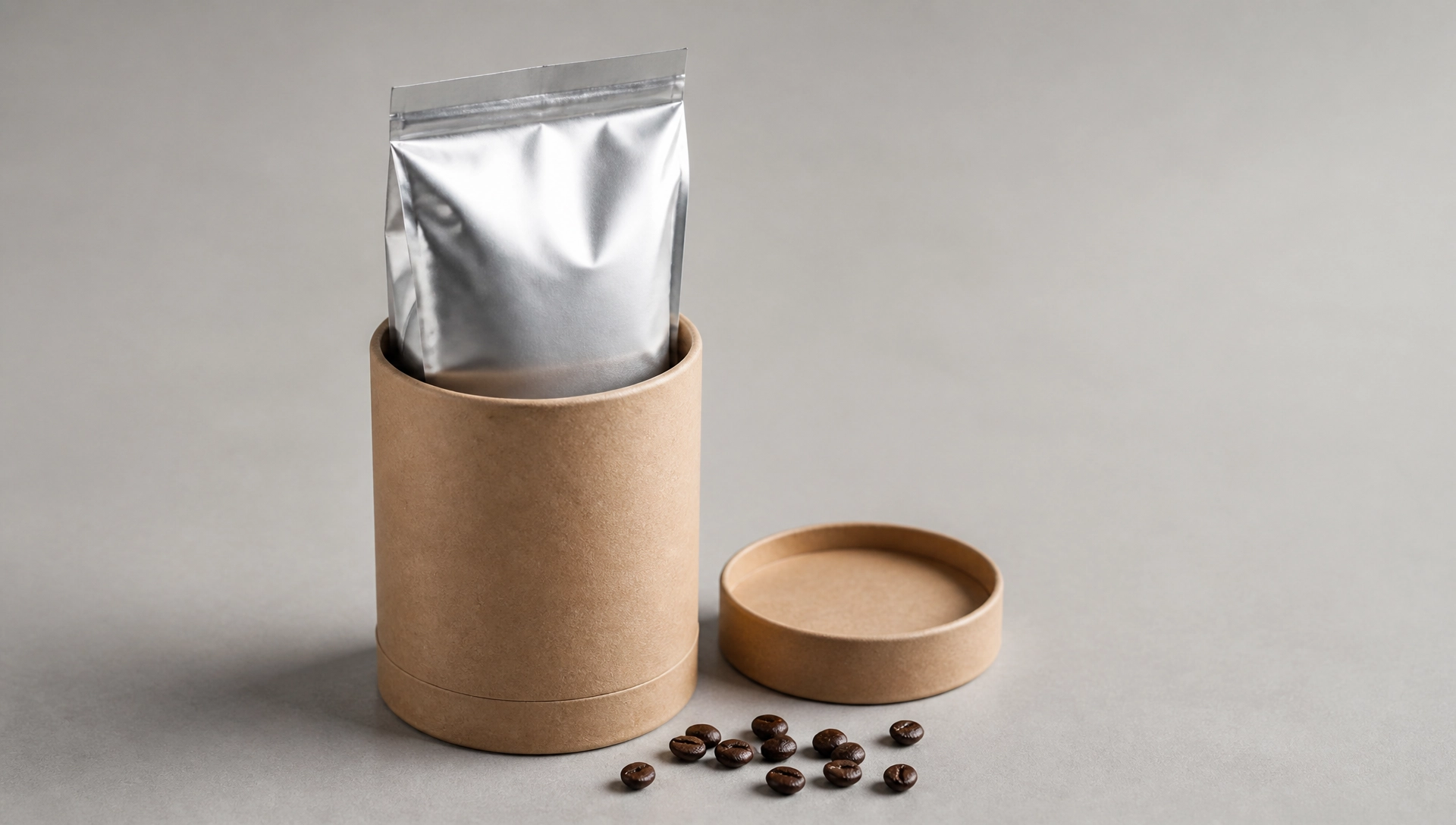
Opzioni materiali: Where the Real Decisions Happen
Material choice is where mostimballaggio alimentare sostenibile projects succeed or quietly fail.
Carta Kraft
Natural, unbleached, and instantly readable as responsible. Widely available food-grade. Inoltre, its texture suits artisan tea, caffè, and bakery brands especially well.
Carta artistica e cartone patinato
Smooth and highly printable for photographic packaging. It works fine as an outer layer. Tuttavia, standard lamination affects recyclability, so consider aqueous coating where the finish is decorative rather than protective.
Carta speciale e strutturata
Biancheria, sentito, and embossed stocks lift a premium tea or chocolate range. Di conseguenza, they let you skip soft-touch lamination while still feeling luxurious.
Food-Grade Paper and Greaseproof Liners
The workhorses ofimballaggio alimentare sostenibile. Greaseproof papers handle bakery and fried snacks. Nel frattempo, food-grade white papers suit dry goods with modest barrier needs.
PE-Coated and Water-Based Barrier Papers
These offer moisture protection with a thinner plastic layer than a full laminate. So they represent a genuine middle ground — though they aren’t plastic-free, and you should describe them accurately.
Foil Liners and High-Barrier Laminates
Aluminium foil delivers the strongest protection against oxygen, umidità, leggero, and aroma loss. Perciò, coffee and long-shelf-life products often still need it. It’s a mixed-material construction, but honest framing beats a failed product.
Choosing Between Barrier and Fibre Purity
If your project sits closer to the plastic-free end of the spectrum, la nostra guida su Idee di packaging senza plastica per cosmetici e cura della pelle covers fibre-only construction in depth — many of those principles transfer directly to dry food.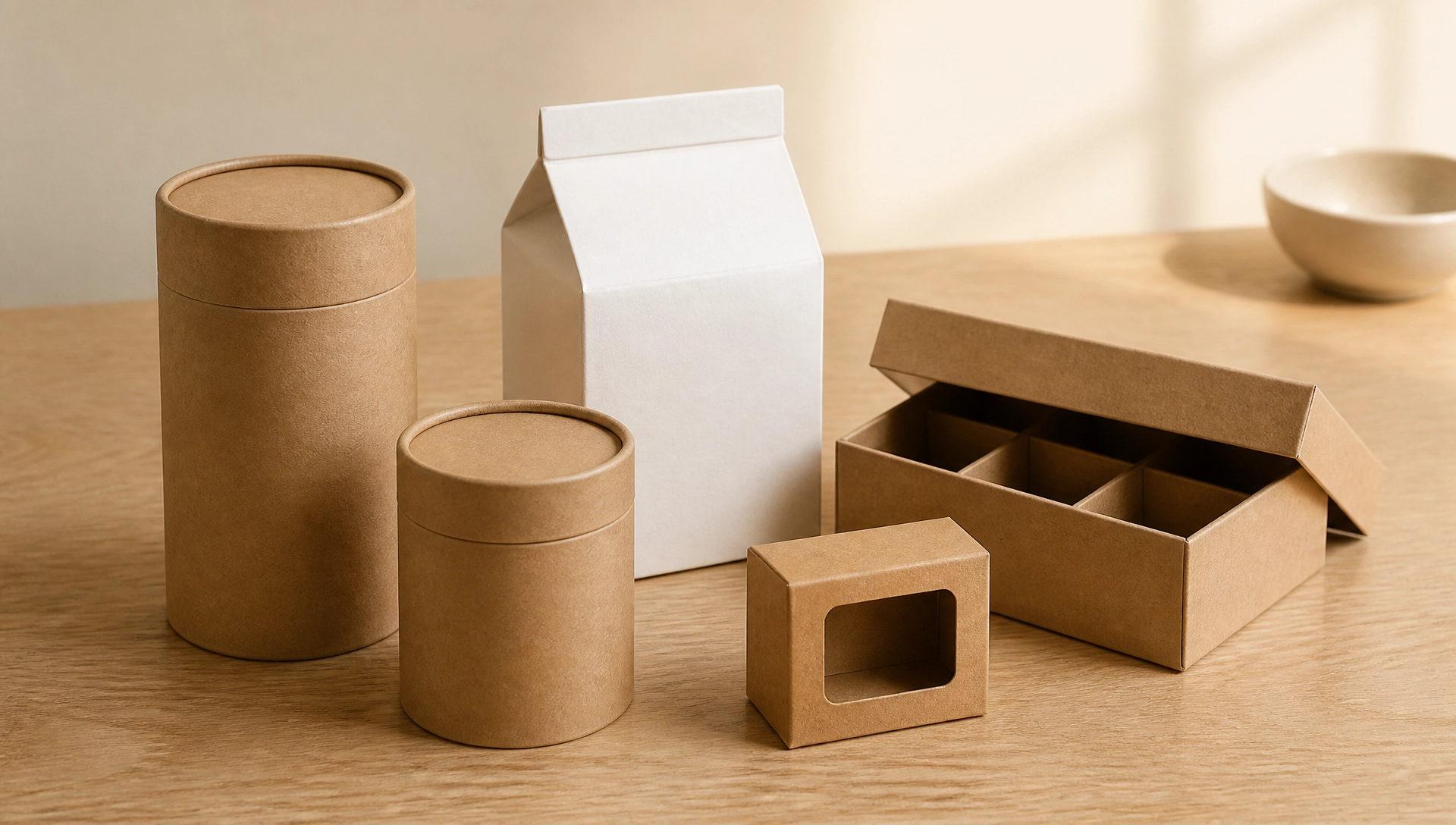
Structure Options for Food and Beverage
Structure decides how yourimballaggio alimentare sostenibile performs on shelf and in transit.
Tubi di carta
A kraft tube around a sealed inner pouch gives you shelf presence plus separable materials. It suits tea, caffè, spezie, and snack gifting particularly well. La nostra guida suImballaggi in tubi di carta biodegradabili per la bellezza & Cibo covers tube construction in detail.
📦Prodotti correlati: Tubi di carta personalizzati / Imballaggio alimentare / Imballaggio cosmetico
Cartoni pieghevoli
Cartoni pieghevoli with tuck-end or auto-lock closures remain the volume workhorse. Efficiente, imballato piatto, and cheap to ship.
Rigid Boxes and Gift Formats
Scatole rigide suit premium tea, cioccolato, and hampers. Inoltre, paperboard or moulded pulp inserts hold individual items neatly without foam.
Finestre
A film window shows the product but adds plastic. In alternativa, an open die-cut window works when the item already sits in a sealed inner bag. So decide based on whether shoppers genuinely need to see the contents.
Maniche e costruzioni telescopiche
A sleeve lets several SKUs share one base structure. Nel frattempo, telescopic tubes and lid-and-base builds add protection and a satisfying reveal.
Closures and Reclosability
Tin-tie closures, tuck flaps, and paper labels all offer reclosability without plastic zippers. Tuttavia, for products needing a genuine airtight reseal, a sealed inner pouch remains the practical answer.
Livello di spedizione
Scatole di cartone ondulato with paper tape complete a coherent fibre story from warehouse to doorstep.
Printing and Finishing for Food Brands
Ink and Food Safety Come First
Here’s something specific toimballaggio alimentare sostenibile for edible products. Ink, adesivo, and coating choices aren’t purely aesthetic — they carry migration implications. Di conseguenza, your printer needs documented food-grade systems, not just nice colour reproduction.
Metodi di stampa
- Offset CMYK o digitale — Full-colour artwork for photographic food imagery and ingredient graphics.
- Corrispondenza Pantone — Consistent brand colour across every batch, which matters when your range sits together on shelf.
- Serigrafia — Inchiostro opaco e vivido, well suited to kraft tubes and specialty stocks.
Finishes That Work Well
- Goffratura e debossing — Mechanical, no added material, strong tactile signal for premium tea and chocolate.
- Stampa a caldo — Small foil accents lift perceived value considerably.
- Rivestimento acquoso — Water-based scuff protection instead of plastic film.
Finishes to Review Carefully
- Laminazione opaca e lucida — Effective protection, but it complicates recyclability. So use it where genuinely needed, not by default.
- Spot UV — Multe in aree mirate; worth checking the coating chemistry for food-adjacent applications.
Compliance and Food Contact Safety
The Legal Baseline
Every layer of yourimballaggio alimentare sostenibile that touches food in the EU must comply withRegolamento (CE) NO 1935/2004 on food contact materials. Inoltre, manufacturing must follow Good Manufacturing Practice under Commission Regulation (CE) NO 2023/2006.
What That Means Practically
Your supplier should provide declarations of compliance, migration testing where applicable, and documentation covering inks, adesivi, and coatings — not just the base board. So ask for the full set rather than a single certificate.
Standards Retailers Request
- Materiali di imballaggio BRCGS — Attualmente emesso 7. Major retailers frequently require it from imballaggio alimentare sostenibile fornitori.
- IFS PACsecure — A packaging-specific standard developed by IFS with PAC, recognised across EU retail.
- IFS Food — Requested where the supplier also handles food operations.
- FSC — Certified fibre sourcing with chain of custody through your converter. Nostro Imballaggi in carta certificata FSC guide explains label types and verification.
Regulations on the Horizon
- PPWR — Design rules and Declaration of Conformity, applying from 12 agosto 2026.
- EUDR — 30 Dicembre 2026 per operatori grandi e medi; 30 Giugno 2027 per micro e piccoli operatori.
- EPR — National registration and fees in each EU market. Vedere Conformità EPR degli imballaggi per i marchi che vendono nell'UE.
Claim It Accurately
A foil-lined tube isn’t plastic-free, and saying so invites trouble. Invece, describe what’s true: separable materials, reduced plastic, certified fibre, recyclable outer. NostroImballaggio in carta riciclabile guide covers claim wording in more depth.
Come personalizzare: Passaggi 1–3
Fare un passo 1: Define the Product and Its Enemies
Primo, tell us what the food actually is — fat content, umidità, aroma sensitivity, target shelf life, and whether it touches the package directly. Genuinely, this determines everything downstream inimballaggio alimentare sostenibile design.
Fare un passo 2: Decide Where the Barrier Lives
Prossimo, decide whether the fibre carries the barrier or a sealed inner pack does. Separating those roles usually gives you a better sustainability outcome than forcing one material to do both jobs.
Fare un passo 3: Scegli Struttura e Materiale
Then we’ll recommend theimballaggio alimentare sostenibile construction — tube, cartone, scatola rigida, or sleeve — plus the specific liner and board grade for your conditions.
Come personalizzare: Passaggi 4–6
Fare un passo 4: Artwork and Food-Safe Finishing
Invia il tuo logo in AI, EPS, o PDF ad alta risoluzione con codici Pantone. Nel frattempo, we confirm ink and coating systems suit food-contact requirements for your specific application.
Fare un passo 5: Sample and Shelf-Life Testing
Never skip this — and for food, test with the real product, not an empty sample. Grassi, oli, and aromatics interact with paper, rivestimenti, and adhesives over time. Perciò, real shelf-life validation protects you from an expensive recall later.
Fare un passo 6: MOQ, Tempi di consegna e documentazione
Il MOQ inizia in genere tra 500 e 1.000 unità a seconda della struttura. I cartoni pieghevoli richiedono circa 15-20 giorni; scatole e tubi rigidi richiedono 25-35 giorni dopo l'approvazione del campione. We supply material specifications and compliance documentation alongside delivery.
Perché scegliere l'imballaggio in confezione
Food-Grade Manufacturing
- 2,000㎡ laboratorio per alimenti — A dedicated food-safe production environment, separated from general manufacturing. Per imballaggio alimentare sostenibile, this is the single most important thing to verify in any supplier.
- 20,000㎡ fabbrica — Produzione interna completa dalla fustellatura alla finitura, so we control every stage.
- 10,000,000+ capacità mensile — We scale from a 5,000-unit pilot to millions.
Design and Documentation
- 20+ progettisti interni — Mai esternalizzato. Sviluppo strutturale, liner selection, opera d'arte, and print-ready files.
- Compliance documentation — Food-contact declarations, specifiche dei materiali, and component weights for your EPR and retailer filings.
- Approvvigionamento certificato — FSC-certified materials with chain of custody support.
- 60+ mercati di esportazione — Incoterms e dogane gestite quotidianamente.
Una nota onesta
We won’t pretend every food product can go fully fibre-only today. Coffee and long-shelf-life snacks often still need a barrier layer we can’t deliver in paper alone. So we’d rather design you a genuinely separable, reduced-plastic structure than help you make a claim that collapses under scrutiny.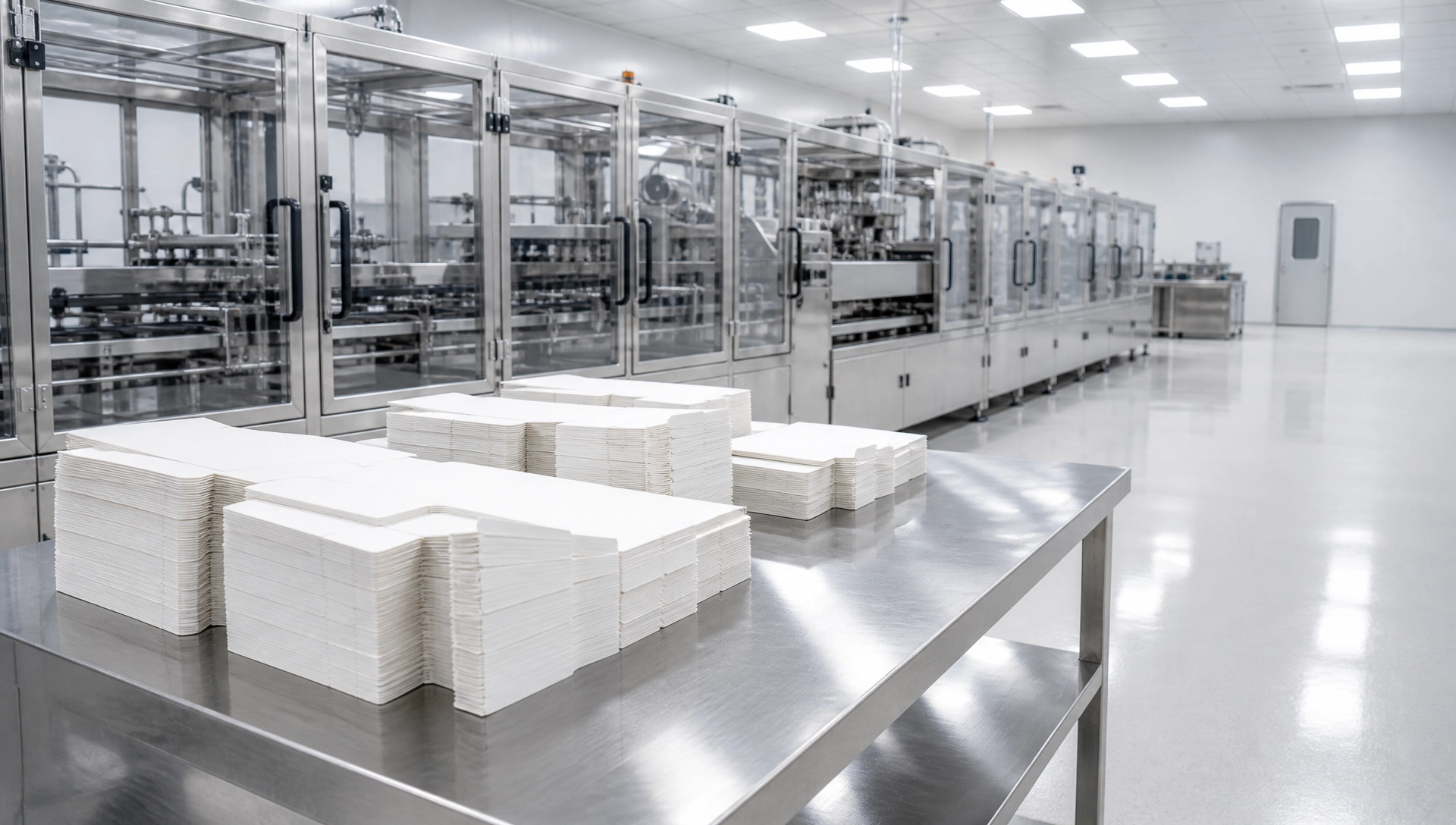
Domande frequenti: Barriers and Shelf Life
Q1: Can I package coffee without any plastic? Whole bean coffee for short local distribution sometimes manages with a heavily coated paper bag. Tuttavia, for retail shelf life and export, most brands still need a sealed high-barrier pouch inside a kraft tube or carton. That structure separates cleanly after use.
Q2: How long will my product stay fresh in paper packaging? That depends entirely on your product, the barrier specification, and storage conditions — so nobody can quote you a number without testing. Di conseguenza, we always recommend real shelf-life trials with your actual formulation.
Q3: Does loose leaf tea need a liner? Di solito sì, if it touches the board directly. Tea loses aroma quickly and absorbs odours. Tuttavia, bagged or sachet tea often sits fine in an unlined carton because the inner wrap already protects it.
Q4: Will greasy snacks stain a kraft box? Without a greaseproof liner, very likely. Perciò, specify a food-grade greaseproof layer for anything with meaningful fat content.
Domande frequenti: Conformità, Cost and Sourcing
Q5: What food safety documentation should I ask for? Request declarations of compliance under Regulation 1935/2004, migration test reports where applicable, and documentation covering inks, adesivi, and coatings. Inoltre, ask whether the supplier holds BRCGS Packaging Materials or IFS PACsecure certification.
Q6: Is sustainable food packaging more expensive? It varies. La rimozione della laminazione riduce i costi, while high-barrier liners add it. Onestamente, the bigger cost driver is usually structure complexity and tooling rather than the sustainability element itself.
D7: Can I print full-colour artwork on sustainable food packaging? SÌ. CMYK and Pantone both work on food-grade stock. The important part is confirming that your printer uses documented food-safe ink systems for the specific application.
Q8: Di cosa hai bisogno per iniziare un preventivo?? Send your product type, dimensioni, quantità, mercato di riferimento, durata di conservazione richiesta, e file del logo. Allora ti consiglieremo quello giustoimballaggio alimentare sostenibile struttura, fodera, and finish for your range.
Guide correlate
Food packaging decisions usually branch into several connected questions. Quindi li abbiamo trattati ciascuno separatamente:
- Questa guida — How to protect food properly while reducing packaging impact.
- Idee di packaging senza plastica per cosmetici e cura della pelle — Fibre-only construction principles, many of which transfer to dry food.
- Imballaggi in carta certificata FSC per marchi eco-consapevoli — Dimostrare da dove proviene la fibra.
- Imballaggio in carta riciclabile: Cosa dovrebbero sapere i marchi globali — Whether your finished pack enters a recycling stream.
- Conformità EPR degli imballaggi per i marchi che vendono nell'UE — What you register and pay in each EU market.
In sequenza, coprono: will it protect the food, can we remove plastic, where did the fibre come from, can it be recycled, Ewhat must we file.
Esplora altre soluzioni di imballaggio personalizzate
- Scatole pieghevoli — Leggero, cartoni per la vendita al dettaglio completamente personalizzabili.
- Scatole rigide — Premium gift boxes for tea, cioccolato, and hampers.
- Scatole di cartone ondulato — Imballaggio durevole per l'e-commerce e la spedizione.
- Scatole a prova di bambino — Imballaggio sicuro per i prodotti regolamentati.
- Accessori — Inserti personalizzati, carta velina, nastri, ed etichette.
- Tubi di carta — La nostra collezione dedicata al tè, caffè, spezie, and premium gifting.
Ready to Start Your Project?
Gettingimballaggio alimentare sostenibile right isn’t about choosing the greenest material on paper. It’s about matching the barrier to the product honestly, putting the fibre where it does the most good, and being able to document every claim you make. And the brands that approach it this way rarely end up with either a failed product or a shaky sustainability story.
Raccontaci la taglia del tuo prodotto, quantità, file del logo, e mercato di riferimento. Il nostro team ti consiglierà poi la struttura giusta, materiale, and finish — plus the food-contact documentation your buyers will ask for.
✉️ [Inviaci il tuo brief → Ottieni un preventivo personalizzato 24 Ore] Includi: dimensioni del prodotto · quantità · mercato di riferimento · file del logo
Imballaggio del pacco | 20,000㎡ Fabbrica | 2,000㎡ Workshop sul settore alimentare | Materiali certificati FSC | 60+ Mercati di esportazione
Disclaimer: Questa guida offre informazioni commerciali generali suimballaggio alimentare sostenibile e riflette le fonti normative disponibili al pubblico a partire da agosto 2026. It does not constitute food safety or legal advice. Requirements vary by product, market, and application. Perciò, confirm your specific obligations with a qualified food-contact compliance advisor before production.