Skip to content
You can approve a corrugated board grade, receive clean-looking cartons and still find the bottom layer bowing after several humid weeks in storage. That is why buyers need to define stacking strength around the real packed weight, pallet pattern, warehouse climate and storage period—not around a material certificate alone. Just as importantly, stacking strength must leave a justified margin for handling, misalignment and changes that occur between a laboratory and a working warehouse.
Quick answer: Stacking strength is the ability of a closed corrugated box or unit load to support vertical pressure during storage and distribution without collapsing or deforming beyond the agreed limit. A useful specification combines the load on the bottom carton, expected storage time, temperature and relative humidity, pallet support, box construction, closure method and validation with representative packed samples.
What Is Corrugated Box Stacking Strength?
Stacking strength describes the vertical load a completed box can withstand in its intended orientation and use condition. In practical terms, the corners, side panels, top and bottom flaps, seams, internal fit and packed product all share the load. A weak score line, crushed corner, oversized box or unsupported void can therefore reduce performance even when the corrugated board itself meets its ECT value.
Moreover, this distinction matters because a board test is not a warehouse guarantee. First, Edge Crush Test, or ECT, measures the edgewise compression resistance of a board sample. By contrast, a box compression test evaluates an erected container, while a palletized test can evaluate several cartons or a complete unit load. In addition, the current ASTM packaging standards directory lists ASTM D642 for determining the compressive resistance of shipping containers, components and unit loads.
So, when a supplier says, “This is a 32 ECT box,” the sensible next question is, “Under which warehouse conditions, with which product, for how long and in what pallet pattern?” That small pause can prevent a very expensive surprise later.
How Warehouse Loads Build Up
To estimate the first load case for stacking strength, start with the bottom carton in one vertical column. In a simple, evenly aligned stack, it carries the packed cartons above it:
Load above the bottom carton = (number of cartons in the vertical column − 1) × gross packed weight per carton
For example, if six identical cartons are stacked vertically and each packed carton weighs 12 kg, the simplified static load above the bottom carton is 60 kg. However, 60 kg is not automatically the required laboratory compression value. The real specification must also account for dwell time, humidity, pallet gaps, overhang, load sharing, vibration, handling damage and the difference between short-duration peak strength and a sustained warehouse load.
However, there is no responsible universal safety factor for every box. For example, a dry, climate-controlled warehouse with aligned cartons is not the same as a tropical warehouse, a cold-chain route with condensation or a mixed pallet stored for three months. Therefore, the compensation factor should be justified from the distribution environment, customer protocol, historical damage data and representative testing—not selected from a generic chart without context.
Therefore, before a supplier recommends a board grade, send these inputs:InputWhy it changes the specificationInternal box dimensionsPanel size and slenderness influence deformation and compression performance.Gross packed weightThe bottom layer must carry the products and cartons above it.Maximum stack heightWarehouse and vehicle stacks may create different worst-case loads.Storage durationCorrugated containers can deform progressively under a constant load.Temperature and relative humidityCellulosic materials change properties as the atmosphere changes.Pallet type and deck layoutGaps, flexible deckboards and damaged pallets create uneven support.Pallet patternColumn, interlocked and mixed-size layouts transfer load differently.Product and insert supportA rigid, well-fitted product may share load; a large void may not.Closure methodTape, glue, staples and flap overlap influence box integrity.Allowed deformation“No collapse” may be insufficient if bowed panels damage labels or automation.
ECT, BCT and Long-Term Creep
Good stacking strength decisions use several measurements for different questions. ECT helps compare corrugated board constructions. Mullen burst indicates resistance to rupture under hydraulic pressure, but it does not directly state how much warehouse load a finished carton can carry. For a purchasing-level comparison, see our guide to corrugated box strength: ECT vs Mullen. BCT measures the complete box under compression and is far closer to the use case, although the result still depends on sample conditioning, box geometry, closure, platen setup and whether the box is empty or packed.
Most importantly, a short BCT result is not the same as a safe long-term working load. Corrugated boxes can continue to deflect while a constant load remains in place—a time-dependent behavior known as creep. ASTM D7030 specifically addresses short-term creep performance under a constant compression load and explains that deflection-versus-time data can help predict time to failure. Consequently, a carton that survives a quick compression peak may still bow or collapse after days or weeks.
For a broader validation plan, read our guide to corrugated box testing, compression, drop and ISTA protocols. Compression answers only one part of the risk. Drops can crush corners, vibration can loosen the packout and repeated handling can reduce the remaining margin before the pallet even reaches long-term storage.
Meanwhile, the current ISTA procedure-change record clarifies for ISTA 3E that the largest stack between the warehouse and vehicle should be used in compression calculations. In other words, do not assume the warehouse is automatically the worst case; map the whole distribution route first.

Humidity, Conditioning and Storage Time
Humidity is one of the most common reasons stacking strength in service differs from a dry-room test. Corrugated board is cellulosic, so its physical properties change with temperature and relative humidity. ASTM D4332 explains why packages are conditioned in a specified atmosphere before testing and notes that special laboratory conditions may represent phases of the distribution environment.
This is especially important for refrigerated foods, beverages, frozen goods and products that move between air-conditioned rooms and warm loading docks. Condensation may form during the transition. Likewise, cartons stored against a damp wall or directly on a wet floor can absorb moisture locally, creating a weak point that a standard dry sample never revealed.
A practical warehouse plan should therefore include the following controls:
- Keep cartons and pallets off wet floors and away from leaking walls or roofs.
- Record temperature and relative humidity where finished goods are actually stored.
- Allow cartons to acclimatize when they move between very different climates.
- Rotate inventory so that unplanned dwell time does not quietly become months.
- Quarantine cartons with crushed corners, water staining or separated seams.
- Test samples after the conditioning profile that matches the target lane.
- Review the specification when the market, season, warehouse or storage period changes.
Also, do not hide uncertainty behind a single “warehouse average.” A monthly average can look comfortable even though several humid days create the real hazard. If the package is business-critical, evaluate both the normal condition and a defensible worst-case condition.
Pallets, Stacking Pattern and Alignment
Pallet setup can preserve or destroy stacking strength before the board grade has a chance to perform. The vertical edges of a regular slotted carton usually carry much of the compression load. Therefore, column stacking—placing carton corners directly above one another—often supports better top-to-bottom load transfer. Interlocking layers may improve lateral stability, but the offset can interrupt corner alignment and reduce vertical efficiency. The correct choice depends on box geometry, pallet stiffness, unit-load containment and testing.
Watch these common warehouse failure points:Pallet or stack conditionWhat can go wrongPractical controlCarton overhangUnsupported edges bend and corners lose their load path.Fit the pallet footprint or redesign the case count and pattern.Wide deckboard gapsBottom panels bridge unsupported spaces and deform.Confirm pallet design and place critical load paths over support.Horizontal offsetCorners no longer align through the stack.Use pallet guides, layer diagrams and operator training.Mixed carton sizesSmall boxes create point loads under larger boxes.Separate SKUs or design a verified mixed-load pattern.Damaged palletBroken or warped boards create uneven support.Inspect and reject pallets before loading.Loose unitizationCartons migrate during handling and lose alignment.Validate stretch wrap, straps, anti-slip sheets or corner boards.Excessive wrap forceSide panels can be pulled inward before storage begins.Set and verify the wrapping recipe for the actual carton.Double stacking palletsThe upper pallet introduces concentrated deck and runner loads.Validate the complete two-pallet configuration, not one box alone.
Warehouse safety is broader than carton compression. In the United States, OSHA 29 CFR 1910.176(b) requires tiered materials to be stacked, blocked, interlocked and limited in height so they remain stable and secure against sliding or collapse. Local rules may differ, and rack capacities, sprinkler clearances, seismic requirements, forklift practices and pallet ratings need their own qualified review. A packaging specification should support that system, not replace it.
Common Applications
Different products challenge stacking strength in surprisingly different ways:
- Perfume and fragrance: Glass bottles are dense and fragile. Fitted inserts can restrict movement, although the shipper still needs enough top-to-bottom support for warehouse and e-commerce handling.
- Skincare and cosmetics: Jars, pumps and mixed-height kits may create uneven internal support. A level insert or partition can prevent concentrated loads on caps and closures.
- Tea, coffee and snacks: Lightweight primary packs may leave large voids inside the master case. Dividers, tighter case sizing and controlled headspace help the outer carton carry load consistently.
- Food and beverages: Cans, bottles and sealed pouches may be heavy, chilled or exposed to condensation. Food-contact status and cold-chain conditions must be specified separately.
- Candles and home fragrance: Wax-filled glass vessels add weight, while summer heat may change the product and insert behavior. Prototype tests should use filled retail units.
- Apparel and soft goods: The product may provide little structural support. Overfilled clothing can also push side panels outward and disturb the load path.
- Industrial and bulk components: Dense metal or mechanical parts require partitions that control movement without transferring sharp point loads into the carton walls.
Yes, two cartons with the same external dimensions can need very different board and insert designs. The product is part of the packaging system, so test it that way.
Material Options
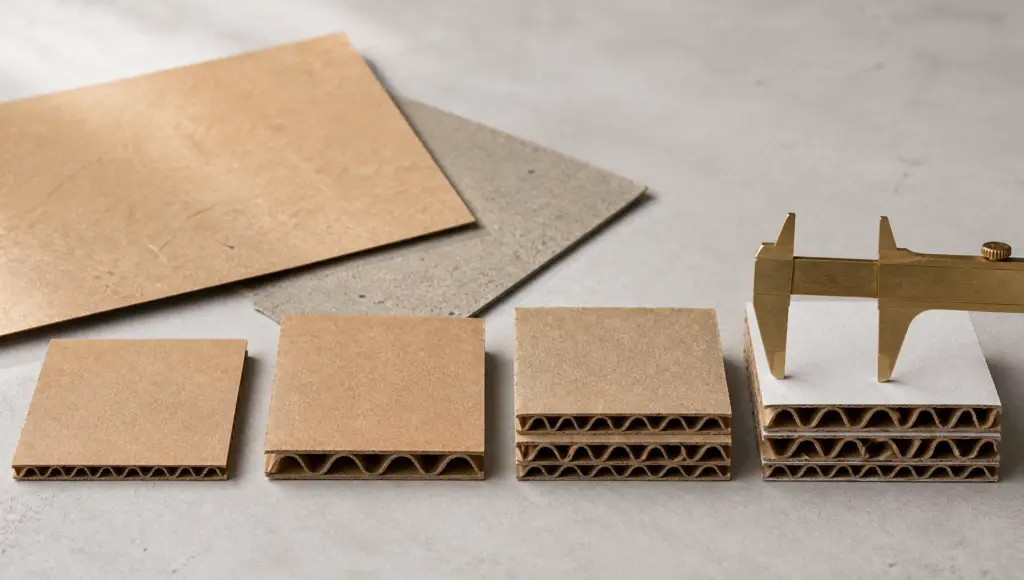
Material selection should create stacking strength with the least material that still meets the verified performance target. Options include single-wall, double-wall and, for demanding industrial loads, selected triple-wall constructions. Flute profile, liner and medium basis weight, virgin or recycled fiber blend, moisture exposure and converting quality all influence the final result.
For branded packaging, the visible surface can use brown kraft liner, white kraft, coated art paper or specialty paper laminated to corrugated board. However, a premium facing does not automatically increase compression capacity. In fact, the designer must still check scoring, lamination, cracking, warping and how the facing behaves in the warehouse climate.
In addition, food programs may require a verified food-grade liner, functional coating or separate primary barrier. A foil liner can help with light, aroma, grease or moisture in specific constructions, but it may change recyclability and should be assessed against the actual product, contact type and target-market rules. Finally, never describe a corrugated shipper as food safe for direct contact unless the complete material, ink, adhesive and coating system has supporting documentation for that intended use.
Structure Options
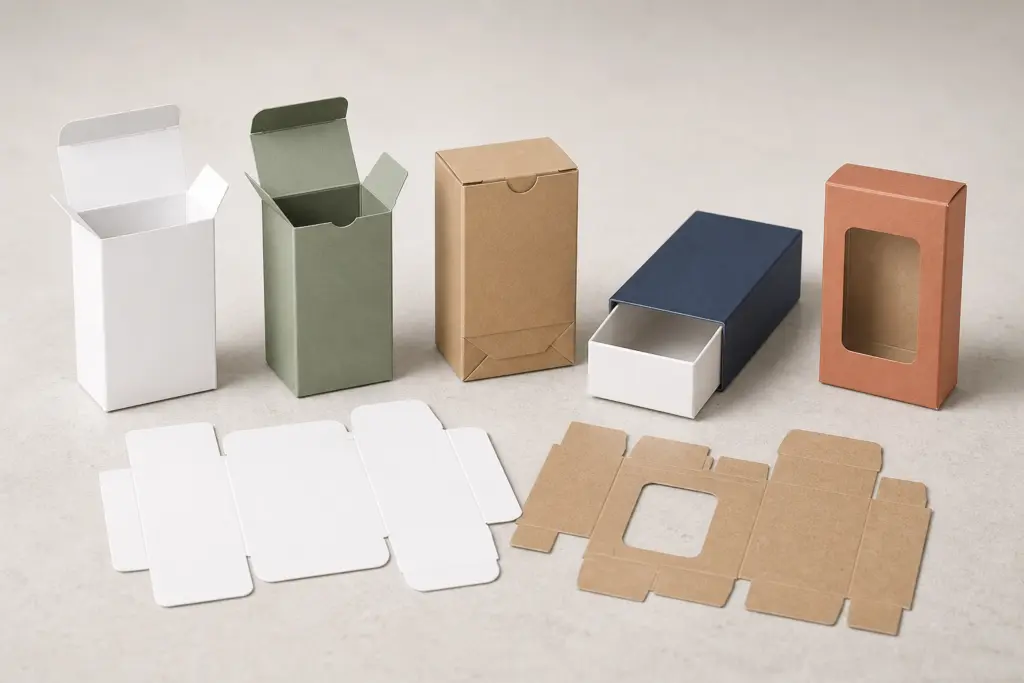
Structure can improve stacking strength without simply adding more paper. A regular slotted container is efficient for many warehouse programs, while a full-overlap box adds top and bottom coverage. A die-cut mailer can work for compact e-commerce packs, and a half-slotted case with a separate lid may suit loading from above. Telescopic structures can provide adjustable depth or reinforced side walls for selected applications.
Moreover, inserts, partitions and dividers do more than organize products. When correctly engineered, they reduce movement, separate fragile units and can help distribute load. However, inserts should not be assumed to carry compression unless that role is designed and tested. Likewise, windows remove material from a panel, so their size and position must be evaluated rather than treated as a purely visual choice.
Sleeves can add branding or localized reinforcement. Meanwhile, push-up and twist-up mechanisms usually belong to paper tube primary packaging, not corrugated warehouse cases. Those packs are typically placed inside a corrugated master carton, where the tube dimensions, lid fit and layer pattern become part of the shipper design.
Printing & Finishing Options
Printing and finishing should support the brand without quietly weakening stacking strength. Corrugated boxes can use flexographic, litho-laminated or selected digital printing with CMYK or Pantone colors. Premium programs may also use hot stamping, embossing, debossing, spot UV, matte lamination, gloss lamination or soft-touch film.
Still, the finish must work with the structure. Heavy embossing across a score, a dense laminate over a fold or excessive pressure during converting can affect crease quality. Surface coatings also change friction between cartons, which may influence pallet stability, while dark colors can make scuffing more visible. For warehouse cases, keep critical barcodes, handling marks and batch data readable after rubbing, wrapping and condensation exposure.
If recyclability is a target, compare the marketing benefit of plastic films or metallic layers with lower-material alternatives. Water-based coatings, restricted foil areas and unlaminated print may be suitable in some markets, although the final claim should follow local collection and recycling infrastructure.
Related Products
- Custom Paper Tubes for push-up, twist-up, telescopic and rigid cylindrical primary packs
- Food Packaging for tea, coffee, snacks and verified food-contact programs
- Cosmetic Packaging for perfume, skincare, makeup and beauty gift sets
Compliance & Sustainability
Compliance does not prove stacking strength, and a compression test does not prove compliance. Buyers need both workstreams when the product, customer or market requires them.
- BRCGS Packaging Materials: The BRCGS standard provides a framework for packaging safety, quality and operational controls. Confirm the supplier’s current certificate, scope, site address and product category rather than relying on a logo alone.
- IFS: IFS Food evaluates food producers, whereas IFS PACsecure is the packaging-focused standard for manufacturing and converting processes. Food companies operating under IFS Food may pass specific packaging requirements down to suppliers.
- FSC: FSC Chain of Custody verifies the path of eligible forest-based material through the supply chain. It supports responsible sourcing claims, but it is not a box compression rating.
- EUDR: The EU Deforestation Regulation covers listed commodities and derived products, including wood-related categories. Scope can depend on whether packaging is traded as a product in its own right or used only to support, protect or carry another product, so importers should verify the current classification and obligation for their case.
- EPR and PPWR: Extended producer responsibility duties vary by market. In the EU, the Packaging and Packaging Waste Regulation sets packaging and waste rules that should be reviewed alongside national registration, reporting and labeling duties.
- Food-contact safety: Direct-contact use requires a documented material, ink, adhesive, coating and migration-risk review for the food type and conditions of use. Secondary packaging for sealed food should be described accurately as secondary packaging.
Sustainability also means preventing product damage. A lighter box that collapses and wastes the product, freight and replacement shipment may be a worse outcome than a slightly stronger, verified design. Therefore, optimize after testing rather than reducing board grade by guesswork.
How to Customize a Warehouse-Ready Corrugated Box
To customize stacking strength efficiently, begin with the warehouse and distribution brief—not the artwork. A useful process looks like this:
- Define the product. Send product dimensions, gross weight, fragility, temperature sensitivity and whether the product supports load.
- Confirm internal dimensions. State length × width × height and dimensional tolerance. Avoid using external dimensions when the product fit is the critical requirement.
- Map the load. Provide maximum cartons per column, layers per pallet, pallet size, pallet type, overhang limit, double-stack requirement and expected rack or floor storage method.
- Describe the environment. Include storage duration, normal and worst-case temperature/RH, cold-chain transitions and target countries.
- Choose material and structure. Review flute, single- or double-wall board, liner, closure, inserts, dividers, ventilation holes and hand holes.
- Add branding. Supply an editable AI, PDF or EPS logo file plus Pantone references, barcode requirements and finish preferences.
- Prototype the real packout. Assemble the box with production-equivalent product, insert, tape and pallet pattern. Check fit, panel bowing, closure and handling.
- Validate and approve. Agree on conditioning, BCT or constant-load checks, pallet testing and any required ISTA or customer-specific protocol. Use a qualified third-party laboratory when independent reporting is required.
- Lock the specification. Record internal dimensions, board construction, performance criteria, print, tolerances, sampling plan and acceptance limits.
- Confirm commercial terms. MOQ, sample cost, sample lead time and bulk lead time depend on dimensions, board, print, tooling, finish, test requirements and order volume.
Finally, do not change the board grade, flute direction, adhesive, die line or pallet pattern without reviewing whether requalification is needed. A “small” cost-saving change can alter the complete load path.
Why Choose Pack Packaging?
Pack Packaging combines structural development and branded production so stacking strength can be reviewed alongside product fit, graphics, inserts, palletization and target-market requirements. Our resources include a 20,000 m² factory, a 2,000 m² food-grade workshop, 10,000,000+ monthly capacity and a 20+ design team.
For a warehouse project, our team can review your internal dimensions, gross packed weight, board options, closure, pallet layout, printing and finish. We can also prepare samples and coordinate an appropriate third-party test plan when independent ASTM, ISTA or customer-protocol reporting is requested. As a result, the quotation is tied to a defined packout rather than a vague request for “a stronger box.”
Frequently Asked Questions
1. How do you calculate the required stacking strength?
First, calculate the static load above the lowest carton using the actual gross packed weight and maximum vertical stack. Next, account for storage duration, relative humidity, pallet support, alignment, handling damage and the selected validation method. Because these risks vary widely, the final compensation factor should be justified for the real distribution environment rather than copied from a universal rule.
2. Is ECT the same as box compression strength?
No. ECT measures the edgewise compression resistance of a corrugated board sample. BCT evaluates an erected box and includes the effects of dimensions, panel geometry, scores, seams and construction quality. Even then, a short BCT result should not be treated automatically as a long-term warehouse working load.
3. How many corrugated boxes can I stack safely?
There is no safe answer based only on flute type or carton height. You need the gross packed weight, tested box performance, storage time, humidity, pallet support, stacking pattern and workplace rules. Also check rack, pallet and floor-load limits through the responsible warehouse professionals.
4. Does high humidity weaken corrugated boxes?
Yes, elevated moisture exposure can change the physical properties of paper-based packaging and reduce its compression margin. Therefore, condition samples for the expected route, keep cartons away from wet floors and walls, and review cold-chain condensation risk.
5. Is column stacking always better than interlocking?
Column stacking usually aligns corners more directly and can improve vertical load transfer. However, interlocking may offer greater lateral stability in some unit loads. The best pattern depends on the carton, product, pallet, containment system and handling route, so validate the complete unit load.
6. Should compression tests use empty or filled boxes?
That depends on the purpose and method. Empty-box testing can compare carton constructions consistently, whereas testing with the real product and insert reveals load sharing, voids, concentrated pressure and product damage. Define the sample state in the test plan and never compare results from different setups as though they were equivalent.
7. What information should I send for a quotation?
Send the internal size, product use, gross packed weight, quantity, maximum stack, storage time, warehouse temperature/RH, pallet layout, target market, logo file and required tests. With that information, we can recommend a stacking strength target, structure, material, sample plan, MOQ and lead time.
8. Can I reduce board weight without increasing collapse risk?
Possibly, but optimize the whole system. Better dimensions, aligned corners, improved inserts, a stronger pallet, reduced overhang or a more efficient pattern may allow material reduction. Nevertheless, confirm the revised design with conditioned samples and representative testing before mass production.
Request a Custom Quote
Tell us your product size, quantity, logo file and target market. Our team will recommend the right structure, material and finish, then review the stacking strength requirement against your packed weight, pallet pattern, climate and storage period.
Send us your size, product use, quantity and logo file to get a custom quote.