You may have already confirmed the product, packaging structure and quotation. Entonces, just when the project seems ready to move forward, the supplier asks one more question:
“Can you send us the print-ready artwork?"
This is where many custom packaging projects suddenly slow down.
Correct archivos de ilustraciones de embalaje personalizados help prevent missing fonts, logotipos borrosos, incorrect colors, misplaced hot stamping, outdated dielines and unnecessary sample revisions. Más importante aún, good artwork allows the packaging supplier to understand exactly how your box or tube should be printed and finished.
Entonces, before you send that final AI or PDF file, it is worth checking whether the artwork is actually ready for production—not simply whether it looks good on your screen.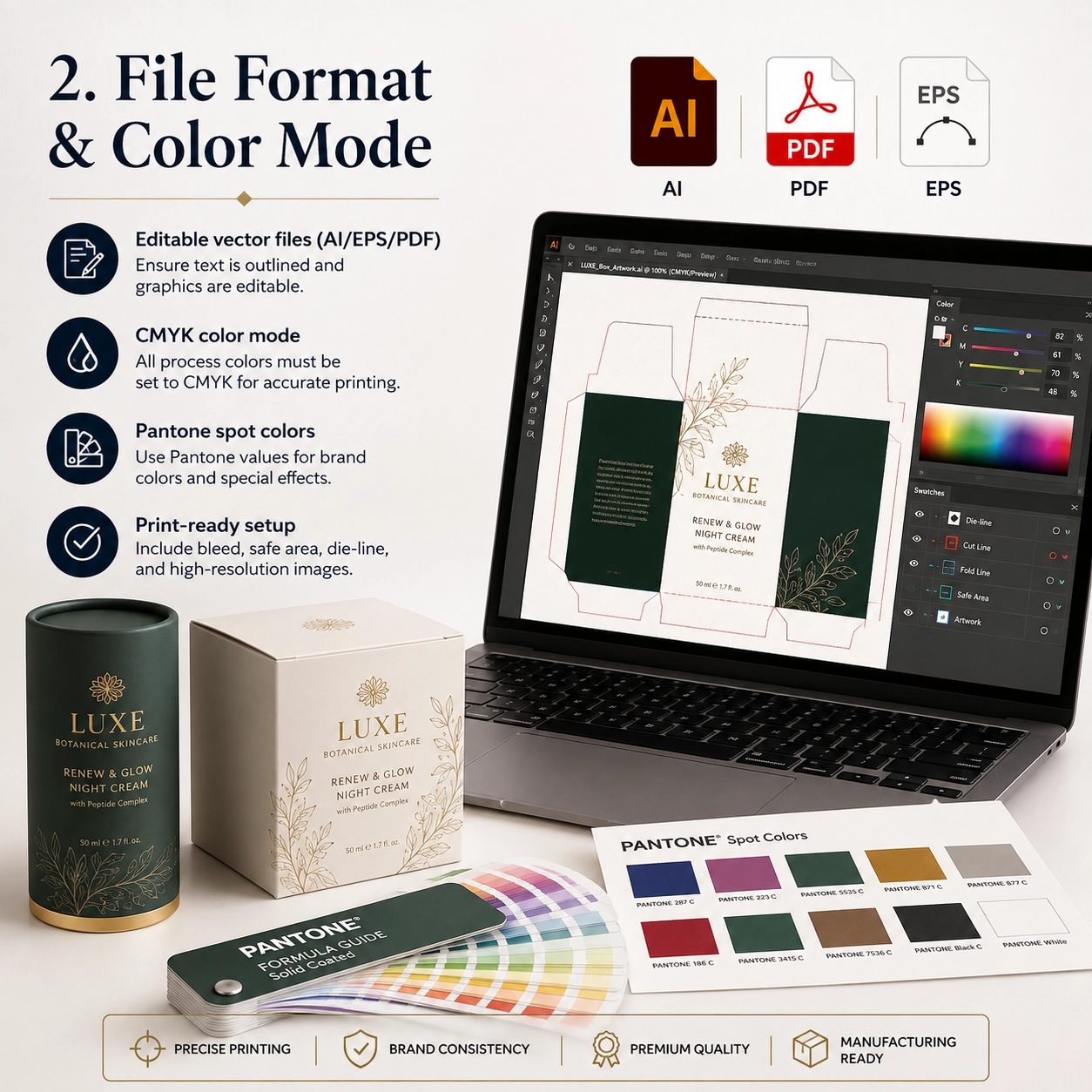
¿Qué es este tipo de embalaje??
In this article, we are not talking about one particular box or paper tube. En cambio, we are talking about the technical artwork required to manufacture custom paper packaging.
Archivos de ilustraciones de embalaje personalizados are production files built on the approved packaging dieline.
Unlike a JPG mockup, they tell the factory where to:
- Cut
- Fold
- Glue
- Apply foil
- Realzar
- grabado
- Apply spot UV
- Create a window
- Position regulatory text
En otras palabras, the mockup explains the visual idea, while the technical artwork explains how that idea becomes a physical package.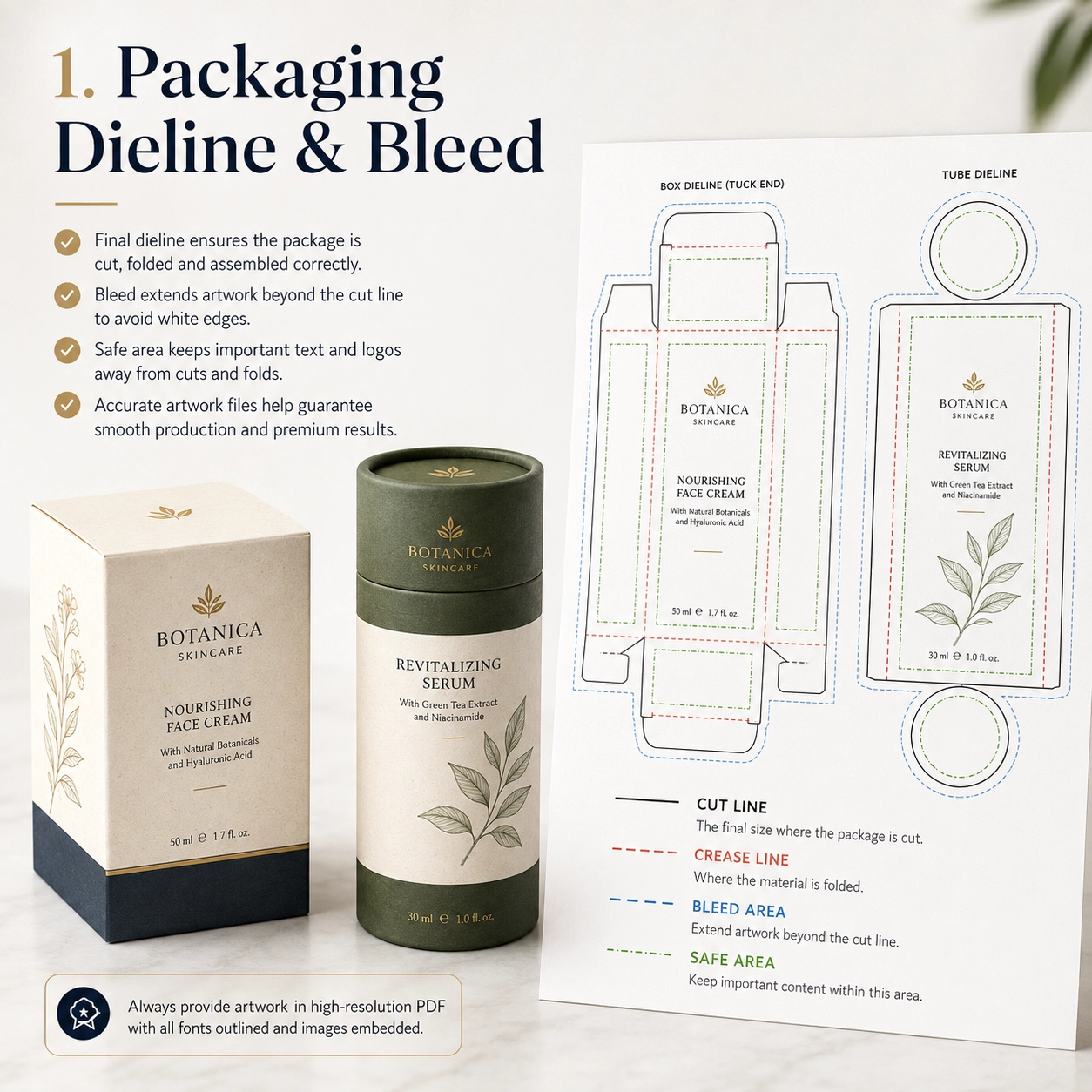
Common Artwork Components
A packaging production file may contain:
- dieline
- Cut line
- Crease line
- Área de pegamento
- Sangrar
- Zona segura
- Ilustraciones CMYK
- colores pantone
- Product text
- Código de barras
- Capa de estampado en caliente
- capa de relieve
- Capa de grabado
- Capa UV puntual
- Window line
- Insertar obra de arte
Por lo tanto, the final artwork should always be created around the approved production structure rather than an estimated size.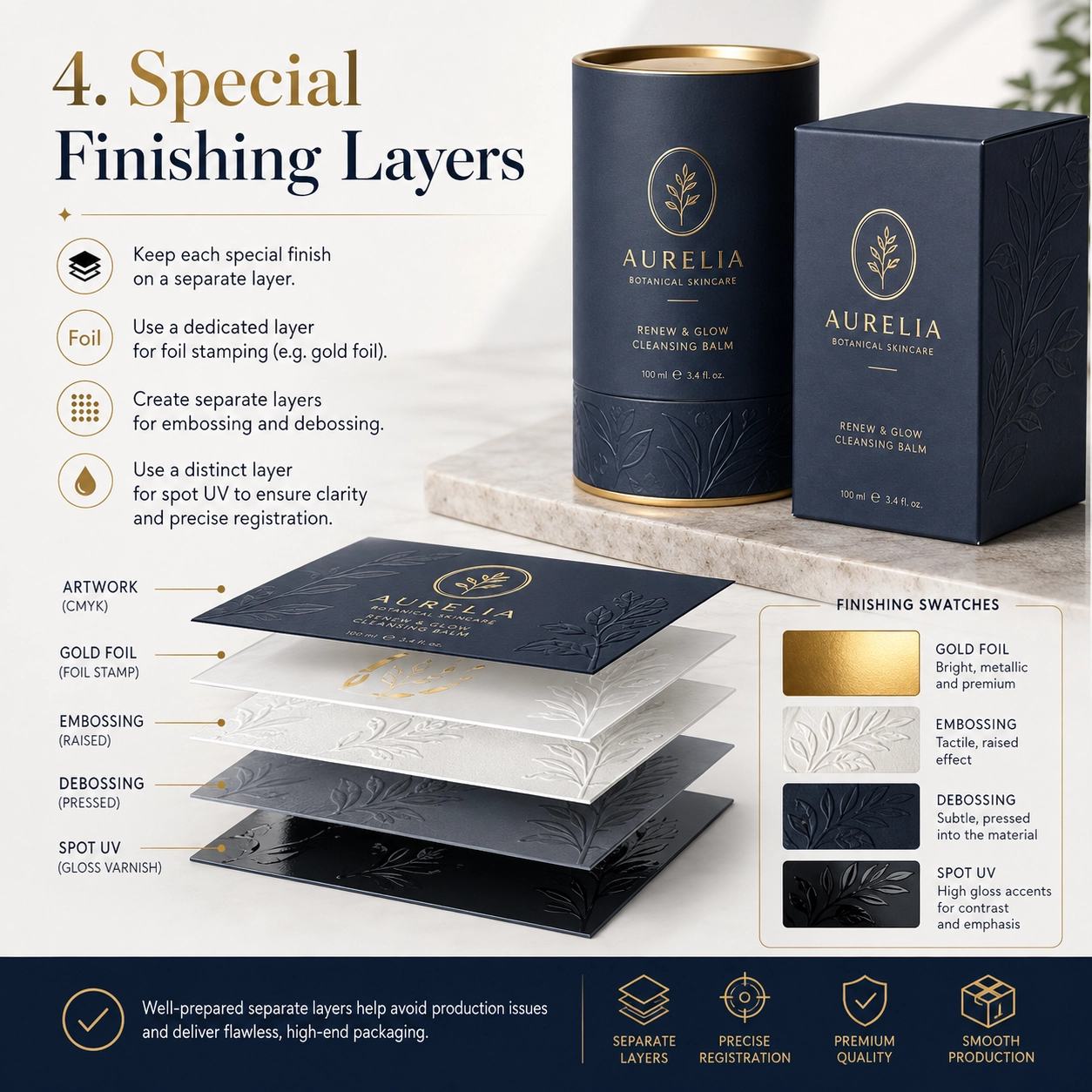
Preferred Artwork Formats
For many packaging projects, editable formats such as these are practical:
- AI
- PDF editable
- EPS
Mientras tanto, high-resolution PSD or TIFF files may be used for photographs or raster artwork.
Vector graphics are especially useful for logos, texto, dielines and finishing areas because Illustrator vector artwork can be scaled for print without the pixelation associated with low-resolution raster graphics.
Why JPG or PNG Is Usually Not Enough
A JPG may show the design clearly. Sin embargo, normalmente no contiene editable:
- dielines
- Spot colors
- Foil paths
- Caminos en relieve
- Cutting paths
- Separate finishing layers
Por lo tanto, a JPG is better treated as a visual reference rather than the only production file.
If you only have a JPG, tell the packaging supplier early. The design or prepress team can then determine whether the artwork needs to be rebuilt.
Aplicaciones comunes
la preparación de archivos de ilustraciones de embalaje personalizados varies according to the product category.
Embalaje de perfumes
Perfume packaging often looks visually simple but may involve several premium finishing processes.
Por ejemplo, a rigid perfume box or paper tube may require separate layers for:
- Dark green Pantone printing
- Logotipo de lámina dorada
- Embossed brand mark
- Laminación mate
- Insertar marca
If the gold logo must also be embossed, the supplier needs to know whether the embossing follows exactly the same shape.
Por lo tanto, separate the layers clearly.
A practical Illustrator layer structure could look like:
- DIELA
- IMPRESIÓN CMYK
- pantone
- LÁMINA DE ORO
- REALZAR
- PUNTO UV
- INSERTAR
This makes communication much easier.
Cuidado de la piel y cosméticos
Cosmetic packaging often contains more written information than perfume packaging.
Typical content may include:
- Nombre del producto
- Ingredientes
- Instrucciones
- Contenido neto
- Advertencias
- Detalles del fabricante
- Código de barras
- Batch information
Como consecuencia, typography and safe areas become especially important.
Before sending the artwork, check whether small text is too close to:
- Líneas de plegado
- Cutting edges
- ventanas
- Glue flaps
- Costuras de tubo
Té y café
Tea and coffee packaging frequently combines branding with detailed product information.
Esto puede incluir:
- Country of origin
- Notas de sabor
- Instrucciones de preparación
- Ingredientes
- Peso neto
- Código de barras
If the artwork is printed on natural kraft paper, keep in mind that the brown paper base will affect how colors appear.
Por lo tanto, do not assume that a color shown on a white monitor will reproduce identically on kraft paper.
chocolate y dulces
Chocolate and confectionery packaging often combines:
- CMYK illustrations
- Fotografía
- lámina de oro
- ventanas
- Product information
A window introduces an additional technical area.
Por lo tanto, the artwork should clearly show the window die-cut line while keeping text and important graphics outside the required production tolerance.
Candle Packaging
Candle packaging often uses simpler, more premium artwork.
A typical design might combine:
- Dark background
- Logotipo de la marca
- Nombre del aroma
- Ilustración botánica
- lámina de oro
- Peso del producto
Sin embargo, dark surfaces can make small printing or finishing inconsistencies more visible.
Por lo tanto, physical sampling is especially valuable for premium candle packaging.
Embalaje de regalo
Gift packaging gives designers more creative freedom.
Sin embargo, structures such as drawer boxes, magnetic boxes and telescopic packaging have several visible surfaces.
Como consecuencia, the designer should consider the entire unboxing sequence rather than designing only the front panel.
Opciones de materiales
The paper selected for production affects how archivos de ilustraciones de embalaje personalizados will reproduce in real life.
Papel kraft
Natural kraft paper has a brown base tone.
Por lo tanto, bright colors may appear more muted compared with printing on white coated paper.
Suitable design directions include:
- Impresión en negro
- verde oscuro
- Marrón
- Tinta blanca donde sea compatible
- lámina de cobre
- Matte gold foil
De hecho, the natural material itself can become part of the artwork.
Papel de arte
Coated art paper provides a smooth surface for:
- impresión CMYK
- Pantone
- Fotografía
- tipografía fina
- Degradados
- Ilustraciones detalladas
Afterward, it can receive:
- Laminación mate
- Laminación brillante
- Laminación suave al tacto
- Laminación antirrayas
Papel especial
Los trabajos especializados pueden incluir:
- textura de lino
- textura de cuero
- papel metalizado
- papel perlado
- Papel teñido
- textura en relieve
Sin embargo, deeply textured surfaces can reduce the visual clarity of very fine details.
Por lo tanto, extremely thin logo lines or small foil details may need to be simplified before production.
Papel de calidad alimentaria
Food packaging may require approved food-contact materials or internal barrier components.
Sin embargo, these technical materials are generally specified separately from the outer decorative artwork.
Por ejemplo, the external design may be printed on art paper, while the inside uses:
- Papel de calidad alimentaria
- papel recubierto de PE
- Papel resistente a la grasa
- Forro de aluminio
- Bolsa interior
Forro de aluminio
Té, café, nuts and snack tubes may use an aluminum foil or multilayer liner.
Generalmente, the exterior artwork file still controls only the outer branding.
Sin embargo, if an internal component also requires printing, provide separate artwork and clearly identify the part.
Opciones de estructura
Packaging structure should be finalized before the designer completes archivos de ilustraciones de embalaje personalizados.
De lo contrario, a structural change may force the artwork to be redesigned.
Paper Lid Tube
A standard paper tube normally contains:
- cuerpo principal
- Tapa
- Bottom
- Seam area
Avoid placing the main logo directly over the vertical seam.
En cambio, define the primary viewing area.
Tubo hombro-cuello
A shoulder-neck tube contains an inner neck that becomes visible after the lid is removed.
Esto crea otra oportunidad de marca..
Por ejemplo:
- Dark green exterior
- Gold inner neck
- Cream interior
Sin embargo, all visible components should be included in the approved material and production specification.
Telescopic Structure
A telescopic tube may use:
- Long upper lid
- Short lower base
- Inner insert
Por lo tanto, the designer should confirm:
- Upper-section height
- Lower-section height
- Superposición
- Orientación frontal
Do not guess these dimensions.
Embalaje de ventana
Window artwork must use the approved die-cut position.
El diseño debe considerar:
- Forma de ventana
- Tamaño de ventana
- Film area
- Posición del producto
- Zona segura
Además, the real product should remain aligned behind the window.
Tubo de papel con inserto
An insert may use:
- EVA
- EPE
- Cartón
- pulpa moldeada
- bandeja de plastico
If the insert includes printed paper or a branded card, provide a separate artwork file.
Tubo de flexión
Push-up paper tubes contain moving internal components.
Por lo tanto, critical graphics should stay away from areas where movement or seams may affect visibility.
Tubo giratorio
Twist-up packaging requires precise dimensions.
Por esta razón, the final dieline should be approved before artwork production begins.
Embalaje de manga
Sleeves can be very useful for multiple SKUs.
Por ejemplo, one base package may be used for five different products while each product receives a different sleeve.
Como resultado, brands can reduce structural complexity while maintaining product differentiation.
Impresión & Opciones de acabado
Aquí es donde archivos de ilustraciones de embalaje personalizados become especially important.
Different printing and finishing processes should not be merged into one unidentified artwork layer.
Impresión CMYK
CMYK is commonly used for process printing involving:
- Fotografía
- Degradados
- Ilustraciones
- Multicolor graphics
Adobe’s Illustrator print documentation instructs users to switch RGB documents to CMYK mode when preparing color separations for process printing.
Sin embargo, printed color can still be influenced by the paper, tinta, coating and finishing.
Por lo tanto, do not approve critical brand colors solely from a phone or monitor.
Pantone / Colores directos
Spot colors are useful when a brand requires a particular signature shade.
Por ejemplo:
- Marca verde
- Burgundy
- Navy
- Orange
Clearly identify the required Pantone or spot color in the artwork.
Do not simply write:
"Por favor, haga coincidir este verde".
Además, request a physical proof when strict color matching is commercially important.
Estampado en caliente
Hot stamping should normally be provided as a separate vector layer.
Por ejemplo:
LÁMINA DE ORO
Do not create a gold gradient in Photoshop and assume that it communicates metallic foil production.
En cambio, provide a clean vector shape showing exactly where the foil should be applied.
Realce
Embossing raises the surface.
Por lo tanto, provide a separate vector layer showing the exact embossed area.
A simple label could be:
REALZAR
If foil and embossing must register together, make that clear in both the artwork and production instructions.
grabado
Debossing creates a recessed surface.
como relieve, it should be supplied as a separate, clearly labeled vector area.
Punto UV
Spot UV crea un contraste brillante sobre áreas seleccionadas.
Por lo tanto, create a separate layer called:
PUNTO UV
Do not merge the effect into the CMYK artwork.
Laminación mate
Full matte lamination normally applies across the entire printed surface.
Por lo tanto, it usually does not need its own artwork layer.
En cambio, specify the film in the finishing requirements.
Laminación brillante
Gloss lamination follows the same principle.
Sin embargo, if only one logo or pattern needs gloss, the process may actually be spot UV rather than full gloss lamination.
How to Prepare Custom Packaging Artwork Files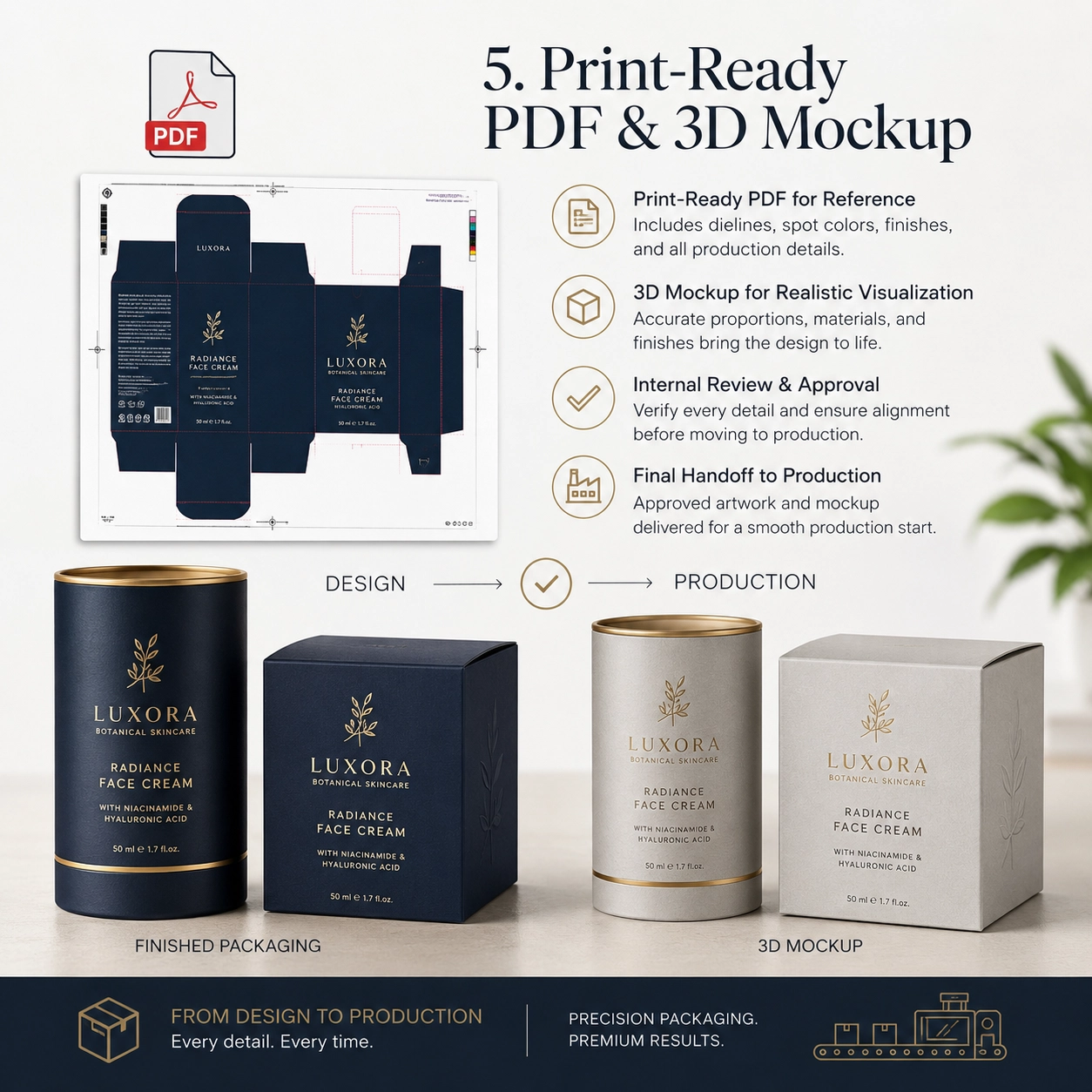

antes de enviar archivos de ilustraciones de embalaje personalizados a la fábrica, go through the following workflow.
Paso 1: Utilice la línea de troquel final aprobada
Never design final production artwork on an early structural drawing.
If the package dimensions change, request a new dieline.
Paso 2: Keep the Dieline at Actual Size
Do not resize or stretch the dieline.
A production dieline should represent the actual package dimensions.
Paso 3: Add Bleed
If background colors, photographs or illustrations reach the trim edge, extend them beyond the final trim line.
Illustrator supports document bleed and printer marks through its Marks & Bleed controls.
Many commercial projects use approximately 3 milímetros, but the packaging supplier’s specification should always take priority.
Paso 4: Respect the Safe Area
Keep important elements away from trim and fold tolerances.
These elements include:
- Logo
- Código de barras
- Nombre del producto
- Ingredientes
- Texto pequeño
Paso 5: Prepare the Correct Print Color Mode
Para impresión de proceso, prepare the file using the agreed CMYK workflow.
If Pantone colors are required, identify them separately.
Paso 6: Check Fonts
Missing fonts can change text layout.
Por lo tanto, either outline the fonts where appropriate or package the required font resources according to the agreed workflow.
Adobe Illustrator’s Package command can collect the Illustrator file together with linked graphics and eligible font resources for handoff.
Always keep an editable master version before converting text into outlines.
Paso 7: Comprobar imágenes vinculadas
One of the most common handoff problems is missing linked images.
Illustrator’s Links panel shows placed linked and embedded files, while the Package function can gather linked assets for transfer.
Before sending the project, check that every required image is included.
Paso 8: Keep Logos Vector Where Possible
Vector logos produce cleaner results for:
- Impresión
- estampado en caliente
- Realce
- Escalada
Avoid extracting a small logo from a website screenshot.
Paso 9: Capas de acabado especiales separadas
A good file structure could be:
- DIELA
- CMYK
- pantone
- LÁMINA DE ORO
- REALZAR
- DEBOSS
- PUNTO UV
- VENTANA
This makes the intended manufacturing processes obvious.
Paso 10: Check Overprint
Overprint settings can change how overlapping objects reproduce.
Illustrator includes dedicated overprint and color-separation controls, so these settings should be reviewed during prepress when relevant.
Paso 11: Exportar un PDF listo para imprimir
Along with the editable file, export a high-quality PDF reference.
Illustrator supports PDF creation for print workflows, including PDF/X-related options.
The supplier can use the PDF to compare the intended layout against the editable artwork.
Paso 12: Include a 3D Mockup
A 3D rendering is not the technical production file.
Sin embargo, it is very useful because it shows:
- Orientación frontal
- Opening direction
- Posición del logotipo
- Expected finished appearance
En otras palabras:
Artwork tells the factory how to produce it.
Mockups tell the factory how you expect it to look.
Providing both reduces ambiguity.
Lista de verificación previa de la obra de arte del embalaje
Before sending your file, controlar:
- Correct dieline
- Correct packaging size
- Sangrado incluido
- Safe zone checked
- CMYK workflow confirmed
- Colores Pantone identificados
- Fonts supplied correctly
- Linked images included
- Logos are vector
- Calidad de imagen comprobada
- Código de barras comprobado
- Text proofread
- Capa de lámina separada
- Capa de relieve separada
- Capa de grabado separada
- Capa UV puntual separada
- Window position confirmed
- Dieline kept separate
- PDF exported
- Mockup supplied
- Final internal approval completed
Acrobat Pro’s Preflight tools are specifically designed to analyze PDFs for print-production problems before output.
How Artwork Affects Sampling and Production Time
Poorly prepared archivos de ilustraciones de embalaje personalizados can delay a packaging project before manufacturing even starts.
Por ejemplo:
El proveedor recibe un JPG.
Then the editable artwork is requested.
Próximo, the AI file arrives but linked images are missing.
Después, the correct images are supplied.
Sin embargo, the dieline is outdated.
Once the dieline is corrected, the designer discovers that the foil layer has not been separated.
Se requiere otra revisión.
At this point, several days may have passed—even though no mass-production machine has started.
Por lo tanto, good artwork preparation can directly improve the efficiency of the packaging development process.
Planning Your Packaging Lead Time?
Artwork approval is only one part of the overall project.
Si también está planeando un muestreo, production and delivery, lee nuestro Tiempo de producción de tubos de papel personalizados: Guía completa de plazos de entrega.
Esa guía explica cómo:
- Aprobación de obra de arte
- Muestreo
- Cantidad mínima de pedido
- Disponibilidad de materiales
- Insertos
- Acabado especial
- Múltiples SKU
can influence the complete production schedule.
Juntos, these articles answer two important purchasing questions:
¿Está mi obra de arte lista para imprimir??
y
How long will production take after it is approved?
Common Artwork Mistakes
Enviar solo una captura de pantalla
A screenshot may show the design direction, but it usually cannot provide the editable technical information required for production.
Por lo tanto, supply editable artwork whenever possible.
Designing Before the Structure Is Final
If the dieline changes, artwork positions also change.
Como consecuencia, finalize the packaging structure first.
Missing Linked Files
Check all linked photographs and graphics before sending the project.
Low-Resolution Logos
A logo copied from a website may look acceptable on a monitor but reproduce poorly in print.
En cambio, ask for the original vector version.
Using Too Many Unidentified Layers
Clear layer names reduce communication problems.
Por ejemplo:
Layer 17 Copy 2
is much less useful than:
GOLD FOIL.
Merging Foil Into CMYK
The printer needs to know what should be printed and what should be foil stamped.
Por lo tanto, keep those processes separate.
Ignoring the Tube Seam
For cylindrical packaging, avoid placing important branding on the spiral or vertical outer-wrap seam whenever the structure makes that area visually sensitive.
Designing on Hidden Areas
Some artwork can disappear beneath:
- Superposición de la tapa
- Glue flaps
- Pliegues interiores
- Mangas
Por lo tanto, check the assembled package before approving the design.
Cumplimiento & Sostenibilidad
Packaging artwork can also contain regulatory or compliance information.
Depending on the product and market, this may include:
- Nombre del producto
- Ingredientes
- Contenido neto
- Advertencias
- Información del fabricante
- Área de lotes
- Código de barras
- Información de reciclaje
The brand, importer or responsible party should confirm the exact regulatory requirements for the destination market.
FSC
If an FSC trademark is used, its use should comply with the applicable certification and trademark-approval requirements.
Por lo tanto, do not simply download an FSC logo and place it on packaging without confirming authorization.
Contacto con alimentos
Food-contact safety depends on the approved packaging materials and full construction, not simply the exterior graphics.
Dependiendo de la aplicación, los compradores pueden solicitar:
- Informes de contacto con alimentos
- Informes de migración
- Declaraciones de materiales
- Información de tinta
- Información adhesiva
BRC e IFS
BRCGS Packaging Materials and relevant IFS systems may support supplier-quality or food-packaging requirements.
Sin embargo, certification references and logos should only be used appropriately.
EUDR y EPR
For applicable markets and supply chains, packaging buyers may also need to consider material due diligence and producer-responsibility requirements.
Por lo tanto, regulatory review should happen before the final artwork is locked whenever these requirements affect printed information.
Sustainable Artwork Choices
Luxury packaging does not automatically require the maximum number of finishing processes.
Por ejemplo, good typography combined with textured paper and one small foil logo may create a stronger premium effect than:
- Full lamination
- Large foil areas
- Several metallic colors
- Multiple UV coatings
Por lo tanto, good design can sometimes reduce production complexity as well as material use.
Cómo personalizar
A smooth archivos de ilustraciones de embalaje personalizados workflow starts before the designer opens Illustrator.
Paso 1: Send Product Information
Proporcionar:
- Nombre del producto
- Tamaño del producto
- Peso del producto
- Photos
- Physical sample if possible
Paso 2: Choose the Packaging Structure
Seleccionar:
- tubo de papel
- caja rígida
- Caja plegable
- Cajón
- Caja de manga
- Window packaging
- Telescopic packaging
Paso 3: Confirm the Size
Approve final dimensions.
Do not finalize the artwork before this step.
Paso 4: Elige el material
Seleccionar:
- papel kraft
- papel de arte
- Papel especial
- Material de calidad alimentaria
- Forro de aluminio
Paso 5: Confirmar el inserto
Las opciones pueden incluir:
- Sin inserción
- Cartón
- EVA
- EPE
- pulpa moldeada
- bandeja de plastico
Paso 6: Confirmar impresión
Elegir:
- CMYK
- Pantone
- Impresión a un color
- Combination printing
Paso 7: Select Finishing
Possible choices include:
- estampado en caliente
- Realce
- grabado
- Punto UV
- Laminación mate
- Laminación brillante
- Laminación suave al tacto
- Laminación antirrayas
Paso 8: Solicite la línea final
Once the structure and size are approved, request the final production dieline.
Paso 9: Preparar la obra de arte
Supply:
- AI
- PDF editable
- EPS where appropriate
Also provide a PDF reference and, ideally, a 3D mockup.
Paso 10: Confirmar cantidad mínima de pedido
Provide realistic quantities.
Por ejemplo:
- 500 piezas
- 1,000 piezas
- 3,000 piezas
- 5,000 piezas
- 10,000 piezas
Paso 11: Confirmar el plazo de entrega
Share the required:
- Fecha de lanzamiento
- Factory completion date
- fecha de entrega
- Destino
Paso 12: Aprobar la muestra
Finalmente, controlar:
- Tamaño
- Estructura
- Color
- Obra de arte
- Frustrar
- Realce
- Ajuste de inserción
- Posicionamiento del producto
Once these points are approved, mass production can proceed more efficiently.
Productos relacionados: Tubos de papel personalizados / Envasado de alimentos / Envases Cosméticos
¿Por qué elegir el embalaje en paquete??
Pack Packaging admite tubos y cajas de papel personalizados desde el desarrollo estructural hasta la producción en masa..
Nuestras instalaciones de fabricación cubren 20,000㎡, incluyendo un 2,000㎡ taller de calidad alimentaria. Además, La capacidad de producción mensual de tubos de papel supera 10,000,000 piezas.
Nuestro 20+ equipo de diseño de miembros puede ayudar con:
- Dieline development
- Montaje del producto
- Artwork checking
- Selección de materiales
- Diseño de inserción
- impresión CMYK
- impresión pantone
- estampado en caliente
- Realce
- Punto UV
- Muestreo
- Production preparation
When customers send archivos de ilustraciones de embalaje personalizados, our team reviews the graphic layout together with the actual structure rather than treating the design as an isolated image.
Nuestras capacidades OEM y ODM incluyen:
- Tamaños personalizados
- tubos de papel
- Cajas rígidas
- Cajas plegables
- Cajoneras
- Cajas de manga
- papel kraft
- papel de arte
- Papel especial
- Materiales de calidad alimentaria
- Inserciones de cartón
- Inserciones de EVA
- Inserciones de EPE
- Insertos de pulpa moldeada
- CMYK
- Pantone
- estampado en caliente
- Realce
- grabado
- Punto UV
- Laminación mate
- Laminación brillante
- Laminación suave al tacto
- Laminación antirrayas
- Muestras estructurales
- Muestras impresas
- inspección de calidad
- Embalaje de exportación
Depending on the final materials, Aplicación del producto y mercado de destino., supporting documentation may include FSC-related documentation, informes de contacto con alimentos, BRC-related information, Información relacionada con IFS, RoHS 2.0, REACH-SVHC and EPR support.
The exact documentation should always be confirmed against the final approved specification.
Preguntas frecuentes
1. What file format should I send for packaging printing?
IA editable, PDF or EPS files are commonly useful for packaging production. A PDF reference and 3D mockup can also make the intended finished appearance clearer.
2. ¿El diseño del empaque debe ser CMYK o RGB??
For standard process printing, artwork is typically prepared in a CMYK print workflow. Illustrator provides CMYK document mode and separation controls specifically for print output.
3. Do I need bleed?
If artwork reaches the trim edge, bleed is generally required. Illustrator supports defined bleed areas and bleed marks, while the exact amount should follow the packaging manufacturer’s specification.
4. Do fonts need to be outlined?
Fonts can be outlined where appropriate or supplied through an agreed packaged workflow. Always keep an editable master file because outlined text is no longer normal editable type.
5. Do foil, embossing and spot UV need separate layers?
Sí. Clearly separated vector layers make it much easier for the prepress and production teams to identify each special process.
6. ¿Puedo enviar un Canva?, JPG or PNG file?
You can use them as references. Sin embargo, the packaging supplier may still require editable production artwork containing dielines, vector logos and special-finishing information.
7. Why does the printed color look different from my monitor?
Screen display and physical printing use different output processes, mientras papel, tinta, coatings and lighting can also influence the final appearance.
Por lo tanto, physical approval is recommended when exact brand color matters.
8. Can you help check my artwork before printing?
Sí. The design and prepress team can review the artwork against the approved structure and identify potential production issues before sampling.
Explore más soluciones de embalaje personalizadas
Buscando más opciones de embalaje? Descubra nuestra gama completa de productos de embalaje personalizados diseñados para diferentes industrias y aplicaciones..
Cajas plegables – Cajas de cartón ligeras y totalmente personalizables para embalaje minorista.
Cajas Rígidas – Cajas de regalo rígidas premium para marcas de lujo..
Cajas Corrugadas – Soluciones duraderas de embalaje para envío y comercio electrónico.
Cajas a prueba de niños – Embalaje seguro para productos regulados.
Accesorios – Inserciones personalizadas, papel de seda, cintas, etiquetas, y más.
Tubos de papel – Explore nuestra colección dedicada de envases de tubos de papel personalizados para té, café, productos cosméticos, velas, espíritu, y otros productos premium en nuestra web especializada.
Necesita embalaje personalizado? Póngase en contacto con nuestro equipo hoy para obtener una cotización gratuita y una consulta de expertos..