You may have already confirmed the product, packaging structure and quotation. Poi, just when the project seems ready to move forward, the supplier asks one more question:
“Can you send us the print-ready artwork?"
This is where many custom packaging projects suddenly slow down.
Correct custom packaging artwork files help prevent missing fonts, blurry logos, incorrect colors, misplaced hot stamping, outdated dielines and unnecessary sample revisions. Ancora più importante, good artwork allows the packaging supplier to understand exactly how your box or tube should be printed and finished.
COSÌ, before you send that final AI or PDF file, it is worth checking whether the artwork is actually ready for production—not simply whether it looks good on your screen.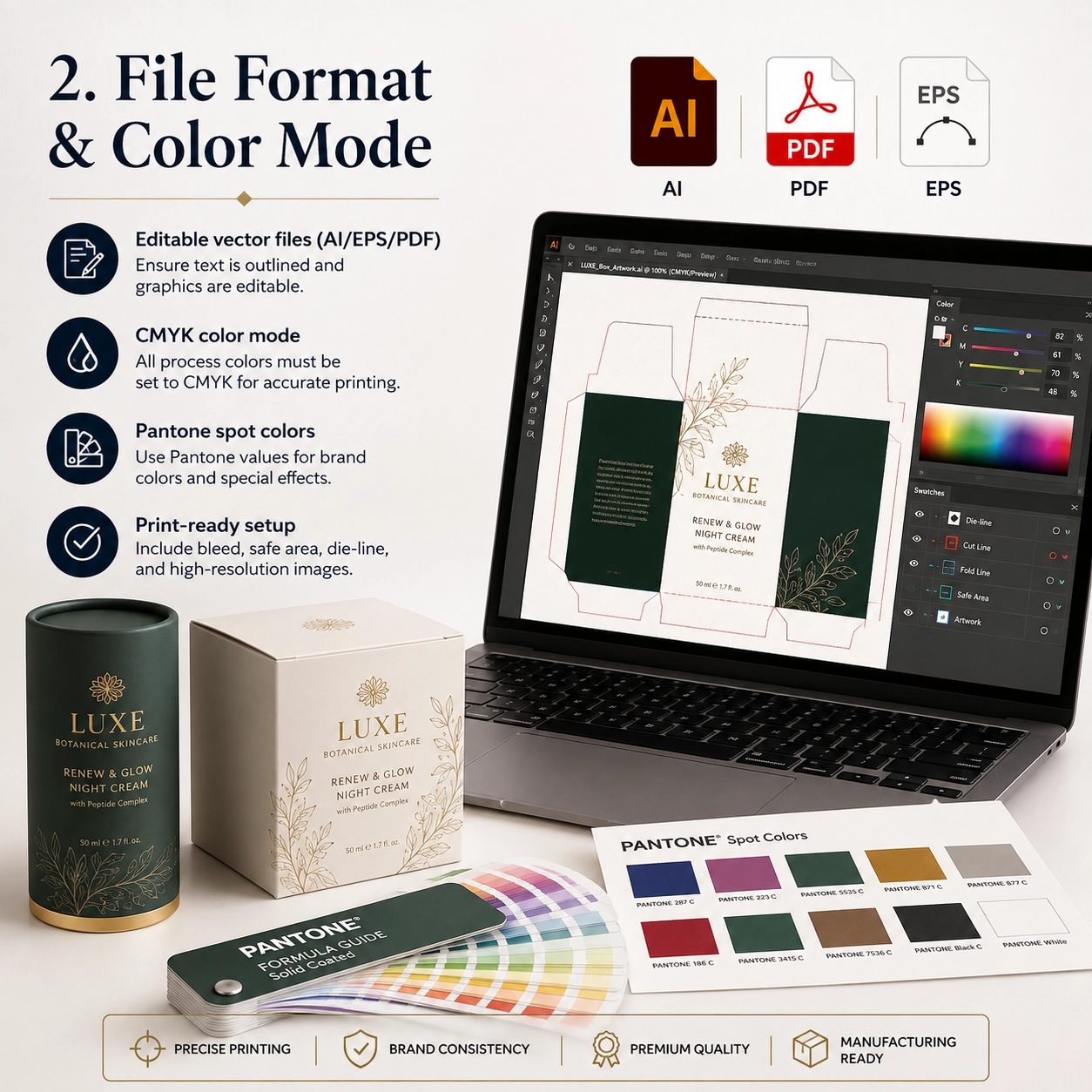
Cos'è questo tipo di imballaggio?
In this article, we are not talking about one particular box or paper tube. Invece, we are talking about the technical artwork required to manufacture custom paper packaging.
Custom packaging artwork files are production files built on the approved packaging dieline.
Unlike a JPG mockup, they tell the factory where to:
- Cut
- Fold
- Glue
- Apply foil
- Rilievo
- Incidere
- Apply spot UV
- Create a window
- Position regulatory text
In altre parole, the mockup explains the visual idea, while the technical artwork explains how that idea becomes a physical package.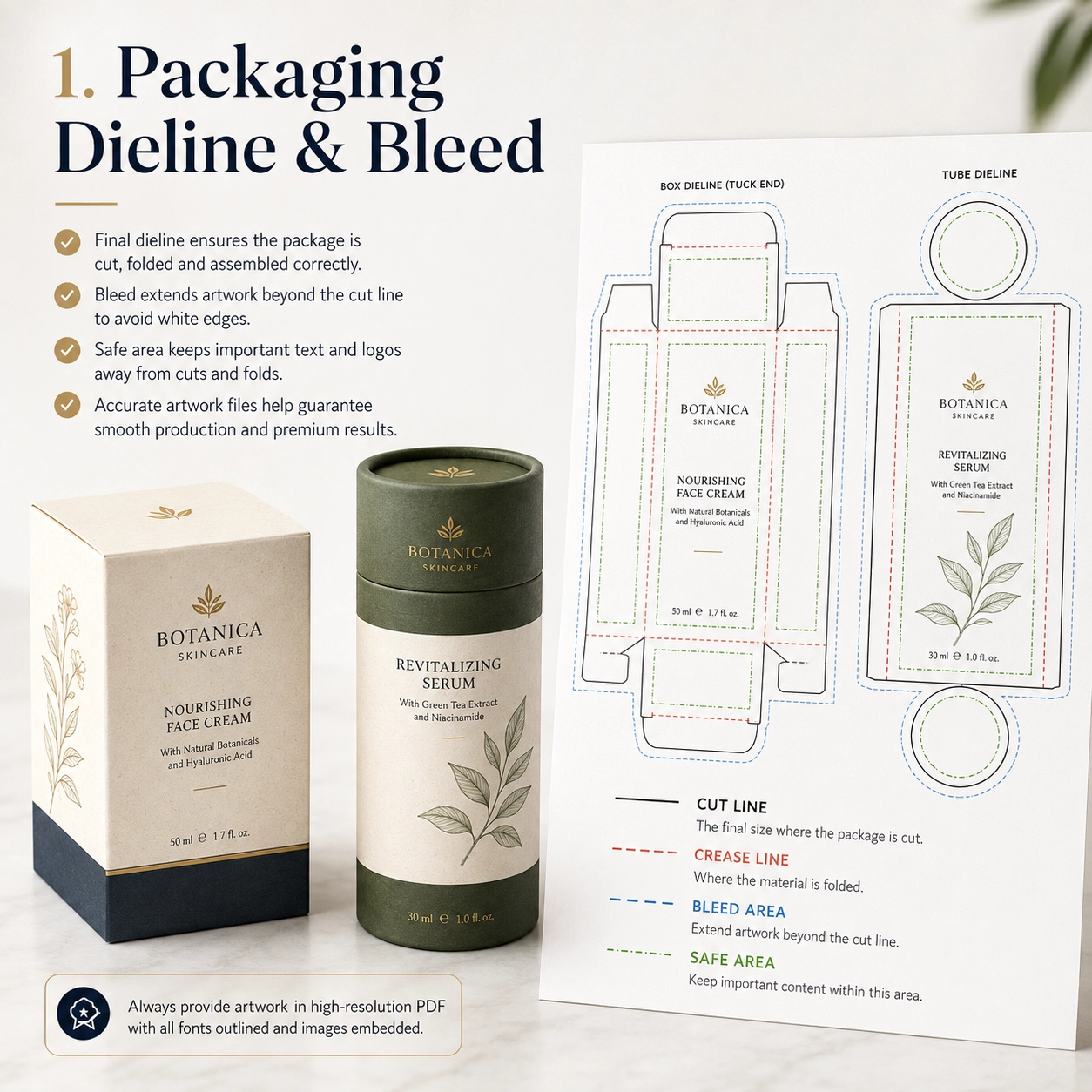
Common Artwork Components
A packaging production file may contain:
- Dieline
- Cut line
- Crease line
- Glue area
- Sanguinare
- Safe area
- Grafica CMYK
- Colori Pantone
- Product text
- Codice a barre
- Hot-stamping layer
- Embossing layer
- Debossing layer
- Spot UV layer
- Window line
- Insert artwork
Perciò, the final artwork should always be created around the approved production structure rather than an estimated size.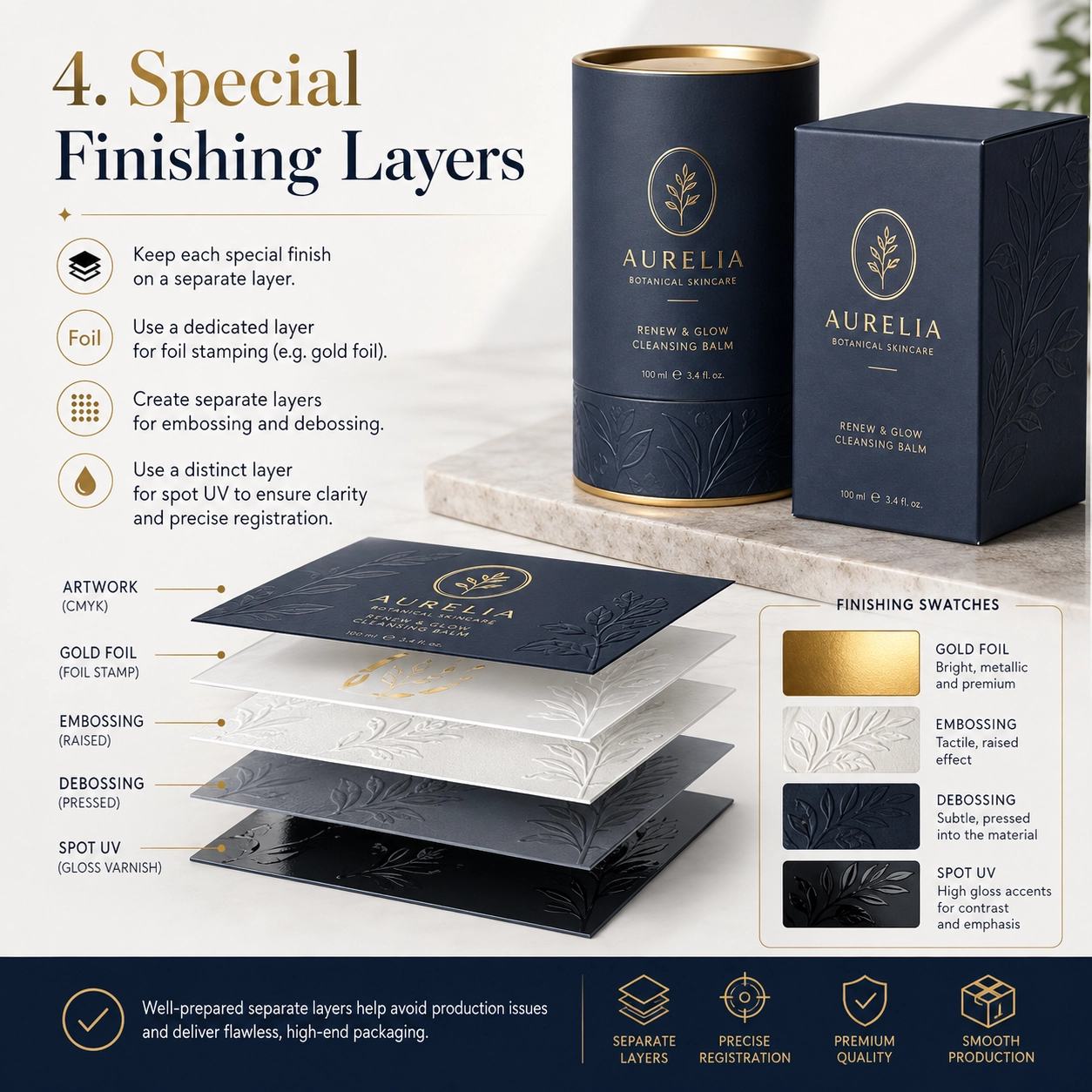
Preferred Artwork Formats
For many packaging projects, editable formats such as these are practical:
- AI
- PDF modificabile
- EPS
Nel frattempo, high-resolution PSD or TIFF files may be used for photographs or raster artwork.
Vector graphics are especially useful for logos, testo, dielines and finishing areas because Illustrator vector artwork can be scaled for print without the pixelation associated with low-resolution raster graphics.
Why JPG or PNG Is Usually Not Enough
A JPG may show the design clearly. Tuttavia, it normally does not contain editable:
- Dielines
- Spot colors
- Foil paths
- Embossing paths
- Cutting paths
- Separate finishing layers
Perciò, a JPG is better treated as a visual reference rather than the only production file.
If you only have a JPG, tell the packaging supplier early. The design or prepress team can then determine whether the artwork needs to be rebuilt.
Applicazioni comuni
The preparation of custom packaging artwork files varies according to the product category.
Confezione di profumi
Perfume packaging often looks visually simple but may involve several premium finishing processes.
Per esempio, a rigid perfume box or paper tube may require separate layers for:
- Dark green Pantone printing
- Logo in lamina d'oro
- Embossed brand mark
- Laminazione opaca
- Insert branding
If the gold logo must also be embossed, the supplier needs to know whether the embossing follows exactly the same shape.
Perciò, separate the layers clearly.
A practical Illustrator layer structure could look like:
- DIELINE
- CMYK PRINT
- PANTONE
- GOLD FOIL
- EMBOSS
- SPOT UV
- INSERT
This makes communication much easier.
Cura della pelle e cosmetici
Cosmetic packaging often contains more written information than perfume packaging.
Typical content may include:
- Nome del prodotto
- Ingredienti
- Directions
- Net contents
- Avvertenze
- Manufacturer details
- Codice a barre
- Batch information
Di conseguenza, typography and safe areas become especially important.
Before sending the artwork, check whether small text is too close to:
- Fold lines
- Cutting edges
- Finestre
- Glue flaps
- Tube seams
Tè e caffè
Tea and coffee packaging frequently combines branding with detailed product information.
Ciò può includere:
- Country of origin
- Flavor notes
- Istruzioni per la preparazione
- Ingredienti
- Net weight
- Codice a barre
If the artwork is printed on natural kraft paper, keep in mind that the brown paper base will affect how colors appear.
Perciò, do not assume that a color shown on a white monitor will reproduce identically on kraft paper.
Cioccolato e Caramelle
Chocolate and confectionery packaging often combines:
- CMYK illustrations
- Fotografia
- Lamina d'oro
- Finestre
- Informazioni sul prodotto
A window introduces an additional technical area.
Perciò, the artwork should clearly show the window die-cut line while keeping text and important graphics outside the required production tolerance.
Candle Packaging
Candle packaging often uses simpler, more premium artwork.
A typical design might combine:
- Dark background
- Brand logo
- Scent name
- Botanical illustration
- Lamina d'oro
- Peso del prodotto
Tuttavia, dark surfaces can make small printing or finishing inconsistencies more visible.
Perciò, physical sampling is especially valuable for premium candle packaging.
Confezione regalo
Gift packaging gives designers more creative freedom.
Tuttavia, structures such as drawer boxes, magnetic boxes and telescopic packaging have several visible surfaces.
Di conseguenza, the designer should consider the entire unboxing sequence rather than designing only the front panel.
Opzioni materiali
The paper selected for production affects how custom packaging artwork files will reproduce in real life.
Carta Kraft
Natural kraft paper has a brown base tone.
Perciò, bright colors may appear more muted compared with printing on white coated paper.
Suitable design directions include:
- Stampa nera
- Verde scuro
- Brown
- White ink where supported
- Lamina di rame
- Matte gold foil
Infatti, the natural material itself can become part of the artwork.
Carta d'arte
Coated art paper provides a smooth surface for:
- Stampa CMYK
- Pantone
- Fotografia
- Tipografia raffinata
- Gradienti
- Illustrazioni dettagliate
Afterward, it can receive:
- Laminazione opaca
- Laminazione lucida
- Laminazione morbida al tatto
- Laminazione antigraffio
Carta speciale
Specialty papers may include:
- Trama di lino
- Leather texture
- Carta metallizzata
- Carta perlata
- Carta tinta in massa
- Embossed texture
Tuttavia, deeply textured surfaces can reduce the visual clarity of very fine details.
Perciò, extremely thin logo lines or small foil details may need to be simplified before production.
Carta per alimenti
Food packaging may require approved food-contact materials or internal barrier components.
Tuttavia, these technical materials are generally specified separately from the outer decorative artwork.
Per esempio, the external design may be printed on art paper, while the inside uses:
- Carta per alimenti
- Carta patinata PE
- Carta resistente ai grassi
- Fodera in lamina
- Custodia interna
Fodera in lamina
Tè, caffè, nuts and snack tubes may use an aluminum foil or multilayer liner.
Generalmente, the exterior artwork file still controls only the outer branding.
Tuttavia, if an internal component also requires printing, provide separate artwork and clearly identify the part.
Opzioni della struttura
Packaging structure should be finalized before the designer completes custom packaging artwork files.
Altrimenti, a structural change may force the artwork to be redesigned.
Paper Lid Tube
A standard paper tube normally contains:
- Main body
- Coperchio
- Metter il fondo a
- Seam area
Avoid placing the main logo directly over the vertical seam.
Invece, define the primary viewing area.
Tubolare spalla-collo
A shoulder-neck tube contains an inner neck that becomes visible after the lid is removed.
This creates another branding opportunity.
Per esempio:
- Dark green exterior
- Gold inner neck
- Cream interior
Tuttavia, all visible components should be included in the approved material and production specification.
Struttura telescopica
A telescopic tube may use:
- Long upper lid
- Base inferiore corta
- Inner insert
Perciò, the designer should confirm:
- Upper-section height
- Lower-section height
- Overlap
- Front orientation
Do not guess these dimensions.
Imballaggio per finestre
Window artwork must use the approved die-cut position.
The design should consider:
- Window shape
- Dimensione della finestra
- Film area
- Product position
- Safe area
Inoltre, the real product should remain aligned behind the window.
Paper Tube With Insert
An insert may use:
- EVA
- EPE
- Cartone
- Polpa modellata
- Vassoio di plastica
If the insert includes printed paper or a branded card, provide a separate artwork file.
Tubo push-up
Push-up paper tubes contain moving internal components.
Perciò, critical graphics should stay away from areas where movement or seams may affect visibility.
Tubo attorcigliato
Twist-up packaging requires precise dimensions.
Per questo motivo, the final dieline should be approved before artwork production begins.
Sleeve Packaging
Sleeves can be very useful for multiple SKUs.
Per esempio, one base package may be used for five different products while each product receives a different sleeve.
Di conseguenza, brands can reduce structural complexity while maintaining product differentiation.
Stampa & Opzioni di finitura
This is where custom packaging artwork files become especially important.
Different printing and finishing processes should not be merged into one unidentified artwork layer.
Stampa CMYK
CMYK is commonly used for process printing involving:
- Fotografia
- Gradienti
- Illustrazioni
- Multicolor graphics
Adobe’s Illustrator print documentation instructs users to switch RGB documents to CMYK mode when preparing color separations for process printing.
Tuttavia, printed color can still be influenced by the paper, inchiostro, coating and finishing.
Perciò, do not approve critical brand colors solely from a phone or monitor.
Pantone / Spot Colors
Spot colors are useful when a brand requires a particular signature shade.
Per esempio:
- Brand green
- Burgundy
- Navy
- Orange
Clearly identify the required Pantone or spot color in the artwork.
Do not simply write:
“Please match this green.”
Inoltre, request a physical proof when strict color matching is commercially important.
Stampa a caldo
Hot stamping should normally be provided as a separate vector layer.
Per esempio:
GOLD FOIL
Do not create a gold gradient in Photoshop and assume that it communicates metallic foil production.
Invece, provide a clean vector shape showing exactly where the foil should be applied.
Goffratura
Embossing raises the surface.
Perciò, provide a separate vector layer showing the exact embossed area.
A simple label could be:
EMBOSS
If foil and embossing must register together, make that clear in both the artwork and production instructions.
Incisione
Debossing creates a recessed surface.
Like embossing, it should be supplied as a separate, clearly labeled vector area.
Spot UV
Spot UV creates glossy contrast over selected areas.
Perciò, create a separate layer called:
SPOT UV
Do not merge the effect into the CMYK artwork.
Laminazione opaca
Full matte lamination normally applies across the entire printed surface.
Perciò, it usually does not need its own artwork layer.
Invece, specify the film in the finishing requirements.
Laminazione lucida
Gloss lamination follows the same principle.
Tuttavia, if only one logo or pattern needs gloss, the process may actually be spot UV rather than full gloss lamination.
How to Prepare Custom Packaging Artwork Files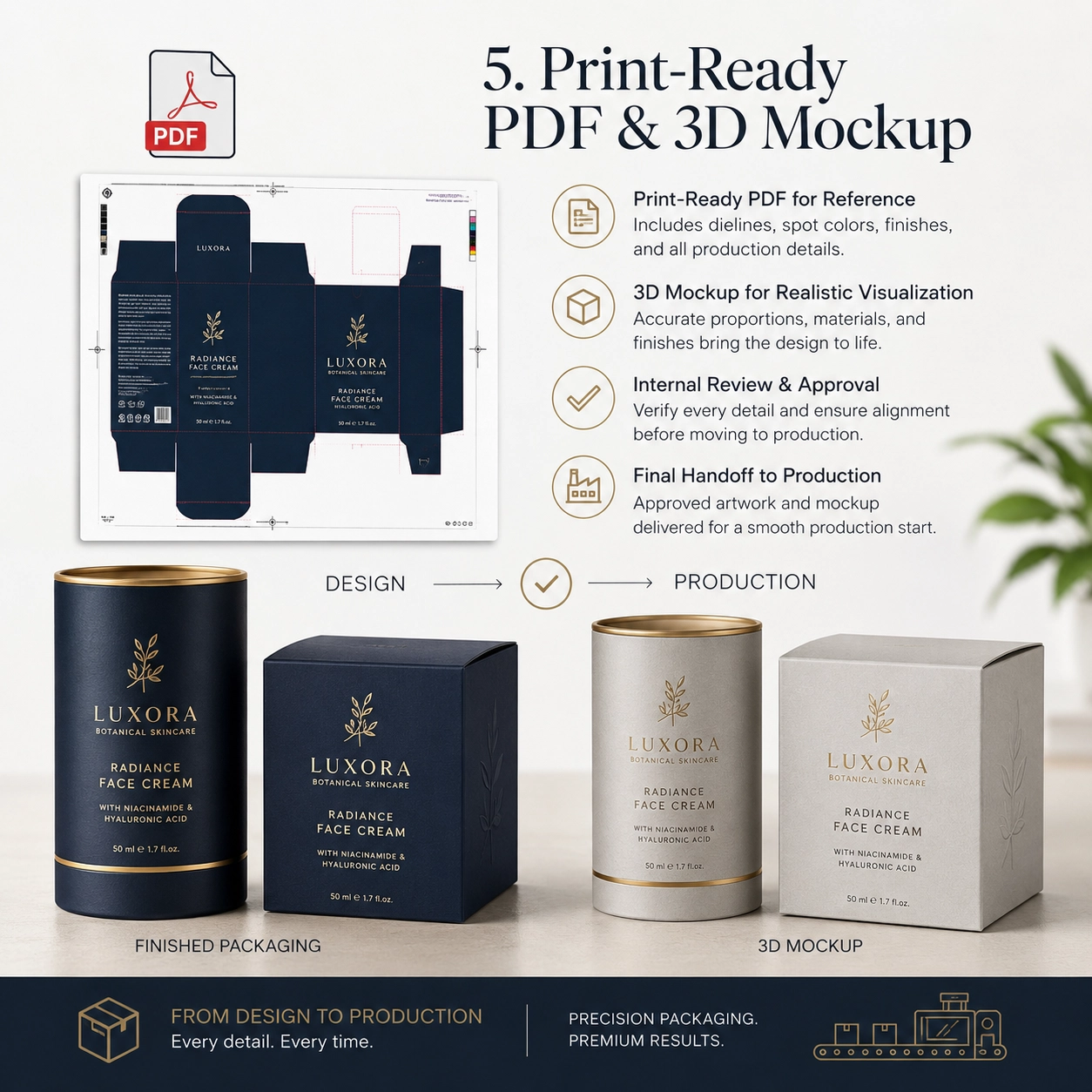

Before sending custom packaging artwork files to the factory, go through the following workflow.
Fare un passo 1: Use the Final Approved Dieline
Never design final production artwork on an early structural drawing.
If the package dimensions change, request a new dieline.
Fare un passo 2: Keep the Dieline at Actual Size
Do not resize or stretch the dieline.
A production dieline should represent the actual package dimensions.
Fare un passo 3: Add Bleed
If background colors, photographs or illustrations reach the trim edge, extend them beyond the final trim line.
Illustrator supports document bleed and printer marks through its Marks & Bleed controls.
Many commercial projects use approximately 3 mm, but the packaging supplier’s specification should always take priority.
Fare un passo 4: Respect the Safe Area
Keep important elements away from trim and fold tolerances.
These elements include:
- Logo
- Codice a barre
- Nome del prodotto
- Ingredienti
- Small text
Fare un passo 5: Prepare the Correct Print Color Mode
For process printing, prepare the file using the agreed CMYK workflow.
If Pantone colors are required, identify them separately.
Fare un passo 6: Check Fonts
Missing fonts can change text layout.
Perciò, either outline the fonts where appropriate or package the required font resources according to the agreed workflow.
Adobe Illustrator’s Package command can collect the Illustrator file together with linked graphics and eligible font resources for handoff.
Always keep an editable master version before converting text into outlines.
Fare un passo 7: Check Linked Images
One of the most common handoff problems is missing linked images.
Illustrator’s Links panel shows placed linked and embedded files, while the Package function can gather linked assets for transfer.
Before sending the project, check that every required image is included.
Fare un passo 8: Keep Logos Vector Where Possible
Vector logos produce cleaner results for:
- Stampa
- Stampa a caldo
- Goffratura
- Scaling
Avoid extracting a small logo from a website screenshot.
Fare un passo 9: Separate Special Finishing Layers
A good file structure could be:
- DIELINE
- CMYK
- PANTONE
- GOLD FOIL
- EMBOSS
- DEBOSS
- SPOT UV
- WINDOW
This makes the intended manufacturing processes obvious.
Fare un passo 10: Check Overprint
Overprint settings can change how overlapping objects reproduce.
Illustrator includes dedicated overprint and color-separation controls, so these settings should be reviewed during prepress when relevant.
Fare un passo 11: Export a Print-Ready PDF
Along with the editable file, export a high-quality PDF reference.
Illustrator supports PDF creation for print workflows, including PDF/X-related options.
The supplier can use the PDF to compare the intended layout against the editable artwork.
Fare un passo 12: Include a 3D Mockup
A 3D rendering is not the technical production file.
Tuttavia, it is very useful because it shows:
- Front orientation
- Opening direction
- Posizione del logo
- Expected finished appearance
In altre parole:
Artwork tells the factory how to produce it.
Mockups tell the factory how you expect it to look.
Providing both reduces ambiguity.
Packaging Artwork Preflight Checklist
Before sending your file, controllo:
- Correct dieline
- Correct packaging size
- Bleed included
- Safe zone checked
- CMYK workflow confirmed
- Pantone colors identified
- Fonts supplied correctly
- Linked images included
- Logos are vector
- Image quality checked
- Barcode checked
- Text proofread
- Foil layer separated
- Embossing layer separated
- Debossing layer separated
- Spot UV layer separated
- Window position confirmed
- Dieline kept separate
- PDF exported
- Mockup supplied
- Final internal approval completed
Acrobat Pro’s Preflight tools are specifically designed to analyze PDFs for print-production problems before output.
How Artwork Affects Sampling and Production Time
Poorly prepared custom packaging artwork files can delay a packaging project before manufacturing even starts.
Per esempio:
The supplier receives a JPG.
Then the editable artwork is requested.
Prossimo, the AI file arrives but linked images are missing.
Dopo di che, the correct images are supplied.
Tuttavia, the dieline is outdated.
Once the dieline is corrected, the designer discovers that the foil layer has not been separated.
Another revision is required.
At this point, several days may have passed—even though no mass-production machine has started.
Perciò, good artwork preparation can directly improve the efficiency of the packaging development process.
Planning Your Packaging Lead Time?
Artwork approval is only one part of the overall project.
If you are also planning sampling, production and delivery, leggi il nostro Custom Paper Tube Production Time: Complete Lead Time Guide.
That guide explains how:
- Approvazione dell'opera d'arte
- Campionamento
- MOQ
- Disponibilità materiale
- Inserti
- Special finishing
- Multiple SKUs
can influence the complete production schedule.
Insieme, these articles answer two important purchasing questions:
Is my artwork ready for printing?
E
How long will production take after it is approved?
Common Artwork Mistakes
Sending Only a Screenshot
A screenshot may show the design direction, but it usually cannot provide the editable technical information required for production.
Perciò, supply editable artwork whenever possible.
Designing Before the Structure Is Final
If the dieline changes, artwork positions also change.
Di conseguenza, finalize the packaging structure first.
Missing Linked Files
Check all linked photographs and graphics before sending the project.
Low-Resolution Logos
A logo copied from a website may look acceptable on a monitor but reproduce poorly in print.
Invece, ask for the original vector version.
Using Too Many Unidentified Layers
Clear layer names reduce communication problems.
Per esempio:
Layer 17 Copy 2
is much less useful than:
GOLD FOIL.
Merging Foil Into CMYK
The printer needs to know what should be printed and what should be foil stamped.
Perciò, keep those processes separate.
Ignoring the Tube Seam
Per confezioni cilindriche, avoid placing important branding on the spiral or vertical outer-wrap seam whenever the structure makes that area visually sensitive.
Designing on Hidden Areas
Some artwork can disappear beneath:
- Sovrapposizione del coperchio
- Glue flaps
- Inner folds
- Maniche
Perciò, check the assembled package before approving the design.
Conformità & Sostenibilità
Packaging artwork can also contain regulatory or compliance information.
Depending on the product and market, this may include:
- Nome del prodotto
- Ingredienti
- Net contents
- Avvertenze
- Manufacturer information
- Batch area
- Codice a barre
- Recycling information
The brand, importer or responsible party should confirm the exact regulatory requirements for the destination market.
FSC
If an FSC trademark is used, its use should comply with the applicable certification and trademark-approval requirements.
Perciò, do not simply download an FSC logo and place it on packaging without confirming authorization.
Contatto alimentare
Food-contact safety depends on the approved packaging materials and full construction, not simply the exterior graphics.
A seconda dell'applicazione, gli acquirenti possono richiedere:
- Rapporti sui contatti alimentari
- Rapporti sulla migrazione
- Dichiarazioni materiali
- Informazioni sull'inchiostro
- Informazioni sull'adesivo
BRC e IFS
BRCGS Packaging Materials and relevant IFS systems may support supplier-quality or food-packaging requirements.
Tuttavia, certification references and logos should only be used appropriately.
EUDR e EPR
For applicable markets and supply chains, packaging buyers may also need to consider material due diligence and producer-responsibility requirements.
Perciò, regulatory review should happen before the final artwork is locked whenever these requirements affect printed information.
Sustainable Artwork Choices
Luxury packaging does not automatically require the maximum number of finishing processes.
Per esempio, good typography combined with textured paper and one small foil logo may create a stronger premium effect than:
- Full lamination
- Large foil areas
- Several metallic colors
- Multiple UV coatings
Perciò, good design can sometimes reduce production complexity as well as material use.
Come personalizzare
A smooth custom packaging artwork files workflow starts before the designer opens Illustrator.
Fare un passo 1: Send Product Information
Fornire:
- Nome del prodotto
- Dimensioni del prodotto
- Peso del prodotto
- Foto
- Physical sample if possible
Fare un passo 2: Choose the Packaging Structure
Select:
- Tubo di carta
- Rigid box
- Cartone pieghevole
- Drawer box
- Scatola a maniche
- Window packaging
- Telescopic packaging
Fare un passo 3: Confirm the Size
Approve final dimensions.
Do not finalize the artwork before this step.
Fare un passo 4: Scegli il Materiale
Select:
- Carta kraft
- Carta d'arte
- Carta speciale
- Food-grade material
- Fodera in lamina
Fare un passo 5: Conferma l'inserimento
Le opzioni possono includere:
- Nessun inserto
- Cartone
- EVA
- EPE
- Polpa modellata
- Vassoio di plastica
Fare un passo 6: Confirm Printing
Scegliere:
- CMYK
- Pantone
- Stampa ad un colore
- Combination printing
Fare un passo 7: Select Finishing
Le scelte possibili includono:
- Stampa a caldo
- Goffratura
- Incisione
- Spot UV
- Laminazione opaca
- Laminazione lucida
- Laminazione morbida al tatto
- Laminazione antigraffio
Fare un passo 8: Request the Final Dieline
Once the structure and size are approved, request the final production dieline.
Fare un passo 9: Preparare l'opera d'arte
Supply:
- AI
- PDF modificabile
- EPS where appropriate
Also provide a PDF reference and, ideally, a 3D mockup.
Fare un passo 10: Conferma MOQ
Provide realistic quantities.
Per esempio:
- 500 pz
- 1,000 pz
- 3,000 pz
- 5,000 pz
- 10,000 pz
Fare un passo 11: Conferma il tempo di consegna
Share the required:
- Launch date
- Factory completion date
- Delivery date
- Destinazione
Fare un passo 12: Approvare il campione
Finalmente, controllo:
- Misurare
- Struttura
- Colore
- Opera d'arte
- Sventare
- Goffratura
- Inserire in forma
- Posizionamento del prodotto
Once these points are approved, mass production can proceed more efficiently.
Prodotti correlati: Tubi di carta personalizzati / Imballaggio alimentare / Imballaggio cosmetico
Perché scegliere l'imballaggio in confezione?
Pack Packaging supporta tubi e scatole di carta personalizzati dallo sviluppo strutturale fino alla produzione di massa.
Il nostro impianto di produzione copre 20,000㎡, compreso a 2,000㎡ laboratorio per alimenti. Inoltre, La capacità di produzione mensile di tubi di carta supera 10,000,000 pezzi.
Nostro 20+ membro del team di progettazione può aiutare con:
- Dieline development
- Product fitting
- Artwork checking
- Selezione dei materiali
- Inserisci disegno
- Stampa CMYK
- Stampa Pantone
- Stampa a caldo
- Goffratura
- Spot UV
- Campionamento
- Production preparation
When customers send custom packaging artwork files, our team reviews the graphic layout together with the actual structure rather than treating the design as an isolated image.
Le nostre capacità OEM e ODM includono:
- Dimensioni personalizzate
- Tubi di carta
- Scatole rigide
- Cartoni pieghevoli
- Scatole a cassetti
- Scatole a maniche
- Carta kraft
- Carta d'arte
- Carta speciale
- Materiali per uso alimentare
- Inserti in cartone
- Inserti in EVA
- Inserti in EPE
- Inserti in polpa stampata
- CMYK
- Pantone
- Stampa a caldo
- Goffratura
- Incisione
- Spot UV
- Laminazione opaca
- Laminazione lucida
- Laminazione morbida al tatto
- Laminazione antigraffio
- Campioni strutturali
- Campioni stampati
- Ispezione di qualità
- Imballaggio per l'esportazione
Depending on the final materials, applicazione del prodotto e mercato di destinazione, supporting documentation may include FSC-related documentation, segnalazioni di contatto con alimenti, BRC-related information, Informazioni relative all'IFS, RoHS 2.0, REACH-SVHC and EPR support.
The exact documentation should always be confirmed against the final approved specification.
Domande frequenti
1. What file format should I send for packaging printing?
IA modificabile, PDF or EPS files are commonly useful for packaging production. A PDF reference and 3D mockup can also make the intended finished appearance clearer.
2. Should packaging artwork be CMYK or RGB?
For standard process printing, artwork is typically prepared in a CMYK print workflow. Illustrator provides CMYK document mode and separation controls specifically for print output.
3. Do I need bleed?
If artwork reaches the trim edge, bleed is generally required. Illustrator supports defined bleed areas and bleed marks, while the exact amount should follow the packaging manufacturer’s specification.
4. Do fonts need to be outlined?
Fonts can be outlined where appropriate or supplied through an agreed packaged workflow. Always keep an editable master file because outlined text is no longer normal editable type.
5. Do foil, embossing and spot UV need separate layers?
SÌ. Clearly separated vector layers make it much easier for the prepress and production teams to identify each special process.
6. Can I send a Canva, JPG or PNG file?
You can use them as references. Tuttavia, the packaging supplier may still require editable production artwork containing dielines, vector logos and special-finishing information.
7. Why does the printed color look different from my monitor?
Screen display and physical printing use different output processes, while paper, inchiostro, coatings and lighting can also influence the final appearance.
Perciò, physical approval is recommended when exact brand color matters.
8. Can you help check my artwork before printing?
SÌ. The design and prepress team can review the artwork against the approved structure and identify potential production issues before sampling.
Esplora altre soluzioni di imballaggio personalizzate
Alla ricerca di più opzioni di imballaggio? Scopri la nostra gamma completa di prodotti per l'imballaggio personalizzato progettati per diversi settori e applicazioni.
Scatole pieghevoli – Cartoni leggeri e completamente personalizzabili per l’imballaggio al dettaglio.
Scatole rigide – Scatole regalo rigide premium per marchi di lusso.
Scatole di cartone ondulato – Soluzioni di imballaggio durevoli per spedizioni e e-commerce.
Scatole a prova di bambino – Imballaggio sicuro per i prodotti regolamentati.
Accessori – Inserti personalizzati, carta velina, nastri, etichette, e altro ancora.
Tubi di carta – Esplora la nostra collezione dedicata di imballaggi personalizzati in tubi di carta per il tè, caffè, cosmetici, candele, spiriti, e altri prodotti premium sul nostro sito specializzato.
Hai bisogno di un imballaggio personalizzato? Contatta il nostro team oggi per un preventivo gratuito e una consulenza di esperti.